Showing posts with label kitchener. Show all posts

Wednesday, May 27, 2015

The art and science of transit stop placement

Man, it's been a while since my last post! I've been busy with the Active Transportation Advisory Committee, still working a little with TriTAG, but mostly taking care of real life. But the march of progress brings new lessons and observations. I have a few things to post about now, but I'll start with what is freshest on my mind.

And that is: we're seeing new transit routes being created, and we're making some mistakes with transit stop spacing and placement. But there's confusion about why they're mistakes. Mistakes are being made because we're treating the entire region with the same standard, without considering that parts of our region, the cores, have more potential riders and potential destinations.  

Our system will benefit more from more closely spaced stops at strategic locations within these dense urban areas than from assuming one central stop can serve an entire core, or that one standard can serve an entire region.

Some background:


The new 204, and Queen St.


Regional Council's Planning & Works committee heard from a few delegations on Tuesday about the upcoming GRT improvements. There are concerns about rationalizing existing routes with the introduction of a new iXpress route. But there was also a vocal debate about that new 204 iXpress (travelling along Highland to Queen, through downtown, and out east along Victoria.) In particular, about its stop placement.


 A couple of residents of the Bread and Roses coop at Queen and Courtland took issue with the (apparent) stop placement at Queen and Mill, instead of what looked more logical to them, Queen and Courtland, where there are almost a thousand housing units just in the nearby major buildings alone.

In fact, it got even messier when it was revealed that the "GRT stops" at Queen/Highland and Queen/Mill were actually both 1-way stops, separated by a few hundred metres, a situation which serves nobody well.

In response, staff and some councillors argued that this area is well served by other routes and by the planned stop at Charles St. terminal. But that misses the point that the 204's potential is being undermined.

First, let's talk about GRT's defined goals.


Stop coverage


GRT stops are defined to have a 450m effective radius, for calculating what parts of the city are covered by transit. ION LRT stops will have a larger effective radius, on the logic that people will walk further for better service. GRT's "iXpress" stops are also intended to have a larger spacing than regular routes, so that the buses can move faster.

These standards are important because they give GRT and the region an objective measure they can use for planning, and some defense against the reality that quality of service is uneven, and changes will always make some people unhappy. GRT works very hard to make sure routes and stop placements are sensible. Coverage standard is not the only tool in their toolbox, but it's a big one.

The problem is, it's only a tool, and it won't maximize the benefit or performance of transit. And being bombarded by people complaining about the removal, the moving, or even the placement of a route or a stop, planners are still missing important information amongst the noise.

The 204 stop placement issue reveals this. An objectively strong argument is made for putting the stop here rather than there. Region staff and councillors seem ready to dig their heels in against this argument.

What do they need to consider?


Trip Generation?


Transit stop placement needs to consider the potential for trip generation. And this analysis is already being done. In the example above, there is clear potential for trip generation at Queen/Courtland, but the location is being discarded because it fails other tests: coverage overlap with the terminal, for one. Route overlap too, which is really coverage again because the coverage question isn't where do you want to go, but can you get to anywhere at all.

Our downtown cores are big trip generators. Transit is most attractive when it stops close to a potential rider or their destination. Adding stops closer together within a downtown makes transit more attractive to a lot of people.


Modal Shift?


A delegate made a strong point about the many current car users who live in the immediate vicinity of Queen and Courtland, and how strong transit presence and convenient stop placement in that location will have a big bottom-line effect on the region's efforts to increase the modal share of travel by transit.

This point is so far unaddressed by Region staff, who largely see the location as sufficiently well served by transit without assessing the quality of that transit versus the trip generation potential of that location.

Again, to satisfy the coverage goal, it doesn't matter where you can get to, or how frequently, as long as a bus going anywhere shows up nearby at some point. This is the reality for much of the region's suburban areas which are hard to serve with transit. It is a poor defense for a major urban node.

If the region can provide quality, frequent, convenient iXpress transit service to a large number of current drivers and potential riders, the potential for ridership increase may outweigh the incremental impact of an additional stop.


Travel within downtown?


The potential for transit use within a downtown core, in particular Kitchener's quite substantial downtown, is being completely missed in this discussion. By assuming all transit users will gravitate to a central terminal, GRT is actually making it extremely difficult to cross from one end of our downtown core to the other.

The effect of this is actually turning downtown edges into transit deserts. There's so much service at the terminal that routes, especially iXpresses, don't need to stop nearby. Except that those living on the outer edge of a dense downtown are presented with a long walk, despite the fact there is much more potential for transit use there than along most of the rest of the route.

And if you want to get to the other side of downtown, you're out of luck. You could walk to the terminal, assuming you can find a bus that will stop near where you're going. Or you could try a local route that does stop frequently enough, but then pay a layover time penalty at the terminal. Or you could play transfer roulette.

If the region wants to make more of our downtowns accessible by transit users, it needs to stop assuming "one big central point" is all a downtown needs.


What about ION?


Despite LRT positioned as rapid transit with wide stop spacing, ION planners have, curiously, placed a higher stop frequency within the city cores of Waterloo and especially downtown Kitchener. Notably, they have added stops that its predecessor, 200 iXpress, does not have.
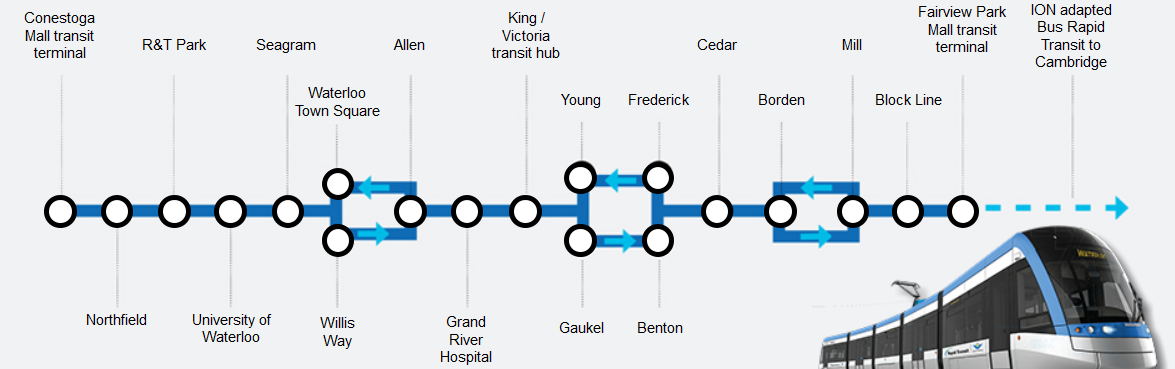


In Uptown, a new Allen stop joins the Waterloo Town Square pair. In downtown Kitchener, we have Victoria, Young/Gaukel, Frederick/Benton, and Cedar where only Victoria and the Charles St. terminal exist as stops today. And Victoria was added to the 200 only recently.

ION planners recognized the need to serve downtowns with multiple stops and to target destinations. Regional transit staff need to take a similar approach with iXpress.
  

Scaling stop spacing based on density


Density provides transit ridership through increased trip generation. Promixity to good transit service also drives ridership. Good transit service is partly driven by route speed, which is negatively affected by the number of stops along the route, so that is a major tradeoff. For most of its history, GRT has actually had too many stops on its routes, slowing down buses, raising costs and making its service less compelling.

But in attempting to deal with this problem, the region wants to treat all places the same. Stop spacing over 1km apart makes for rapid buses through our suburbia, and is an acceptable tradeoff between service quality and availability. But stop spacing at this scale within an urban core doesn't just affect downtowners, but also the potential suburban users who may head there.

We need to look at density when placing stops. We can't assume an entire downtown will be served at one central point, because there are so many potential riders who live on the edge of that dense core who transit will fail to attract, and also too many potential riders elsewhere who are destined for parts of downtown that are too far from that central point.

Every stop slows down a route, obviously. And everyone wants a bus stop on their doorstep, with a rapid trip in between. Clearly you can't add stops everywhere.

But does it make sense to treat a dense urban cluster of apartment buildings, with multiple seniors' residences and other attractions as a place with the same transit need as a suburban hinterland of single family homes on widing avenues? Can we afford to ignore the ridership potential of parts of our downtown cores presented with poor access to transit that runs right by their front doors?


Practical Outcomes


iXpress buses represent the bones of our new transit network as they link up with the ION spine. Like ION, they need to provide good cross-town service. Also like ION, they must serve the downtown cores well.

Instead of simplistic coverage goals, we need a metric that will balance overall access to transit with high quality service for the most people and destinations. 

For iXpress, that may mean switching to a 500m stop spacing standard within the boundaries of Kitchener, Waterloo, and Cambridge cores. There's so much to do in these places, so many attractions, and a large and growing number of people. In these places, transit should be compelling and convenient.

Remember, high density areas are high generators of both trip origins and destinations. Serve them well, and you'll get a lot more riders for your transit service dollar.


Avoid making the worst of a bad situation


There's an addendum here, if you're still reading this polemic.

That 204 stop at Mill? The one that turned out to be a single-direction stop with the other 300m away? This is awful. Don't do this.

Splitting stops is sometimes necessary, but always bad. Human Transit talks clearly about how split routes turn potentially useful transit into "symbolic transit", i.e. they look like good lines on a map but they don't serve anyone well. Split stops are just about as bad.

Consider the situation of St. Mary's hospital. The 204, tragically, does not serve the hospital directly (something I urged planners to consider.) But that's OK, right? There's a 204 stop 400m away at Highland. Unless you're heading the other direction, in which case it's over 700m away. You're better off taking a different bus, or a taxi.

The same goes for the hapless residents at Queen/Courtland. 350m to the "Mill" stop near the Iron Horse trail is objectively not so bad, but 650m to its companion stop at Highland is pointless: you may as well use Charles Terminal (while it's still there.)

Nobody wins with a split stop situation like this. Bad enough that it gave the impression of better coverage than was already there, an unfortunate communication gaff. It also gives the impression of useful service to a wide area, where in reality very few in the area will find the route useful. Only people who live between these two one-way stops will find them useful, and there just aren't as many of them. Certainly not as many as you'd find in around a sensible two-way stop location placed at a densely populated intersection.


Tuesday, February 25, 2014

For want of a sidewalk

Okay, I admit, I'm not one to tolerate cognitive dissonance in others for very long. I want to dissect it until the internally conflicted belief or viewpoint is cut open for all to see. I can cut pretty deep, too.

And occasionally, I do it to myself (and that's what really hurts, as the song goes.) In a fit of honesty, this time I'll do it out in the open.

Last night, I spoke at Waterloo city council on behalf of TriTAG, generally supporting a plan that will see Lexington Road gain new bike infrastructure, and sidewalks on one side of the road where none exist at all today. I did take some time to talk about how sidewalks on only one side are "a compromise" and "the bare minimum" but generally we gave Waterloo a pass. A mature neighbourhood, after all. Limited budget. It's understandable.

And who wants their kids walking to school along this?

At the same time, mood among TriTAG members has been far less charitable towards the city of Kitchener. In January, city council there decided to go against staff recommendations and cancel plans for adding sidewalks to the unimproved side of Glasgow St. after local residents showed up to make their case against it. Yesterday, council chose to defer an item regarding sidewalks on the bare side of Palmer and Kennedy streets, near the Courtland Ave. Schneiders plant. The item will be revisited on Monday so that local residents have more chance to react.

On their own, these two data points show a disturbing trend: Kitchener city council seems willing to be pushed off sidewalk infill projects on streets that already have some minimal infra.

You probably see where I'm going with this, but I should get one thing out of the way before I get to the meat of the matter. Sidewalks on both sides should be the goal on all city streets. Basic pedestrian infrastructure that accesses all destinations are the first steps to creating a walkable city, and missing sidewalks on one side are a barrier to this. The busier the street (and Glasgow is quite a busy street, complete with transit service!) the more important this becomes. The people who you see satisfied with sidewalks on just one side are not the people who you should be thinking about when you eschew access to the other.

Nothing says "Make transit welcoming" like a bus stop on someone's lawn.


Right! Now that we've got that out of the way, I'll address the elephant at the room: it's not fair to excoriate Kitchener councilors for failing to implement second sidewalks on Glasgow St. when I give a thumbs up to Waterloo for a plan that falls short of providing second sidewalks for Lexington Road. Furthermore, deferral on Kennedy and Palmer is not cancellation.

So to councilors Glenn-Graham & Davey and mayor Zehr: I apologize. In speaking to each of them, I learned that they all intended to uphold the pedestrian charter and approve additional sidewalks unless there are real legitimate reasons not to. Okay then. We'll see how Monday plays out, but I should have given the benefit of the doubt.

Still, I am concerned that Kitchener has opened a Pandora's box, because new sidewalks are always a hot-button issue. One one hand, we need a rich pedestrian network to make a place walkable and we benefit from it. But on the other, sidewalks on our own property are a maintenance burden (because the public will to pay for municipal sidewalk clearing in the winter has not been there) and backfitting sidewalks in mature neighbourhoods often comes at the cost of mature trees, to say nothing of landowners' sense of ownership and privacy.

While Palmer is quieter than Glasgow or Lexington, it does connect to the Iron Horse Trail.

Furthermore, we made a mess of things a couple of decades ago, going through a phase of extreme car-centrism where we talked ourselves out of a lot of sidewalks. So we're playing catch-up more than we should need to.

So there's a strong local incentive to fight sidewalk infill tooth and nail, despite the fact that we benefit as an inclusive, equitable society to get those missing links corrected. If a city government makes its values crystal clear-- we will fill in sidewalks when the opportunities present because we will provide pedestrian access to all parts of the city as a basic right-- then expectations are set, and those who insist that the city compromise its own values for their personal benefit will not be able to disguise their true motives.

If instead, the city seems willing to grant exceptions if pressed, they will be pressed every time this topic comes up. I think Kitchener will see that for Kennedy/Palmer next week, and with other projects in the future.
What's special about this stretch of Stirling, that we kick pedestrians over to the other side?

Councilors who come to the table with the mindset that sidewalks on both sides of the street are not always a necessity are missing the point that even cases they think are marginal may be worth supporting because it will make the entire strategy easier to defend. They should consider sidewalks on both sides of the street as the expected outcome of any project improving the area, and compromise on that principle only under very extraordinary circumstances. Sidewalk infill should not be done only when it's convenient and nobody minds, or we will all lose.

Would that viewpoint make Kitchener councilors view Glasgow St. differently? I don't know. Should we expect it to change the Waterloo plan for Lexington? At least there we saw a concerted effort to mitigate the impact of one-side sidewalks, but fundamentally these two situations are not that different.

I don't think we should be satisfied with either situation. Waterloo got a pass because they demonstrated forward motion, bringing minimal infrastructure where it was completely absent, but that doesn't change the fact that they compromised. And as for Kitchener? We need to trust that councilors will stay true to the city's pedestrian charter, think critically about each project calling for sidewalk infill... and not lose sight of the big picture.

Trust, but verify. The first test will come Monday.

Tuesday, April 30, 2013

Changing Orbits, Charged Particles and Scientific Principles

No posts for a while, so let's cover a number of topics. Today's topic theme: Science! It's what's for breakfast.

Changing Orbits

I remember the downtown Kitchener of the 90's. Like many long-time residents, this memory has coloured my perception.

In 2007, despite being within walking distance of downtown Kitchener from a house we owned on Cherry St., our lives revolved around uptown Waterloo. Which proved to be an inconvenience because we now faced a 35-40 minute walk to get there. But I remember our first weekend at that place, walking into the downtown, looking for somewhere to enjoy a nice Sunday afternoon... and drawing a complete blank.

In 2009, we decided to move-- not too far away, over to Peltz Avenue. Today is the 4 year anniversary of moving into the house we still live in. Our lives still revolved around uptown Waterloo, but my workplace was now out at Northfield and Bridge (and still is)-- transit options had forced our hand.

In 2012, I observed that we were heading into downtown Kitchener nearly as often as uptown Waterloo. The opening of places like McCabes and Firkin paved the way, we re-discovered the Boathouse, and then later in the year Imbibe became a frequent attraction.

Fast-forward to a Sunday afternoon's walk home from the Boathouse last weekend.

A Sunday lunch and pint overlooking the lake. What's not to like?
 
On that walk home, we observed that we're now downtown Kitchener for our dining options most of the time. Uptown hasn't quite fallen out of favour, it just has less to offer (apart from patios... so we may see a summer resurgence.)

Then, we stopped off to opportunistically check out an open house on Heins Street, very close to Victoria Park. And it was tempting. And I realized: the constraints to our location (I want to maintain a low car commuting rate to allow us to share just one car) is loosening due to transit improvements! The rerouted 35 (it'll be renamed 6) provides immediate benefit for direct travel to work. The new iXpress routes allow for better connections to Waterloo destinations off the mainline. And, of course, LRT is coming.

Taken together, it made the idea of living closer to downtown Kitchener-- its attractions and its renewal-- much more appealing. We aren't exactly raring to move. But this is an eye-opening realization.

Speaking of LRT...
 

Charged Particles

It'll be called "ion". Well, what can I say?

I'll say that I really don't care as long as they don't get it wrong. The name is okay.

I'll tell you what I do care about: this result from the branding telephone survey. It's not about the name, it's about 305 random people's perceptions of the Rapid Transit project:


Whoah. That's 47% favourable to 23% unfavourable. People who are still carrying on with the narrative that "nobody wants LRT" need to consider the distinct possibility that they are in an echo chamber, convinced their voices are the only ones.

(Since the theme is Science-- and apparently breakfasts-- I'll point out that this confidence interval calculator shows that 305 random participants is enough for a usual standard in survey confidence: answers are +/- 5%, 95% of the time. Even on a regional population of 550,000. Unless there is something flawed in the sampling method, with margins like this, it is extremely unlikely-- much less than 5%, to be sure-- that unfavourables are greater than favourables, let alone close to it.)

Okay, let's move on from statistics. It is one of my least favourite sciences.

Scientific Principles

Oh irony. Looks like we're still on statistics.

Kitchener has decided to try sharrows on King Street (along with a number of other measures.) These sharrows are an important step to encourage better road sharing between motorists and cyclists.


I spoke to council and wrote about this topic on behalf of TriTAG. The sharrows are important, but what really gets us excited is that Kitchener is going to measure the effects of the change with cycling counts before and after!

And why shouldn't they measure? We want to know if this sort of thing works. We want to know what works well, and what doesn't, so that we can use that information when choosing future improvements... or to fix and correct flaws that are keeping good ideas from reaching their full potential.

Just last week I was cycling on King St. in downtown Kitchener, taking the lane. Sharrows or no, the legal right exists to take the full traffic lane if there is not enough room for a car to safely pass. The sharrows merely remind everyone about the expectation.

The funny part was, traffic was moving so slow that I went to the sidewalk and (also legally) walked my bike to my destination and it was faster. But that's something you can do when your conveyance doesn't weigh two tons or is the size of small room.

Bonus!

I can't make this section title fit with the Science theme, but everyone likes bonus Science. Since starting this post, I discovered that the City of Waterloo is restarting its Uptown Streetscape improvement project. This project is looking at how to fix the situation in Uptown (north of Erb) where traffic lanes are of substandard width and sidewalks are narrow and crappy in the urban core of the city. It could (and in my opinion should) result in the removal of 1 or 2 traffic lanes.


This change makes complete sense to me, because King Street south of the Town Square will only have 2 traffic lanes in just a couple short years due to the Rapid Transit construction. So why continue with this fantasy that we can have a major arterial road through the pedestrian heart of the city?

This project was going through consultations in 2010, but was suspended in 2011 because the details of RT project would affect things so much. But now the project is restarting. We should soon hear news of new public consultations.

Waterloo needs only look a few kilometres down King Street for the inspiration they need. Kitchener has done a fantastic job with their King reconstruction, and the model could work in uptown.

And on that note, I'll wrap this post up.

Friday, March 15, 2013

Encouraging Developments

Edit: video was moved to a new location, link fixed.

It's sometimes hard to spot concrete evidence of actual progress in our community on a week-to-week, month-to-month scale. But if you look closely, the signs are there. Kitchener-Waterloo is evolving.

A major obstacle in the face of intensification-- namely, mandatory parking minimums in new development-- is starting to erode. There are two reasons why parking minimums are so damaging to urban areas:
  • Vehicle use is ultimately a function of the space devoted to vehicle storage. An oversupply of parking encourages car use over other modes, even when that contributes to congestion and when a car is not necessary for certain trips.
  • People love free parking, but the cost of providing it is high: borne in construction costs for buildings which must provide parking structures to hit their target density, or more often just borne in wasted surface space that spreads a city apart like stretching at a piece of fabric. This decrease in density, in turn, makes the city less navigable without a car.
Ever been to the Sunrise centre? Have you parked at one store, shopped, and then driven to your next stop within the same plaza? I know I have. And the reasons are (a) there is an incredible abundance of parking that I can get close to each store, and (b) the incredible abundance of parking pushes all of these stores so far apart around a windswept, concrete expanse that I don't want to walk. These traits apply doubly for the ironically named "Boardwalk".

The blight even divides Uptown from surrounding neighbourhoods.

Cities in North America have mandated parking minimums built into their zoning rules for virtually every use, on the logic that a new development will increase the need for parking (which is often true). But parking is created in such quantities, and for singular purpose, that taken as a whole there is vastly more parking than we need in virtually all parts of our communities. And often when parking is tight, there is still plenty of supply available, but a territoriality (Parking for Customers Only!) that precludes using it.

That's just the supply side, and I'm not going to touch the demand side beyond suggesting you google "The High Cost of Free Parking" by Donald Shoup.

Back to KW.

This massive Sun Life parking lot straddles the border of Kitchener and Waterloo.

We're not yet at the point where our municipalities are ready to sit down and say "fine, no parking minimums". Our downtowns are (in my opinion) quite ready to let the market drive the amount of parking a new development should provide, but our governments are not ready to make the leap even for our densest, best transit-served areas. But the good news is, we are inching closer.

The Transit Hub at Victoria & King

Aiming to combine LRT, bus, GO, VIA and Greyhound all at the same location-- along with residential and commercial uses, the block bordered by King, Victoria, Duke and the CN tracks has (I believe) now been zoned with a reduced parking minimum of 0.7 spots per dwelling unit for the residential use. (There will also be parking for other purposes at the site.)


This is important, because it will mean that many new residents at this location-- possibly the most accessible location without a car anywhere west of the GTA in Ontario-- will purchase units without a parking spot at all.

It also sets a precedent that Kitchener is open to negotiating on parking minimums. If the market doesn't justify a certain level of parking, developers will be happy to forgo the expense of it, and it appears that at King and Victoria at least, these conditions are expected to exist.

Interestingly, diagonally across the street is the One Victoria development. The company building this, too, is seeking reductions in parking minimums. If there's anywhere in KW this is justifiable, this corner that has access to All The Transit has got to be that place.

Now all the downtown needs is a supermarket.


Meanwhile, what's going on north of the border? Last we checked, Waterloo seemed to be struggling with its priorities, as the 155 Caroline project edges ever closer to approval, bringing to Uptown an overabundance of parking and a rerouting of the Iron Horse trail. In addition, the University neighbourhoods are sporting many a stucco-clad monstrosity, building after building of 5-bedroom student slums driven by existing zoning rules that drives a 1 parking spot per apartment minimum.

But wait... change is afoot. The first fruit of Waterloo's new Northdale zoning rules (which aren't properly in effect thanks to appeals to our ever-meddling OMB) are on the horizon.

300 Phillip Street, Waterloo

A new development is being proposed at the Ontario Seed location for a property package along Phillip that also reaches to Columbia Street. Four buildings are planned, along with significant surface parking. It doesn't look very inspiring, but it manages to do a lot of things right:


  • Mixed use, providing some actual street presence
  • Mixed unit sizes, with 1, 2 and 3 bedroom units that will have much broader appeal than 5-bedroom dormitory apartments
  • A reduced parking requirement of ~0.65 spots per unit. 


Waterloo! I'm impressed! But how is this development possible?

The new zoning rules which (as I mentioned) are not in effect yet allow for a per-bed parking rate of 0.25. This allows for developments that are much more healthy than one full of five-bedroom units. Unfortunately, the 5br buildings we have accumulated will be a legacy we must live with for the next few decades.

The city and the developer have worked together to craft this proposal so that it could be considered as a zoning change. The result is a couple hundred fewer parking spots, as well as a design which brings a good street presence to Phillip and a mix of apartments that are in woefully short supply in this area. Bravo Waterloo.
 

The Community Building Strategy

The Central Transit Corridor project has published a draft Community Building Strategy report (available on their website). It is an impressive and comprehensive document, covering many aspects of how we can transform our city. A necessary component of the CBS is Transit Oriented Development (TOD), a set of guidelines that will allow central areas to intensify with better environments and a reduced emphasis on automobile travel. This includes reduced parking.

And it is not a moment too soon. The rapid transit project, as soon as it was passed by regional council in 2011, unleashed a lot of pent-up demand for development that had been holding its breath and waiting for a final decision.

Since then we have seen many interesting new developments, but also a few examples that aren't so flattering in light of what our goals are. The aforementioned 155 Caroline, as well as the "Northfield Station" project, are examples of Transit Proximate Development: denser development that fails to take advantage of transit, or contribute to making the place pedestrian friendly or accessible.

The CBS is badly needed: it must become a reality, and survive the transition from strategy to implementation. The sooner, the better.


Crossroads


The municipal staff and councils of Kitchener and Waterloo deserve a pat on the back and congratulation for the positive steps they have taken, but this is only the beginning.

We run the risk of intensifying in ways that undermine our urban environment, and leave us with a city that is still lacking at the human scale. We are in a period of precedent setting, where the pattern of future development can still be influenced by what we do now.

There are many positive steps being taken, and our local governments show they understand the challenge they face. And yet, there is still considerable danger that we will not rise to the challenge, that we let past habits and status quo bind us to obsolete and misguided goals.

Parking is just one small aspect of the complex interconnectedness of a modern city. Our need for it will not go away, but we must learn the difference between feeding this need, and legislated gluttony. All things in moderation, and that definitely includes parking. Otherwise, we are going to have a lot of trouble staying in shape... and getting around.

Thursday, October 4, 2012

Still Chicken about Urban Chickens?

Well hello there! Have you forgotten that there's actually a second author on this blog? :D

I'm popping up here to give an old post a little bit of a bump, because lately there has been some activity on the topic. A new group calling themselves the Kitchener Hen Association has been formed, and they are currently in the planning stages of approaching Kitchener City Council to examine the issue. Exciting! If you'd like to follow the group's progress (or get involved) check out (or join) the Facebook group or the Yahoo Groups mailing list.

Here's what I originally wrote on April 12, 2011:

I love the idea of urban hens. There is nothing I would like better than to have a small flock of hens merrily existing in my back yard. It's just another brick in the wall of my plan to turn my back yard into a little urban farm! (This plan still exists mostly in my head, and is being implemented extremely slowly, over the course of years. But it is a plan nonetheless!)

But it seems the City of Waterloo has struck another blow against urban chickens. For the past two years, the City has been running a "pilot project" of sorts, where certain registered households are permitted to keep hens under close scrutiny. After the two years was up (and after lots of study, public consultation, report-writing and bylaw-drafting) at a recent Council meeting the matter was voted on, and came down to a tie. It means the grandfathered hens are still safe, but the motion was defeated.  What's going to happen going forward?? I am a resident of Kitchener (though we are oh-so-close to Waterloo, with the property line of our back yard falling right on the city boundary) and while we in K-Town are expressly prohibited from keeping hens by the letter of the law, I had hoped that if Waterloo went ahead with allowing urban chickens, Kitchener City Council would be inspired to follow suit.

There is a blog post HERE that talks about some of the reasons why the motion might have been defeated, and touches on the possibility of an underlying fear that city-dwellers might have against the erosion of the boundaries between urban and rural existence. It's quite interesting.

Of course, bylaws are only enforced when there are complaints, and there are many households in the city of Kitchener with hens! But I'm just not brave enough to do it...I'm terrified of the idea of having to "get rid" of the birds once I have them and my neighbours complain. So, I continue to watch the issue, and fantasize about moving to the darn country where I can do these things....

Thursday, April 26, 2012

Margaret Avenue road diet

I was tweeting away about news that the City of Kitchener is going to road diet Margaret Avenue, so the Kitchener Post ended up interviewing me about it. All they got was opinion, though. I had to wait until Wednesday night to get some fact.

The public information session was sparsely attended (maybe a dozen or so attendees?) and there weren't a lot of surprises either. In fact, it's pretty standard stuff:
  • Margaret's too wide, it drives up speeds
  • Margaret's traffic volume is fairly low (though significant for a road of its type)
  • To make the corridor safer and more usable, Margaret will be repainted to adjust lanes, provide parking and designate cycling lanes.
 And it's really nice to be able to say that's "pretty standard stuff", isn't it?

I spoke to city representatives and we pitched a few ideas back and forth. I've wanted this region to be building out more segregated cycling infrastructure, to grow the number of people on bikes from the vast population of those who are just uncomfortable in traffic. Margaret is getting plain jane cycling lanes though, on the outside of parked cars. And I will begrudgingly admit that given the low budget for the treatment, the high density of driveways and the width available, this is probably the best achievable option.

Still, they have to keep hearing interest about it. Tidbit that came up: Block Line is apparently getting some bike tracks of some sort.

Pictures below. Some last parting notes:

  • Sharrows were discussed for crossing points where the pictures show a gap in line painting. Hopefully they will be added: anything that emphasizes the presence of a cycling right of way to driveway and side street users would be beneficial.
  • Bike boxes were bounced back and forth. We saw no suitable point on this road given the lack of cycling viability of Victoria, and the low levels of traffic.
  • Road diet usually involves the removal of lanes. In this case, we have a road that is wider than it needs to be, but only in one or two small places (near intersections and especially over the bridge) are there any actual lane removals. Still, the principles stand.
And on the lighter side:
  • One of the reps wondered if I had a motorcycle, since I was carrying my new Bern bicycle helmet with me. I told him no, but it's a statement of what I think about riding in traffic. (Also, I love the style.)
  • Two elderly gentlemen were quietly grumbling next to me (and my bicycle helmet) about why the heck don't they just put in four lanes and let the traffic flow?? Those cyclists should use the back streets! Despite the fact that Margaret is a minor road and could triple its traffic level and still be well-served by 2 lanes, I bit my tongue. But it puts the generational attitude gap into depressingly sharp relief.

Please excuse the fuzziness in some of these photos. Crap cellphone camera + people in the way.


Union southward


At Guelph St. (in case you didn't realize)

Rounding the bend towards Wellington

Wellington, Breithaupt, Victoria


Traffic levels of ~6000 vehicles a day - road diet has been applied to 15-20K roads

High speed levels that we can bring down by tightening lanes.

Tuesday, April 12, 2011

Chicken about urban chickens

I love the idea of urban hens. There is nothing I would like better than to have a small flock of hens merrily existing in my back yard. It's just another brick in the wall of my plan to turn my back yard into a little urban farm! (This plan still exists mostly in my head, and is being implemented extremely slowly, over the course of years. But it is a plan nonetheless!)

But it seems the City of Waterloo has struck another blow against urban chickens. For the past two years, the City has been running a "pilot project" of sorts, where certain registered households are permitted to keep hens under close scrutiny. After the two years was up (and after lots of study, public consultation, report-writing and bylaw-drafting) at a recent Council meeting the matter was voted on, and came down to a tie. It means the grandfathered hens are still safe, but the motion was defeated  What's going to happen going forward?? I am a resident of Kitchener (though we are oh-so-close to Waterloo, with the property line of our back yard falling right on the city boundary) and while we in K-Town are expressly prohibited from keeping hens by the letter of the law, I had hoped that if Waterloo went ahead with allowing urban chickens, Kitchener City Council would be inspired to follow suit.

There is a blog post HERE that talks about some of the reasons why the motion might have been defeated, and touches on the possibility of an underlying fear that city-dwellers might have against the erosion of the boundaries between urban and rural existence. It's quite interesting.

Of course, bylaws are only enforced when there are complaints, and there are many households in the city of Kitchener with hens! But I'm just not brave enough to do it...I'm terrified of the idea of having to "get rid" of the birds once I have them and my neighbours complain. So, I continue to watch the issue, and fantasize about moving to the darn country where I can do these things....

Anyway. What really gets me about the whole issue is sort of the same thing as with the local transit debate. There's a very vocal contingent of naysayers who seem to think they can tell me what I can and can't do in my own backyard because it'll somehow diminish the enjoyment of THEIR backyards. In the meantime, I have to waste time combing through my garden to pick out the nasty cat turds from other peoples' cats before I can plant my vegetable seeds. (Seriously, if I wanted to clean litterboxes I would get pet cats of my own.) I have to listen to my neighbourhood barking dogs, and loud music. There are bylaws against all these things, of course, but if I call for enforcement then I'm a bad neighbour.

Urban living has its benefits but sometimes I think I'm just not cut out to co-exist with other people.

Monday, April 11, 2011

Bloomin' Earth Eco-Fair THIS SATURDAY

Just wanted to give everyone a heads-up, the Bloomin' Earth Eco-Fair is happening THIS SATURDAY April 16th from 9am - 3pm at Kitchener City Hall! Come check out this amazing event. I will be there with my recycled bottle glassware - beautiful and functional earth-friendly art! (Also some stained glass!)