Showing posts with label cycling. Show all posts

Monday, August 28, 2017

Division and finger-pointing between drivers and cyclists

Recently, radio talk show host Mike Farwell penned a column on cycling, or rather cyclists, that has a lot of people all a-twitter. Farwell's main thrust was that cyclists need to behave better on the road, and take responsibility for each other's behaviour. And this has rubbed a lot of people with two-wheeled experience the wrong way.

Myself included.

But let's start with what was good about Farwell's column. He hit a number of solid points I agree with:
  • Lower speed limits would reduce accident severity,
  • We should support better active transportation infrastructure,
  • There are people who are biking like idiots.
Yes, there are people biking like idiots. I agree! But after this point is where, for me, Farwell's line of reasoning takes a dangerous blind turn.

Later in the column, he rattled off a list of incidents where someone on two wheels did something stupid and unnecessarily risky. And these people are making him see cyclists in a less courteous light, calling for cyclists to take ownership of these yahoos, and implying that cyclists' place on the road was morally at stake.

But who are these cyclists, anyway?

We're all just people trying to get where we're going.


Am I a cyclist? I drove to work today, so probably no. But I've spent years biking to work and around town multiple times a week, so probably yes. But I have a neck injury and don't know when I'll be able to get on my bike again, so, have I stopped being a cyclist? It's an identity crisis in the making!

I was walking Spur Line Trail the other day, and I was passed by several people on bikes. Are they the cyclists Farwell expects to police each other? How about this older couple who were clearly out experimenting with two wheels and marvelling at how lovely the trail was: how many more pedals until they're held culpable for the actions of others? Do they get membership cards in the mail, or possibly by bike courier?

That's the problem here. When it comes down to this, there is no such thing as a cyclist, except when you're talking about someone on a bike right now. The same thing goes for drivers. The rest of the time, we are just people. The term "cyclist" and "driver" are convenient, but sometimes we tend to mistake what is a temporary state for a permanent, exclusive identity, and I believe Mike Farwell is guilty of just that.

Because if that isn't the case, then I am a cyclist, I am a driver, and I am a pedestrian (an impressive feat since I'm sitting in a desk chair at the moment!) But I don't understand why as a cyclist I should be held responsible for all cyclists, when we clearly don't put a similar burden of responsibility on car users or walkers. The idea that as a driver, I would be responsible for every idjit behind the wheel, is laughable. Also impractical, given how many people in cars seem willing to communicate with just their middle finger. So what makes it OK to impose this moral burden on me for my predilection to pedal?

Nonetheless, this column is strongly insinuating that my right to respect on the road, while on two wheels, depends on my policing others. That is... chilling.

No matter what happens, the person on the bike loses.


When I'm on a bike, I'm already dealing with an uncomfortable power imbalance. If I screw up near a vehicle, the likely result is my death or injury. If someone in a vehicle screws up near me, the likely result is still my death or injury. Even minor accidents I might experience while driving could leave me with a broken collarbone, or broken neck, if they happen when I'm on a bicycle.

As a motorcycle enthusiast, I would have thought Mike Farwell might understand the condition of being a vulnerable road user. Still, while riding a motorcycle Mike does enjoy the ability to keep up with the speed of motorized traffic. (In my experience, motorcycle riders certainly show no problem keeping up with the speed of traffic!)

But it takes a strong stomach to claim your place on the road while being passed by vehicle after vehicle. Every once in a while, someone is having a bad day and I get to experience that incautious, incourteous close pass, the kind where my life hangs in the balance of a few inches. After an incident like this a couple of years ago, I got to talk to just such a driver.

He had passed me so close that I still don't know how his mirror didn't clip my handlebars. But he was also so close to home (which made his inability to wait 20 seconds for a safe pass even more galling) that I came upon him at his driveway. And he had absolutely zero willingness to accept any fault, and I guess he felt the need to put me in my place: the conversation ended in a threat that made me go to the police and had me nervously looking over my shoulder for months afterward.

The law says that I can ride my bike on the road, and I seek to do so as safely as possible. As the police officer explained to me with a cop's world-weary pragmatism, there are people out there who just don't believe I should be in their way and I need to watch out.
 

Tribalism and finger pointing


While cycling, I accept responsibility for my own safety, and I strive to use the road in a safe and predictable manner. After all, I already have plenty of incentive to do so. But that does not exclusively identify me as a cyclist.

I have worked hard, even within this blog, to avoid the "cyclist vs. driver vs. pedestrian" tribalism, and not always successfully. What I keep reminding myself is we are just people trying to get around. Sometimes, some of us bike.

The ugly truth is that there are really nasty, careless, thoughtless people on the road. The ones on two wheels, Farwell would have me reach out and police. As for the ones behind the wheel, well, my track record dealing with them is not so good. Neither group will listen to me if I confront them, and some of them might attack me for calling them out, so once again, I only stand to lose. But that's not all.

Farwell's column promotes the idea that there is a cycling "tribe" who needs to earn their place on the road from the driving "tribe"-- and you had better bet that his audience is listening. In doing this, he gives a few hot-headed and irresponsible people more license to treat me with disdain and reckless endangerment, by providing a justification their antisocial behaviour. I would have preferred that he used his platform to remind everyone that sharing the road starts with you, not the other guy.

I can't ask Farwell to take responsibility for these dangerous drivers any more than he should ask me to take responsibility for reckless cyclists.

But as a media personality, whose words have reach and influence people, I can ask Mike Farwell to take responsibility for his message.


Postscript: There's more I could have touched on here, such as sharrows and the evidence that shows them being worse than nothing, or the fact that we could use more education for riding bikes, or the fact that the thing that would have the most effect is just what cycling advocates keep asking for, better infrastructure. Perhaps a second blog post?

There's also the ugliness I saw on Twitter, that I chose not to take part in. Mike Farwell certainly didn't deserve the treatment he got at the hands of some respondents. I would have expected better of people, but once again I saw evidence of a "community" being held responsible for the actions of a few.

The more we reinforce the idea that we are separate camps or tribes, the more this kind of ugliness will surface. I am sorry Farwell got to see the worst side of these "cyclists", but I'll be even sorrier to see the worst side of any "drivers" who take Farwell's message to heart.


Thursday, February 2, 2017

Getting priorities right in Uptown

The latest iteration of plans for reconstructing King Street in Uptown into a walking and cycling friendly place are up for your perusal and feedback. Take a look and provide your comments soon!

There's a lot to like here. King as a two-lane street allows for improvements across the board:
  • Safer lane widths and lower traffic speeds
  • More room for pedestrians, shorter crossing distances
  • Protected bike lanes providing destination access to all levels of cyclists.
There's other great features in here too: some protected intersection features at Erb and at Bridgeport, and positioning of bus pads and parking on the street side of the bike lanes, which limits dooring and blocking potential.


It's encouraging to see this plan, particularly as evidence mounts of the positive safety impacts and economic benefits that come from humanizing our downtown spaces.

Walking up. Cycling up. Business up. Collisions down.


Still, there are some valid criticisms and concerns. I spoke with one well-spoken gentleman, and he aired a number of complaints:
  • Truck unloading for businesses is less convenient
  • Corners are tighter (again affecting trucks)
His word for this plan was "myopic". He claimed that King needed to be an arterial road in order to maintain heavy truck access for these businesses to function, and he talked at length about a situation in Cambridge where a semi got stuck in a bad turn and couldn't reverse due to backed up traffic.

It's not that he doesn't have a point. But he was trying to paint these points as deal killers or catastrophes, and they are not. They are simply inconveniences that are worth bearing for the benefits we'll gain. Here's why.

Arterial roads are for through traffic, our downtowns are destinations


King was built as a four-lane arterial, which (along with Bridgeport and Erb) has resulted in a tremendous amount of through traffic passing through Uptown. Some business owners have seen this as their lifeblood, but through traffic doesn't tend to stop.

Crushing the pedestrian realm to move cars faster.

Instead, the traffic volumes make Uptown an unsafe location for people on foot or bike. I'm recalling the death of a student in the heart of Uptown in 2012, but there have been numerous other fatalities along King St. (edit: including, tragically, one today.) In these cases, blame gets apportioned to one party or the other but the cause of death is the same: speed.

Speed comes from wide roadways, and wide roadways come from this myth that we need to route cross-town traffic through our dense cores at the expense of all other road users.

Which makes these places more dangerous, less pleasant places to be, which in turn hampers their economic potential.

King street is a city street. Its job isn't through traffic, it's destination traffic. Drive it if you want to go to Uptown. If you're travelling a long way by car, then use Weber, or Westmount, or the expressway.

Loading and unloading can still happen, it just might take a little more thought.


Firstly, most of Uptown's King St. businesses have rear access. Laneways and rear parking exist for everything between William and Erb.

There's some additional lane width built into the street (3.8m per lane, which is more generous than the regional standard of 3.35m, which is still wider than the existing lanes which are too narrow for buses to occupy safely, hence the current practice of "straddling.")

That room should allow for most traffic to filter around the occasional unloading vehicle.

But if not, there are other steps that can be taken. Early or late deliveries can take advantage of available on-street parking. And smaller delivery vehicles can be used. Does Tim Hortons need to be serviced by a semitrailer? If downtown Toronto Tims can get their supplies, so can Uptown Waterloo's.

These are inconveniences, but if Uptown becomes a more attractive destination for people to visit, then businesses will find ways to overcome obstacles to better serve a growing customer base.

We can't keep up with traffic demand, but we can build an accessible city


There are a lot of new homes being built along the central corridor, and with the arrival of LRT, Uptown Waterloo is well positioned to serve the needs of these residents arriving on foot, transit, or bicycle.

And those residents will need to be able to rely on those modes of travel. We're learning that sprawl and car dependence results in a massively expensive and unsolvable traffic problem: you just can't build enough road and parking to satisfy demand without inducing even more, and the very act of trying will kill any human-friendly space as well as our municipal budget.

So instead, intensification needs to support walkability, and good transit and cycling options provide excellent access for people to the destinations they seek.

The Uptown plan shows how to do just this. An improved, safer pedestrian realm. Regional transit improvements enabling frictionless travel along the corridor and improved cross-town travel. Bike lanes to allow for "a little too far to walk" trips in speed and comfort.

It's the kind of city I want to live in, and I hope you see the value of it too. If that value appears to introduce some automotive inconveniences, it's only because we're used to planners trying to make driving easier at the cost of absolutely everything else in our lives: walkability, our safety, cost, and even our health.

This plan is what getting priorities right looks like.

"When you build for people and places, you get people and places."

Monday, May 30, 2016

Strava and a curious tale of WW2 bombers

The city of Waterloo published an apparently innocent tweet that stopped me in my tracks.


Now, this is a really interesting move on Waterloo's part, but it left me feeling concerned. I'd like to talk about why, in the hopes that it helps Waterloo and other places avoid falling into a common trap.

First, though, credit where credit is due: the city of Waterloo has been doing some excellent stuff over the last few years, by connecting and improving its trails, continuing to extend bike lanes, and supporting a new uptown streetscape with protected bike infrastructure (which will be joined by more trails along Caroline and Erb as part of a regional reconstruction). There are signs of progress in finally making the Lexington overpass bike-friendly. It's really encouraging and I'd like to see other cities (like Kitchener) take a closer look at their initiatives.

Also positive: Waterloo has also taken an interest in data. Loop counters are now installed on several trails across town, counting travelers on foot and on bike year round. Waterloo wants feedback on its improvements, and wants to let real data help them drive decisions. Maybe they can also show that data live at some point!

Now, it seems Waterloo has taken up with Strava to use Strava's health and fitness tracking data to show where people are jogging and biking, using their Metro planning service, which looks like an attempt by Strava to monetize their user's data. (Update: I've been informed that Waterloo isn't using Metro, just looking at the publicly available information on Strava.)

If this is the case, Waterloo had best tread very carefully and realize what they are getting, and what they are not.

There's no arguing Strava's cycling heat map is a beautiful thing. Who doesn't like seeing where Strava users are biking? How couldn't this help us make decisions on cycling infrastructure?

It's so beautiful.
Have you spotted the problem yet? You should ask who are Strava's users, and what are they doing. Are they actually representative of the people you're trying to encourage to use a bicycle?

A cautionary tale


Here's a lesson from history as to why knowing where your data comes from is so important.

During World War II, Allied bombers would fly out over Europe to bomb targets and sometimes they would be shot down. The odds of crews surviving the many missions of their "tour" was depressingly low, because mission after mission, the chance of being the victim of guns or flak catches up with many.

In an effort to increase the survivability of their bombers, military leaders and engineers decided they needed to add armour to their bombers. They couldn't add much-- armour is heavy, and bombers need to fly. So, where would it help the most?

They came up with a clever idea: look at all of the surviving bombers and where they were shot up. Where they were being hit most, it was argued, was where the aircraft should be strengthened.

Statistician Abraham Wald turned this argument on its head. You're only looking at the bombers that came back, he said. They don't need more armour where they've been hit. They need armour where they haven't been hit. It turns out this was around the pilots and in the tail.

All the bombers that had been hit around the pilots and in the tail hadn't returned, so nobody had good data on them. But bringing those bombers and their crew home was the goal. And until Wald pointed this out, nobody realized the mistake they were making.

The black areas mark hits on the surviving bombers


This is called Survivorship Bias and it happens all over the place.

Survivorship Bias and Self-selection Bias


It's not the only kind of statistical bias that Waterloo needs to worry about here, but it's a big one. People who don't bike but could, don't use Strava. The only people Strava can collect data on are those who have managed to make themselves able to tolerate riding on our streets and roads. Everyone who can't has been filtered out.

There's more.

Strava calls itself a "social network for athletes". Its cycling userbase has a lot of athletic cyclists who use Strava to compare their performance to others. In other words, Strava's data is heavily weighted towards the enthusiastic, confident and athletic cyclists who look for places they can ride fast for long distances, and who are more willing to ride in traffic.

This presents a second source of bias: People choose whether to use Strava. This is Self-selection Bias. The people who ride bikes, who choose to use Strava, may not relfect all people riding in general.

(Look ma, I'm finally putting my math degree to good use!)

So what does this mean for Waterloo, which like many cities, wants to grow cycling? The question here is, are the people who they want to attract to cycling similar to Strava users? Do these users' choices about where to ride reflect where the hypothetical 60% Interested But Concerned want to ride, or the trips they'd make?

I would say there are very significant differences between these groups. Strava's cyclists are the "survivors" of bicycle-unfriendly city design, that keeps all but the bravest of us off our bikes. They are making very different choices about their cycling than the majority of people who say they would like to ride a bike but don't. The first such choice is that these cyclists are already riding on streets and roads that would make most of us very nervous.

This is not to say the data is useless. Some of it reflects overall truths: the great success that is the Iron Horse Trail, for instance. But let's take a closer look at these maps. They can lead you into some strange interpretations that don't make sense.

1. Students on bikes are missing

University of Waterloo

Around UW, there is heavy bike traffic on the Laurel trail, and on Ring Road, and on University, Columbia and Westmount. There are virtually no traces within Ring Road.

This is highly surprising. The interior UW campus has many bike racks littered with bikes. Why aren't paths to these points showing? Could it be that students on bikes aren't using Strava? If so, what does that say about how Strava data represent their travel patterns off UW campus?


This is a sign that Strava is completely silent on a major bike-using demographic. Yikes.


2. It takes a lot of nerve to cross 85 on University Avenue

 
University between Weber & Bridge


According to Strava, there's little difference in cycling on University Ave. where bike lanes exist (west of Lincoln Road) and where they don't (over the expressway). In fact, it looks like there's plenty of people on bikes going crossing the expressway on University Avenue. My own experience has been that anyone with a choice avoids crossing here, unless they are supremely confident about mixing with high speed traffic merging on and off the highway.

Someone might look at this and interpret it as a case where bike lanes aren't really having an effect, and that usage by people on bikes is just fine on University Ave. For a certain kind of athlete, that is completely true. When considering the general public, that would be a mistake.

3. Where are the neighbourhood riders?

Eastbridge neighbourhood


If you look at this map, you'd be led to believe that virtually everyone is biking on arterial roads. My experience is that there are a lot of casual riders on neighbourhood streets within this area, and younger students who traverse the quieter streets. These are clearly not being captured in Strava's data set.

What's more, this image doesn't really capture who wants to ride, but can't. The southeast portion of the image is Conestoga Mall, with a supermarket and a transit terminal. Do the lack of traces to here mean that nobody bikes to Conestoga mall? Or just that people who use Strava aren't going shopping or connecting to transit? We can't know. Nor can we determine if the neighbourhood would appreciate a little more bike accessibility at the mall.

The map says nothing.

Approach with Caution


These are just a few examples of where Strava as a planning tool comes up short. As I said before, the data is not without value, but if your goal is to make cycling attractive to the majority of people, then at best this information is incomplete, and at worst it can be deceptive. And it won't always be obvious when that happens, either.

What Strava shows is where a very particular kind of cyclist rides. It doesn't show where improvements would do the most good for the people who could ride but choose not to, which is where cycling growth will come from. Strava wants to make money with their data, so I don't trust them to be forthcoming about this, nor would I say that their agenda matches those of the cities hiring them.

The city of Waterloo should be commended for seeking out data to base their decisions on. I trust the they know that Strava is just one tool among many in their toolbox. It can help them visualize how the city looks from two wheels, but they still need to take a step back from these maps and analyze Waterloo's bike network with careful thought and direct observation.

Let's not lose sight of that.

Meanwhile, I guess I should install Strava. If nothing else, I want my own trips to be represented!

Thursday, October 29, 2015

Bikelash arrives in Waterloo Region


There’s a scourge on our roads, folks. Our comfort and safety is being threatened by road users who bend and break the rules, who fail in their duty of care, and who often move in casual disregard for their own safety or that of others.

Cyclists!

Oh, and drivers! And also, pedestrians!

Actually, all of us human beings, regardless of whether we're -ists or -ers or -ians.

Despite decades of regulation and good intentions, it doesn’t matter whether we’re behind the wheel, behind the handlebars or just simply on foot: we still get it wrong. People speed. People jaywalk. People ride on the sidewalk. And sometimes, people commit mistakes of judgement that have tragic, fatal consequences.

But lately, the Record’s columnists have taken it upon themselves to single out one group of road users for special attention: those darned cyclists. In doing so, they’re reinforcing the myth that we’re all in our own warring camps: the drivers against the cyclists against the pedestrians. Never shall they mix!

This myth ignores the reality that the “cyclist” you pass in your car is just a person on a bike, today. Tomorrow, they may be driving down your street as you walk to the bus. You would hope that when they do, they obey the speed limit. Today, they are hoping you give them at least one metre and pass carefully.

Maybe we should stop saying "cyclist" or "driver" or "pedestrian" and start talking about people getting around in different ways.

You may have heard about a bylaw review where the region is trying to sort out some of the rules that leave us tied up when we try and get around. It will rationalize rules about the use of rollerblades on trails and how automobiles and light rail will interact, for instance. The region also has a bylaw prohibiting side-by-side cycling which is redundant in the face of the Highway Traffic Act, which has clear rules that slower traffic should turn out to the right to allow passing. Cities like Toronto and Ottawa have long since removed such a rule from the book without problems. (Toronto has a great guide on when you should, and shouldn't, consider riding beside someone else.) Region staff proposes tidying this up as well.

But, it's that one proposed rule change has provoked quite a reaction. If ever there was a tempest in a teacup, this is it.

Record columnist Luisa D’Amato decries this and paints “cyclists” as overprivileged one-percenters who are “wagging the dog”. Peter Shawn Taylor has reached all the way around the world to an Australian study years ago that opined side-by-side cycling might create some kind of aggressive cyclist menace, like some kind of “Reefer Madness” awaits us if we don’t keep our society’s bike users in check.

It’s been a the week since that column was published. Every week, 40 people die on the road in Canada alone, the vast majority because of cars. The idea of bikes stealing away the road and threatening us all whips us into a lather. But dozens of real deaths every week get a shrug and a pass. Accidents happen.

For all I talk about riding a bike, I don't see myself as a "cyclist". Like many others, I ride my bike on our region’s roads. I also drive my car on those same roads. The difference is that when I ride, some people have already judged me with all the sins and offences of every bad cyclist they have seen, and they have found me guilty. If I'm behind the wheel, I carry no such burden.

And yet it’s behind the wheel that we, as human beings, are the most dangerous.

These latest developments are part of a new wave of bikelash in Waterloo region. (Some would say that's a good sign.) After Kitchener traffic calming projects brought bike lanes to a couple of streets in the face of street residents' objections, there's a sense that we're somehow doing too much for "those people". But there are no "those people" involved. There's just all of us, trying to get around.

And if more of us are able to get around by bike, is that really so bad? We're much, much less likely to accidentally kill someone on the way.

Wednesday, June 3, 2015

Cycle path for Lexington overpass?

Wednesday night, Waterloo city staff presented their proposal for Lexington Road to the public. After three years of silence, we now get to see how we might bridge Waterloo's great cycling gulf.

The Basics 


The proposal is an interim plan. Staff are telling us what they can do now, instead of ten years from now.

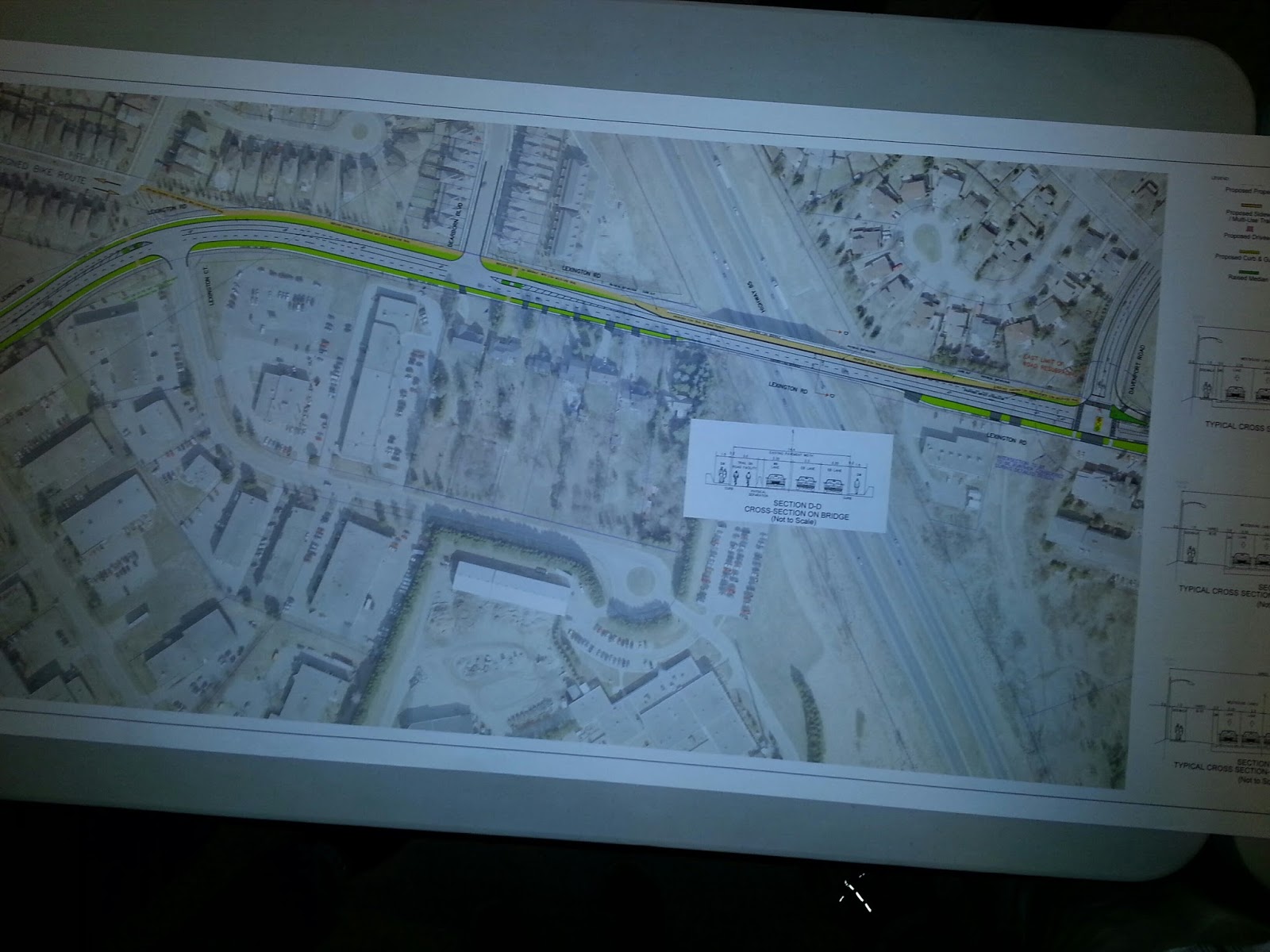
As part of resurfacing Lexington Road, the city of Waterloo proposes to create a multi-use trail that turns into a 2-way cycle path over the highway 85 overpass. Because the overpass cannot be structurally modified, the idea is that this cycle path would take up a traffic lane and be protected from traffic by some form of barrier, possibly jersey barriers.

The proposed multi-use trail will connect Davenport to Holbeach Crescent. That will get people on bike across the expressway, and provide connection through the neighbourhood to the Forwell trails and the rest of the Waterloop.

Click to embiggify.


This part of the Lexington corridor would turn into 2 eastbound lanes, and 1 westbound lane. Travelling further west, it opens up to 2 lanes by the time you reach the Dearborn traffic lights at the bottom of the hill. Further west, there are not many changes.


Not to be forgotten are a couple of pedestrian refuges which will make crossing Lexington on foot safer, and catching GRT's route 31 bus on the other side of the street less of a terrifying adventure. (Seriously, I've watched the terrifying game of Frogger that these riders play.)

So, why this plan? What's going on?

The Background


Like I said, this is an interim plan. In ten to fifteen years, this road could be reconstructed. Before then, the city hopes to have acquired the land they need (especially around Weber) to create a permanent cycling solution while not constricting traffic. That's their goal.

The bridge has been, and continues to be the worst problem. Anything the city does to it has to be approved by the MTO. Structural changes are extremely unlikely. Even what's proposed here still needs their blessing. The good news is that the MTO is apparently much more willing to consider this kind of plan now than they were four years ago.

The last time this stretch of road came up, a proposal to reduce lanes to introduce on-street bike lanes further west was rejected and deferred by council. Possibly as a result of that, staff want to maintain 4 road lanes west of Dearborn leading up to Weber.

What staff have presented fits within their budget. This means they don't need extra money to do this. But is it enough?


The verdict


What this proposal does is add a vital, safe cycling link across the expressway to connect Eastbridge to the Waterloop. Filling that gap is critical. So that's very good.

It doesn't complete the Columbia/Lexington east-west corridor. That is a disappointment.

Despite that, I believe we must support this proposal. Here's why:

To "do this right" would require the city to fund a new multi-million dollar plan that will take years, maybe a decade. Recognizing that, City staff rescued the idea of an interim plan from the scrapheap.

They've come up with something that solves the issues that council raised with the previous proposal. They've done it cheaply, and they could have this in front of council for approval this fall, with potential construction in 2016. We need more of this imaginative problem solving. There are so many critical gaps and problem spots in Waterloo region's cycling network that need attention now. But there is only so much money to go around.

If you punish staff for coming up with pragmatic solutions that can be implemented quickly, we will only see improvements when roads come up for full reconstruction, which means our network will only get random improvements going in haphazardly over the coming decades without regard to need.

What this proposal does well is connect Eastbridge to the rest of Waterloo in a way that people of all ages can hop on a bike and use. That is the critical need. It also helps us build cycling numbers and that will in turn increase momentum for other incremental improvements.

And it is a template for future problem-solving. Not every improvement needs to be as polished and completely conceived as Uptown's streetscape. What we need are pilot programs. We need staff and councils willing to engage in low-cost risk taking. We need to fill the gaps in our cycling network now, whatever way we can.

That's why this proposal deserves a thumbs up. It's not the big win some people were hoping for, but it is definitely a win. And small wins over time add up to big gains.


Tuesday, June 2, 2015

Columbia/Lexington road improvements consultation Wednesday!

This is a big one! After a four year wait from the last attempt at addressing Waterloo's great cycling gulf, Lexington Road over the expressway is finally back on the table.


There is a public consultation for Columbia St. E and Lexington (from King to Davenport) Wednesday, June 3rd from 6:00pm to 8:00pm, at the Mennonite Brethren Church, 245 Lexington Road.


If you want to ride a bike in the city of Waterloo, please consider attending. If you can't, then make a point to provide feedback when the material from the consultation goes online.

Let's recap:

  • The city of Waterloo currently has no bike infrastructure that crosses the expressway. It is Waterloo's great cycling gulf.
    • Soon, there will be a multi-use trail underneath the expressway at King St. North, which will provide some access to the Conestoga mall area.
  • Lexington Road is the only crossing in Waterloo without on/off ramps.
  • Lexington Road is the only crossing in Waterloo that is a city street (not a regional road).
  • Lexington Road is the quietest, lowest-traffic crossing point in Waterloo. It also appears to be the busiest cycling crossing point of the expressway.
  • Lexington/Columbia is an as-yet incomplete planned east-west cycling corridor. This study area is the critical missing piece.

In 2011, the city consulted on potential improvements that included on-street bike lanes, and reducing Lexington to 3 lanes between Davenport and Marsland. Despite the fact that the road is overbuilt for the amount of traffic it sees, the proposal drew concerns and unanswered questions from council at the time and the project was deferred in 2012.

Since then, Davenport's road diet has been completed, and so have the bike lanes along Lexington east of Davenport (with some multi-use trail action coming as well.) Hillside Park and Forwell Creek Park are now part of the "Waterloop" and crossing and connectivity points are being improved.

What will staff bring forward at the new consultation? I'm not sure, but it will hopefully provide a good cycling connection to the Waterloop, and reduce the speeding problem along Lexington. Could it even fill the very challenging King-Weber gap? We'll see.

It will need public support! I hope to see you there.

Thursday, May 28, 2015

Uptown Streetscape is a thing!

On Monday, I had the great pleasure of speaking to Waterloo City Council on behalf of the region's Active Transportation Advisory Committee. In our last meeting, the committee endorsed the plan presented by the project consultants and city staff to revamp Uptown Waterloo's streetscape with wider sidewalks and protected bike lanes.

I also had the pleasure of watching that plan passed unanimously.

The plan was the product of multiple consultations and strong public feedback, which I wrote about previously here and here. I also helped get the word out about protected bike lanes on twitter, on CBC radio (sadly the clip is no longer available), and in blogs. Together with the efforts of a number of passionate individuals, including the inimitable Graham Roe (whose petition garnered a thousand signatures) and tireless Mike Boos (who designed the amazing infographic) we got Waterloo informed, and engaged.

The people spoke, and the project team listened. The BIA got on board, and so did the politicians. What a journey! Considering that in 2010 I heard from one streetscape committee member about the very passionate arguments around the table about removing any traffic lanes at all, this points to a real evolution in thinking by many members of our community.

There are still a few rough edges. While Waterloo has a plan to replace lost parking (the streetscape plan will cost 22 parking spaces, but the LRT construction will affect considerably more), this plan still needs to become a reality and businesses will need to see their customers continue to reach them, whether it's by foot, bike, or car.

There is also the question of intersection design. Protected bike lanes will interact with these intersections similarly to on-street bike lanes, in that they'll be alongside traffic lanes and clearly visible at intersection approaches.

But there are other approaches we could take, including this adaptation of Dutch intersection design for Boston's Commonwealth Avenue.


Or even better, we could take a step further and implement a "protected intersection".


Just some thoughts on how to polish this plan to perfection.

Friday, November 14, 2014

Removing barriers to cycling

I've found that I've been doing a lot more late-season cycling this year than I have in the past, but only under certain conditions. What shapes my decision making is educational when it comes to understanding what makes cycling appealing to more people year-round.

The question of year-round cycling, or even full three-season cycling, is one I wonder about a lot, and written about before. Generally speaking, I don't cycle in winter. There are exceptions, including one trip to Vincenzo's on a sunny, sharply cold day (I ended up taking some paper napkins to line the holes in my helmet because I'd got the windchill equivalent of an ice cream headache.) Or the time I biked to uptown during an incredible January thaw and ended up getting my bike's brake and gear lines wet, and therefore frozen solid for the rest of the winter.

What I've learned is I have two major impediments to winter cycling-- and neither of them are temperature. The biggest single impediment is light (or lack thereof.) The second biggest is biking on snow and ice. Studded tires can go a long way to making small amounts of snow and ice tolerable, but I don't have them because once the time change sets in at the start of November, I'm no longer willing to tolerate cycling home on Lexington Road in the dark, so I haven't invested in them.

So that's where my recent increase in cycling, often in the dark, has been so interesting. It's because I've had multiple trips a week that aren't to work (as most of my cycling travels take me) but to the vicinity of U of W, either for theatre rehearsals, or for curling (at KW Granite.)

This trip is about half the length of my work commute, and often in the evening. A bike commute makes the trip about 20 minutes on my terms, whereas transit takes 30-40 minutes and with poor frequency in the late evenings or on Sunday, especially when I'm trying to get home. And if the car's available, a trip to campus has to contend with paying for parking.

I've also found that cycling to work, and then using GRT bus bike racks to get me and my steed to the UW area for evening commitments, to be a viable option.

So the bike has made a lot of sense, even as the weather gets colder and sunset gets earlier. The trip is simple, and pleasant-- side streets through the Mary-Allen neighbourhood and Uptown, then up through Waterloo Park. There are good bike racks both on campus (though theft is common there) and at the Granite (custom-built bike racks in the outline of curling rocks!) Even at 9:30pm last night, with temperatures around freezing and a chill wind, I'm finding the ride to be pleasant and comfortable.

The lesson here is that cycling conditions and trip length really affect my willingness to hop on the bike, regardless of the amount of light. A 4km bike ride through Uptown and on trails on a freezing November night is tolerable (even pleasant) but a 9km bike ride knowing I have to survive the Lexington Road expressway crossing is not. The length itself is not such a big deal, but the combination of that major barrier and the conditions of Hillside Trail are deal-breakers.

Of course, this is all quite temporary. It's November, and soon the snows will be here. Even my shorter evening trips will become untenable: the Waterloo Park trail will be a rutted, icy mess in between infrequent clearings, and can't be relied on. It will be the barrier that hangs my bike up for the winter.

Which brings us back to the same old same old when it comes to encouraging people to bike: we need  a comfortable environment to cycle in. But everyone has their own particular "deal-breakers". I will tolerate cycling on Lexington Road until it crosses a perceived-risk threshold when the after-work commute gets too dark. Others view it as a year-round deal-breaker. For trips without that kind of major barrier, some will happily jump on the bike but only while weather is warm. Others might bike year-round except for the lack of winter trail maintenance. A hardy few will tough through anything.

Each little improvement we make to the cycling network enables a few more trips for a few more people. Just looking at my usual trip corridor, the Hillside Trail paving will be one less barrier to those whose bikes (or backs, or wrists) can't handle the rough loose surface. Finally providing bike infrastructure across the expressway at Lexington would allow an entire neighbourhood to connect to the rest of the city. Examples of this kind of barrier removal opportunity can be found city-wide. They all build on each other.

And the role of transit in providing support to someone's travels by bike shouldn't be underestimated. Whether it's a flat tire, surprise inclement weather or a change in plans, a bike rack on the front of a GRT bus or within an ION light rail vehicle gives people confidence they'll be able to get through their day without a car, even if the unexpected strikes.

And this is the way we shift travel mode share. An improvement at a time, a few people at a time, and individually, as we learn what we are capable of, where, and when... without being tethered to an automobile.

Tuesday, May 27, 2014

Help us reshape our Uptown

City looks at segregated bike lanes for Uptown
Waterloo councillors agree better infrastructure needed for cyclists
 
It's really quite amazing, isn't it? Enough to leave you thinking that we are on a road to a more human-friendly city, and that public engagement can have a real impact. But we're not there yet.

The Uptown Streetscape Improvement project originally started as a lighting replacement project but has grown quite a lot since. It was shelved for a few years while we answered the LRT question (and finalized the design). If the project hadn't been put on pause, though, we'd never have contemplated the current proposal for wider sidewalks and protected bike lanes.

But over the last few years, our collective consciousness seems to have absorbed some lessons from around Waterloo region and beyond. Streets in our city do not need to be designed for maximum car throughput over all other uses anymore. Instead, we need improvements to the pedestrian realm. We need cycling infrastructure that welcomes everyone, and not just a hardy few. Our main street should support these things, and that means big change for King St.

The current proposal for Uptown (interpreted by Mike Boos)
Some people, in particular a few notable business owners, would prefer to minimize changes. And there is an argument to be made for Uptown: if it ain't broke, don't fix it. Uptown is a raging success, so why tinker? It's reasonable to be wary of the effect any change in parking and car access may have on a business's bottom line

But change comes anyway. By 2017, King Street South will be transformed from a 4 lane arterial to 2 lanes with transitway. And even before the arrival of LRT, our travel pattern is shifting: trips along King that are by car have dipped below 60%, with transit, walking and cycling making up 41% of the mode share at peak times.

And this is despite the fact that Uptown is actually broken and needs fixing. Cramped and worn sidewalks. Substandard lanes that are straddled by the many GRT buses that move through, constricting traffic. When free-flowing vehicles meet a dense pedestrian realm, the results are sometimes fatal. Plenty of bikes on the bike racks, but precious few on the street as cyclists avoid the lanes and instead opt for side streets or just the sidewalk. And yet, Uptown thrives! It does so despite these flaws, not because of them.

So let's imagine how much better it could be if King St were welcoming and accessible to all users.

Two lanes of traffic where four exist now means those lanes can be wide enough for the vehicles that use them, as well as providing enough extra room for emergency vehicles to move up the middle. This, along with a slight reduction in parking spaces (less than 1% of Uptown's parking supply!) provides the room for wide sidewalks for the many pedestrians, with the opportunity for sidewalk seating at cafes.

In addition, there is room to make a protected bike lane connection along King all the way from University to Erb. This will link Wilfrid Laurier University and the many apartments popping up along King to Uptown, while the LRT project will provide bike lanes (albeit unbuffered) through to downtown Kitchener. The Iron Horse and Laurel trails are nearby, along with the future Spur trail and planned crosstown on-street cycling links. These interconnections provide a useful cycling network within reach of the majority who are interested but concerned about using the bicycle for short trips.
A Chicago example of how a protected bike lane fits in the urban core.

And for those businesses along King whose owners are concerned about the effect these changes may bring, I would urge them to consider the upside. There are two to three thousand more residents coming soon within 500m of the King St. corridor who will live in buildings with low parking ratios and they will have easy, convenient access to Uptown thanks to these improvements. They'll be a virtually captive market for uptown retailers, in fact.

Automobile access will still exist, but pessimistically drawing a straight line from "reduced traffic lanes and parking" to "depressed business" ignores the realities that (a) drivers still arrive to King St. businesses on foot (even if they parked down the block) and will be influenced by the state of the pedestrian realm, and (b) once a potential customer is in the car, the Uptown business may have already lost as Uptown is now as close, or far away, as our malls and box stores. The key for success in Uptown is to be as accessible and welcoming as possible to people who have the option to not drive, because these people are growing in number.
And it's not so weird.

These people have a right to shape this city as they want. Businesses in Uptown are stakeholders in the streetscape redesign, to be sure. Their needs and concerns must be listened to. But they must be weighed against the needs and desires of all who live, work and play in Uptown Waterloo, as well as taken in context with the growing body of evidence that our city cores can be "complete streets" and vibrant and successful.

We have a unique opportunity to turn Uptown's King St. in to the kind of Main Street that Waterloo deserves, and with an project lifetime of 25 years, this kind of opportunity only comes around once in a generation. At the same time, we're recognizing both the need for walkability and for cycling infrastructure that the average person finds welcoming, and how these strengths tie in to the adoption of transit and the reduction of traffic congestion in a region that has grown by leaps and bounds. The stage is set.

A lot has to go right for the proposal to become a reality. Project staff need to feel confident about recommending this proposal, and that requires vocal popular support at the May 29th Public Consultation Centre. The city of Waterloo council needs to endorse the recommendation, and then (because it's a two-level project) the regional council needs to approve it. All of that could happen by this fall, if we are willing to speak up in favour of it.


So speak up. This is local, direct engagement with a real potential to shape this city in a positive way. How much more incentive do you need?

Wednesday, December 4, 2013

Waterloo really does bike!

There's a lot going on in Waterloo for bikes. And I'm not just talking about Waterloo Bikes (though they'll come into it). Maybe when they took the fluorine out of the water, they put something else in, because change is afoot in Waterloo-- real physical change, and change in perspective.

Uptown Protected Bike Lanes?


Let's start with the changing attitudes. I've raised the Uptown Streetscape improvement plan before but this fall it came back to the public with a preferred option. One that included bike lanes and reduced traffic lanes. That on its own really says how far we've come! We can actually talk about converting uptown's King Street away from a 4-line thoroughfare, into a complete street serving all users.

But, as proposals go, it wasn't perfect. It's the barest of concessions to bikes and doesn't really provide a welcome cycling environment to attract serious use. So Graham Roe of Waterloo Bikes, as well as yours truly, both spent some time going over the possibilities of protected bike lanes in uptown Waterloo. I put together a detailed post up on TriTAG's blog, which led to a CBC radio spot to discuss the idea. Also, a lot of great conversations during and around the public consultation.
Protected bike lane on Kinzie in Chicago

Graham has carried it further. He has spoken to the issue on radio as well, and even started and promoted a petition that edges towards one thousand signatures.

I think we've moved the needle on this one. But that is largely because it is an idea we're ready to seriously discuss, and a lot of people are realizing they'd bike if the infrastructure was accommodating. This matches what other cities have discovered-- just how many people would move around by bike if they felt it was safe and convenient.
Courtesy: Transitized

And when you throw in a study which demonstrates the rise of alternative transportation in our uptown core, we can paint a picture of a city in transition, both in thought and action.

I might have accused Waterloo in the past of losing its mojo. It seems reports of its demise were greatly exaggerated.

But wait... there's more.

Waterloo Interior Loop is a Real Thing, except for the Loop part


The city of Waterloo presented its latest public information centre on the so-called Interior Loop that I posted about before. Details and boards from the latest PIC are available on the city's website here.

Options have been condensed to concrete proposals and intentions. While the "Loop" aspect of the Interior Loop is still lacking a key piece on its north side, the rest of the trail has received very detailed, systematic examination.
Just two of two dozen points of improvement.

We see consistent crossing treatments, strong signage, trail infill, realignments and surface improvements. All to create a navigable, accessible trail. It's hard not to like, but easy to underappreciate-- this kind of systematic standard-setting usually just doesn't happen.

Okay, so there's still a failure to address the Weber St. crossing of the Laurel trail north of Lincoln. Only marginal improvements will be delivered there this time round. But on the other hand, we have real improvements that will be delivered in 2014, and are already budgeted.

Some of the expected (by me) local resistance to trail improvements has not emerged. In fact, I've heard support for the all-important resurfacing of Hillside Park trail from local residents along warnings about flooding problems that need to be handled.

Winter maintenance is still not on the cards, though.

Meanwhile...

Columbia St. W and Lexington Road Upgrades


Waterloo continues to knock off deficiencies in its east-west network. Out in the west end, a $10M widening project will add lanes, roundabouts, sidewalks and "raised" bike lanes to Columbia between Fischer-Hallmann and Erbsville. This marks the first use of raised or separated bike lanes in Waterloo. There's some chatter about whether the 4-to-2 lane adjustment makes sense on this stretch, but I'll leave that for others to worry about. Hopefully Waterloo also learned to do bike lanes and roundabouts better than this dangerous setup.
DO NOT WANT

East of the expressway, Lexington Road may see new sidewalks, bike lanes, and a multi-use trail between Davenport and University. The Public Information Centre for this is on Wednesday 11th December at Waterloo Mennonite Brethren Church (details). Can these changes be carried through successfully? It may depend on the reaction of residents on Lexington who may prefer to keep their streetscape as-is, if nobody else shows up.

I'll show up. Preserving "the look" and even a few trees can't trump basic human accessibility on foot. We're talking sidewalk on just one side, after all.

Of course, all this leaves an elephant in the room: the stretch of Lexington/Columbia between Davenport and King-- across the expressway, through four massively overspecced lanes, past a nasty choke point at Marsland and through busy Weber. This will be the hardest to deal with, but as I've pointed out before, the most necessary. Waterloo has already blinked once, but as the rest of this corridor comes together, it gets harder and harder to ignore.

What I'm wondering: with a proposed south-side multi-use trail east of the expressway, has someone tipped their hand? Does the city have something up their sleeve for overpass improvements? Has MTO softened their stance on bridge changes to improve walking and cycling?

What about Kitchener?


That's what's great about living in these twin cities. We have two (or four, including Cambridge and the regional government) chances to see good things done well. Of course, it's also two (or four) times as hard getting broad sweeping improvements through region-wide. You take what you can get.

Today, though, Waterloo gets the spotlight. They're bringing some really positive change forward, and more exciting change seems tantalizingly close.

Let's make it happen.


Thursday, September 19, 2013

Waterloo Trail Improvements - summary

These are based on my recollections and conversations at the open house Wednesday.

The "Interior Loop Trail" (contest to come up with a name!) was the showcase of the proposal, and was generally positive, though with some caveats.

Link to PDF
Positives:

Overall, it's ambitious (as trail improvement plans go) to address this route so systematically, and with (according to staff) a lot of potential for change to take place even in the next year. Creating a loop enables a lot of different trips, not just back and forth from uptown, but from neighbourhood to neighbourhood in the north. Improving the quality and consistency of the trail, and taking a serious stab at wayfinding aids, are also welcome.

In addition, a lot of intersections and crossings would be improved. Not a huge amount of detail here, but again the term "systematic" really jumps to mind. Virtually every trail segment and intersection has been looked at.

Downsides: 

As you can see, it won't be a "loop" for a while. In the north is a large section that remains to be worked out, with a couple of possibilities (working out an agreement with Waterloo Inn if/when they redevelop, or following city-owned land close to the highway). But they're still conceptual.

Another small gap lies in Uptown, in the King St. area, though that's not surprising given the LRT construction plans. Also, LRT is responsible for delaying surface improvements in Waterloo Park. But, the same project may yield opportunities to extend paths and trails along the rail corridor up to Northfield and beyond (...St. Jacobs?) This intriguing possibility was raised by Jan D'ailly, chair of the Waterloo advisory committee on active transportation (WACAT).

Other noteworthy items:

Carter and Mackay streets (between Weber and University on the south-east side of the loop) are being proposed with sharrows. I had a discussion with a staffer about whether this was appropriate or desirable. These streets are very low volume wide residential streets, with sparsely used on-street parking. It could be that sharrows will be benign here, and useful wayfinding devices. It struck me as an odd context to apply sharrows in, though.

The proposed trail crossing at Weber/Mackay is still a work in progress. A couple of options were presented. This crossing will be a challenge, but also of great benefit.

Big picture:

The trail system in Waterloo is still disjoint and inconsistent, but this proposal would be a major step in bringing it together if it is followed through.

For cycling, the way we should look at the trail system is as a place where very casual or novice cyclists of any age should feel comfortable and confident to ride. Unfortunately with all of the current breaks, bad intersections and lack of signage, they are not so appealing. When a gentle trail is interrupted by 4 lanes of speeding traffic without any crossing, it is effectively a dead end for many people.

The city of Waterloo should be congratulated for attacking this problem. It's not a perfect proposal, and it's not a complete solution. But as incremental improvements go, this one is bigger than most.

Now we need to see it happen. And that's where we come in: to provide feedback and shape the proposal, and then to be willing to speak to council about the benefits it will bring.

Stay tuned.

Wednesday, September 18, 2013

Waterloo Trail Improvements Open House: TONIGHT!

The City of Waterloo is proposing big trail improvements over the next few years. There is an open house on the trail improvements tonight:

Wednesday, Sept. 18, 2013
6 p.m. to 8 p.m.
Waterloo City Centre (City Hall)
100 Regina Street South

If you walk or cycle in the city of Waterloo and in particular on the trails below, you should check out http://waterloo.ca/atprogram for more information and drop in tonight!

Original PDF here

Note: For those with sharp eyes (it's come up a couple of times) University Avenue at Carter/Hillside Trail is not listed for crossing improvements because a crossing island is already planned there for 2014 as part of regional road reconstruction.

But don't let that stop you from coming down to the open house! This proposal deserves support and maybe you can help provide some constructive criticism.


Monday, May 13, 2013

An inconvenient truth about cycling by the rules

Battling cyclist entitlement


The Atlantic Cities has posted an excellent opinion article called "Cyclists aren't 'special' and shouldn't play by their own rules". The author, Sarah Goodyear, points to Chicago enacting higher fines for dangerous motorist actions, but also for cyclist rule-breaking. Praising its even-handedness, she states the following:

I am truly sick, at this late date, of people wanting to have it both ways: calling for protected bike lanes and a bike share system, demanding that cops step up enforcement when it comes to cars, and then blithely salmoning up a major thoroughfare and expecting everyone look the other way.

If cycling will truly become mainstream, the author emphasizes, it must shed its renegade/outsider trappings and become a team player in our urban environment. As a cyclist, she sees it as a very personal decision:

I am trying to see myself as an ambassador for bicycling and to break the bad habits I formed over years of biking on streets designed solely for cars. If I am going to fight back against the forces that want to intimidate and marginalize me when I am on my bike, I think that riding as squeaky clean as possible is my best strategy these days. The balance has shifted, and with the advent of bike share, modeling good behavior is going to be more vital than ever. Not just to prove the naysayers wrong, but also to be truly safer riders.

And I agree. I try very hard to bike legally and cleanly in a civil and accommodating manner. I too have bad habits formed over the years of biking in an environment designed for automobiles that I suppress. I sometimes see that desire to have our cake and eat it too amongst other cycling advocates and I try to avoid it myself. And yet...

And yet...

Monday, October 1, 2012

[LOABKW] October and the winter coming

Despite a beautiful and long summer of cycling the like I have never seen before (1,750km and counting!) the arrival of October is a reminder that all good things must come to an end soon. Every previous season of cycling has done so before... sometimes earlier, sometimes later.

Canadian winters are the basis of many criticisms of investing in cycling. Taken to the extreme, they are why our cycling infrastructure is, according to some, "wasted six months of the year". While I doubt that my bike will be hung up for anything close to six months, it is a good bet that I will pedal very few kilometres during December, January, or February.

Let's explore why.

Cold

Winter is cold. No question, cycling in winter is less comfortable than other times of the year due to temperature.

Conditions beyond -15C with windchill will weed out many riders. But strangely, the bikes are often out and about with more moderate freezing temperatures... especially as spring approaches and these temperatures feel less frigid by comparison. Skiers know that cold is not an obstacle to outdoor winter travel.

Cold itself is probably the least relevant reason for my lack of winter cycling. Clearly, cold takes its toll, but cities like Minneapolis are much colder than Waterloo and this doesn't stop half of their cycling commuters from carrying on until spring. You can always dress warmer.

Winter biking in Minneapolis. That's -3F. Image source Cascade Bicycle Club

It's usually what accompanies the cold that is more relevant.


Snow and Ice

As an undergrad, I biked through snow now and then. Taxing and difficult, and when ice is involved, quite risky.

But you could say the same thing about driving: difficult and dangerous when ice and snow are around. So why are antiques and convertibles the only cars that hibernate the winter in the garage with the bikes? How is it that most motor vehicles drive on through the winter regardless?

The answer is simple: road maintenance.

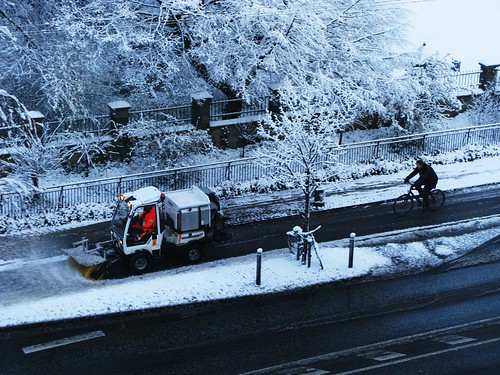
The standard of road maintenance for snow and ice clearing that we see exceeds that of anything else, even (regrettably) sidewalks. As for trails, many see infrequent or even no snow clearing. Ice patches form, and are not as easily melted and dispersed as they are by automobile tires on the city streets.

Also, road maintenance tends to be for car lanes only. Bike lanes get short shrift, often becoming dumping ground for snow piles that, once melted, deposit their suspended debris in a thick mat of tire-destroying crap that remains uncleared until April. That formerly complete street is now a narrow car-only strip of pavement, and drivers once acclimatized to watching for bikes seem to have forgotten all about them.

Image Source: Treehugger

Snow and ice are major obstacles to cycling only because we are allowing them to be. Eventually we will learn from our colder but more cycling-savvy cousins, and we will establish a core cycling network with year-round maintenance. But until then few will be able to ride regularly through the winter because they have nowhere to ride.


Visibility

Winter brings darkness and inclement weather.

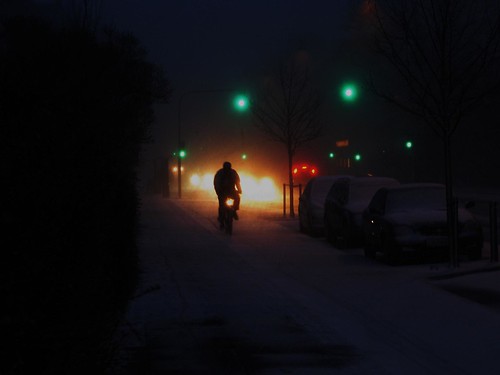
When daylight savings is in effect, most people can cycle commute while the sun is up. As the days shorten and the the clock "falls back" in November, the ride home is suddenly a dark one.

And no matter what we do, we can't change Waterloo's latitude. Even in a climate-changed world, our winter days will always be short.

And yet, despite equating ourselves with Nordic countries, our city is at the same latitude as the balmy south coast of France. Long winter nights are a problem that all of the big cycling nations of Europe contend with, and to a greater degree than we have to.

Image source: Copenhagenize
The problem with cycling in the dark is sharing space with car drivers who have a harder time seeing us. This problem is only an issue when we have to share space with those cars. But with our snow-locked trails closed to us and our cycling lanes covered in plow drifts and glass, we have to contend with spending much more of our time negotiating for space with cars in the dark, possibly as a flurry starts to make conditions even more treacherous.

The solution here is the same as before. Establish a cycling network that is maintained year-round, give people the ability to ride their bikes in safe conditions separate from traffic, and visibility becomes less of a problem.

Image course: Copenhagenize

The hundred year storm

The aspects that lead people to criticize the practicality of cycling and the worth of investing in cycling infrastructure come back again and again to the quality of that infrastructure. Build it and maintain it properly, and these criticisms will lose their force.

Massive blizzards will still roll through each winter, and they will still prevent people from cycling. But then, we also urge people to stay off the roads in cars, too-- and see grim reminders of what happens when people inevitably don't.

But in a multi-modal city, people have choice. For those days that are too snowy, or too cold for even the hardiest cyclists, there is always transit, or carshare, or walking, or simply driving. Cycling is just a part of the puzzle. If it were a year-round transportation option, it could help many people reduce or eliminate their car ownership burden. This way lies real reduction in traffic congestion, as well as big savings for families who now maintain one, two or more cars because they must plan for the coldest season-- but end up using them year-round.

Goals

There's nothing special about our city that makes it impossible to be a bike-friendly place all twelve (or, perhaps, eleven and a half) months of the year.

To get us there, Kitchener and Waterloo should be filling in our trail network with a goal of establishing not only a contiguous, separated network for cycling (something that we still lack), but also committing to maintaining it through the winter.

As for me, this year I'll be carrying on through November as long as I can. This year I've got my sights on an arbitrary, but achievable, numeric goal: 2000km. For me, round numbers are good motivators. A little extra incentive to put on an extra layer, and keep pulling the bike out of the garage. The morning rides are becoming increasingly beautiful as the leaves turn, and that's an extra reward.

After that, I'll look at fighting another winter cycling obstacle: inertia. Yes, it's dark, yes, it's cold... but it's often neither snowy or icy. I haven't done a good job of taking advantage of these days when they come up because the bike is "put away". But if the trails and the expressway overpass are passable, this year I will try to get a few winter rides in as conditions allow.

Perhaps you can too.

Image source: whatsgoinon