Showing posts with label grt. Show all posts

Wednesday, May 25, 2016

A tale of fickle, elusive Transit

Update 27/5: Good news! GRT is reinstating the Weber/Guelph stop to serve the midtown area and it will be back up by mid-next week. The Weber/Union stop will remain closed, as it sees additional service from route 8, and was less used than Weber/Guelph. It was also only about 500m away.

There is concern about keeping the 200 on schedule, but it's encouraging to see responsiveness from GRT on this! I guess there was more than one crotchety blogger on the phone with them after all. For those of you who provided feedback about how you were affected, thank you.

Maybe I need to change the ending to this fairy tale...


nce upon a time, there was a happy central neighbourhood called Mount Hope. In Mount Hope, being very central (directly between two great cities), Transit was present and available, as you might expect. Some residents in the neighbourhood chose to live there because of this, as they could travel the great Central Corridor through the Cities without needing a Car. 
 
But one day, the Great Road Eating Rail Monster came, and Transit ran far away. And the people of Mount Hope were sad.

A little later, just as sad people in Mount Hope were trying to figure out how to live without Transit (likely by buying Cars to drive the few roads not being eaten), Transit came back again! In a different place, but still reachable to the residents of Mount Hope, and they breathed a great sigh of relief.

Unfortunately, it was not to be for long. One day just a few months later, Transit went away again. The Central Corridor buses were to drive by, with strict orders to not stop for the poor people of Mount Hope. In its place, a different bus would come every now and then, once in a while on Saturdays and never at all on Sundays, and it would take people where it went, which was usually not where they wanted to go. And it would take people when it showed up, which was often not when people needed it, because it only came every now and then, only once in a while on Saturdays and never-- it was decreed, never! on Sundays. This was called "Transit", but the people of Mount Hope were not fooled.

But they were once again sad-- not to mention, confused-- and they started browsing new car ads on the Internet because who can trust Transit that comes and goes? The Great Road Eating Rail Monster would eventually leave, having birthed a beautiful Train. But that Train would see fewer riders, because the people of Mount Hope were all driving the Cars they had to buy to get around while the Monster raged and Transit had proven too fickle and elusive to rely on.


The End.


... OK, so, not a great fairy tale. Let me explain. Once, Mount Hope had good access to transit, as the fairy tell told.


And then:
  • The 4, marginally useful at the best of times, was rerouted to cover the cancelled 18.
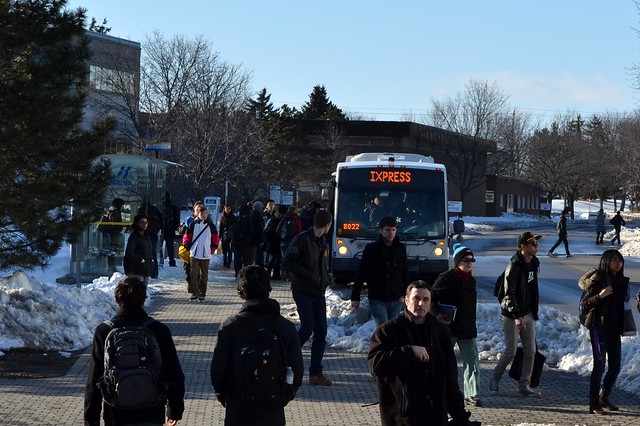
  • When the 200 iXpress detoured over to Weber because of ION construction, it didn't stop anywhere in between uptown and downtown, leaving a lot of riders in the lurch. 
  • Simultaneously, route 7 shifted over to Park St., which was great for the Belmont neighbourhood.
  • Simultaneously, the low-frequency route 6 turned off Wellington at Weber.
  • The Mount Hope neighbourhood has been left high and dry, with only the very occasional route 4, which is a milk run bus with limited service (and no Sunday service.)

But then, the 4 needed to be detoured as well! So to infill the 4 on Weber, GRT added stops for 200 iXpress (which runs every 10-15 minutes and has good Saturday and Sunday service) at Weber/Union and Weber/Guelph.

This gave back good transit access to the Mount Hope neighbourhood.

Now that the 4 is returned to its normal route, the 200 no longer stops at these locations. This is despite the fact it drives right by them, every 10-15 minutes.

The result is awful:


In fact, 200 iXpress travels for an astounding 3.5 km without stopping even once. From the north end of Uptown, all the way to King/Victoria. Certainly, Mount Hope isn't the only area affected by this-- Mary/Allen is, as is anyone in the Midtown area relying on the 200 to get them to points south of Fairview.

But with all these changes put together, the Mount Hope neighbourhood is once again left like an island without transit, unless you count the occasional lonely route 4 bus. And very few people will count this for anything. Frequency matters, and routing matters. GRT has ignored these things when deciding the 200's detour.

In 2015, GRT saw transit ridership fall for the second year in a row. Even accounting for changes to school student busing, and even with new service being added, GRT ridership still fell.

The problem with Mount Hope is just part of a larger issue affecting ridership, and that is the chaos and disruption of ION construction. But unlike a lot of the other aspects of this problem, this one can be solved easily and locally. In fact, the solution was already in place. All we have to do is return to it.


All we have to do is reintroduce stops at Weber/Guelph and Weber/Union for 200 iXpress.

GRT, are you listening?


Wednesday, May 27, 2015

The art and science of transit stop placement

Man, it's been a while since my last post! I've been busy with the Active Transportation Advisory Committee, still working a little with TriTAG, but mostly taking care of real life. But the march of progress brings new lessons and observations. I have a few things to post about now, but I'll start with what is freshest on my mind.

And that is: we're seeing new transit routes being created, and we're making some mistakes with transit stop spacing and placement. But there's confusion about why they're mistakes. Mistakes are being made because we're treating the entire region with the same standard, without considering that parts of our region, the cores, have more potential riders and potential destinations.  

Our system will benefit more from more closely spaced stops at strategic locations within these dense urban areas than from assuming one central stop can serve an entire core, or that one standard can serve an entire region.

Some background:


The new 204, and Queen St.


Regional Council's Planning & Works committee heard from a few delegations on Tuesday about the upcoming GRT improvements. There are concerns about rationalizing existing routes with the introduction of a new iXpress route. But there was also a vocal debate about that new 204 iXpress (travelling along Highland to Queen, through downtown, and out east along Victoria.) In particular, about its stop placement.


 A couple of residents of the Bread and Roses coop at Queen and Courtland took issue with the (apparent) stop placement at Queen and Mill, instead of what looked more logical to them, Queen and Courtland, where there are almost a thousand housing units just in the nearby major buildings alone.

In fact, it got even messier when it was revealed that the "GRT stops" at Queen/Highland and Queen/Mill were actually both 1-way stops, separated by a few hundred metres, a situation which serves nobody well.

In response, staff and some councillors argued that this area is well served by other routes and by the planned stop at Charles St. terminal. But that misses the point that the 204's potential is being undermined.

First, let's talk about GRT's defined goals.


Stop coverage


GRT stops are defined to have a 450m effective radius, for calculating what parts of the city are covered by transit. ION LRT stops will have a larger effective radius, on the logic that people will walk further for better service. GRT's "iXpress" stops are also intended to have a larger spacing than regular routes, so that the buses can move faster.

These standards are important because they give GRT and the region an objective measure they can use for planning, and some defense against the reality that quality of service is uneven, and changes will always make some people unhappy. GRT works very hard to make sure routes and stop placements are sensible. Coverage standard is not the only tool in their toolbox, but it's a big one.

The problem is, it's only a tool, and it won't maximize the benefit or performance of transit. And being bombarded by people complaining about the removal, the moving, or even the placement of a route or a stop, planners are still missing important information amongst the noise.

The 204 stop placement issue reveals this. An objectively strong argument is made for putting the stop here rather than there. Region staff and councillors seem ready to dig their heels in against this argument.

What do they need to consider?


Trip Generation?


Transit stop placement needs to consider the potential for trip generation. And this analysis is already being done. In the example above, there is clear potential for trip generation at Queen/Courtland, but the location is being discarded because it fails other tests: coverage overlap with the terminal, for one. Route overlap too, which is really coverage again because the coverage question isn't where do you want to go, but can you get to anywhere at all.

Our downtown cores are big trip generators. Transit is most attractive when it stops close to a potential rider or their destination. Adding stops closer together within a downtown makes transit more attractive to a lot of people.


Modal Shift?


A delegate made a strong point about the many current car users who live in the immediate vicinity of Queen and Courtland, and how strong transit presence and convenient stop placement in that location will have a big bottom-line effect on the region's efforts to increase the modal share of travel by transit.

This point is so far unaddressed by Region staff, who largely see the location as sufficiently well served by transit without assessing the quality of that transit versus the trip generation potential of that location.

Again, to satisfy the coverage goal, it doesn't matter where you can get to, or how frequently, as long as a bus going anywhere shows up nearby at some point. This is the reality for much of the region's suburban areas which are hard to serve with transit. It is a poor defense for a major urban node.

If the region can provide quality, frequent, convenient iXpress transit service to a large number of current drivers and potential riders, the potential for ridership increase may outweigh the incremental impact of an additional stop.


Travel within downtown?


The potential for transit use within a downtown core, in particular Kitchener's quite substantial downtown, is being completely missed in this discussion. By assuming all transit users will gravitate to a central terminal, GRT is actually making it extremely difficult to cross from one end of our downtown core to the other.

The effect of this is actually turning downtown edges into transit deserts. There's so much service at the terminal that routes, especially iXpresses, don't need to stop nearby. Except that those living on the outer edge of a dense downtown are presented with a long walk, despite the fact there is much more potential for transit use there than along most of the rest of the route.

And if you want to get to the other side of downtown, you're out of luck. You could walk to the terminal, assuming you can find a bus that will stop near where you're going. Or you could try a local route that does stop frequently enough, but then pay a layover time penalty at the terminal. Or you could play transfer roulette.

If the region wants to make more of our downtowns accessible by transit users, it needs to stop assuming "one big central point" is all a downtown needs.


What about ION?


Despite LRT positioned as rapid transit with wide stop spacing, ION planners have, curiously, placed a higher stop frequency within the city cores of Waterloo and especially downtown Kitchener. Notably, they have added stops that its predecessor, 200 iXpress, does not have.


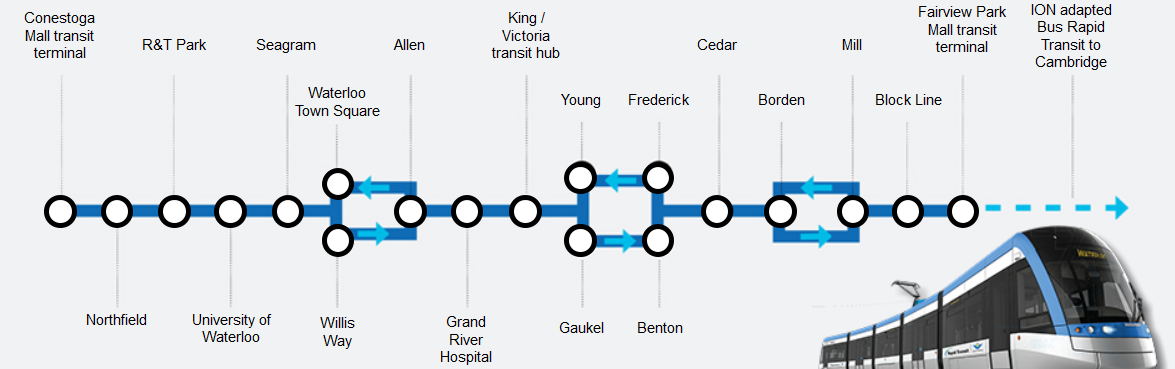
In Uptown, a new Allen stop joins the Waterloo Town Square pair. In downtown Kitchener, we have Victoria, Young/Gaukel, Frederick/Benton, and Cedar where only Victoria and the Charles St. terminal exist as stops today. And Victoria was added to the 200 only recently.

ION planners recognized the need to serve downtowns with multiple stops and to target destinations. Regional transit staff need to take a similar approach with iXpress.
  

Scaling stop spacing based on density


Density provides transit ridership through increased trip generation. Promixity to good transit service also drives ridership. Good transit service is partly driven by route speed, which is negatively affected by the number of stops along the route, so that is a major tradeoff. For most of its history, GRT has actually had too many stops on its routes, slowing down buses, raising costs and making its service less compelling.

But in attempting to deal with this problem, the region wants to treat all places the same. Stop spacing over 1km apart makes for rapid buses through our suburbia, and is an acceptable tradeoff between service quality and availability. But stop spacing at this scale within an urban core doesn't just affect downtowners, but also the potential suburban users who may head there.

We need to look at density when placing stops. We can't assume an entire downtown will be served at one central point, because there are so many potential riders who live on the edge of that dense core who transit will fail to attract, and also too many potential riders elsewhere who are destined for parts of downtown that are too far from that central point.

Every stop slows down a route, obviously. And everyone wants a bus stop on their doorstep, with a rapid trip in between. Clearly you can't add stops everywhere.

But does it make sense to treat a dense urban cluster of apartment buildings, with multiple seniors' residences and other attractions as a place with the same transit need as a suburban hinterland of single family homes on widing avenues? Can we afford to ignore the ridership potential of parts of our downtown cores presented with poor access to transit that runs right by their front doors?


Practical Outcomes


iXpress buses represent the bones of our new transit network as they link up with the ION spine. Like ION, they need to provide good cross-town service. Also like ION, they must serve the downtown cores well.

Instead of simplistic coverage goals, we need a metric that will balance overall access to transit with high quality service for the most people and destinations. 

For iXpress, that may mean switching to a 500m stop spacing standard within the boundaries of Kitchener, Waterloo, and Cambridge cores. There's so much to do in these places, so many attractions, and a large and growing number of people. In these places, transit should be compelling and convenient.

Remember, high density areas are high generators of both trip origins and destinations. Serve them well, and you'll get a lot more riders for your transit service dollar.


Avoid making the worst of a bad situation


There's an addendum here, if you're still reading this polemic.

That 204 stop at Mill? The one that turned out to be a single-direction stop with the other 300m away? This is awful. Don't do this.

Splitting stops is sometimes necessary, but always bad. Human Transit talks clearly about how split routes turn potentially useful transit into "symbolic transit", i.e. they look like good lines on a map but they don't serve anyone well. Split stops are just about as bad.

Consider the situation of St. Mary's hospital. The 204, tragically, does not serve the hospital directly (something I urged planners to consider.) But that's OK, right? There's a 204 stop 400m away at Highland. Unless you're heading the other direction, in which case it's over 700m away. You're better off taking a different bus, or a taxi.

The same goes for the hapless residents at Queen/Courtland. 350m to the "Mill" stop near the Iron Horse trail is objectively not so bad, but 650m to its companion stop at Highland is pointless: you may as well use Charles Terminal (while it's still there.)

Nobody wins with a split stop situation like this. Bad enough that it gave the impression of better coverage than was already there, an unfortunate communication gaff. It also gives the impression of useful service to a wide area, where in reality very few in the area will find the route useful. Only people who live between these two one-way stops will find them useful, and there just aren't as many of them. Certainly not as many as you'd find in around a sensible two-way stop location placed at a densely populated intersection.


Thursday, March 13, 2014

Transit for Cambridge: everyone's on board, almost.

Councillor Jane Mitchell recently laid out why Cambridge is where it is when it comes to transit, and why Mayor Craig's motion to area-rate Cambridge out of paying for LRT (rationalized as Cambridge isn't "getting anything out of it") displays an astonishingly selective memory on his part.

As Mitchell points out, Cambridge's transit has been pulled up by its metaphorical bootstraps since the region took it over. Before then, according to Cambridge regional councillor Brewer, it was raided for funds whenever things were tight. Since the formation of GRT as a regional transit entity, Cambridge has seen a huge service increase (more than doubled) while ridership in Cambridge has more than tripled.

It seems like Cambridge residents are interested in transit. It seems like the region is interested in bringing transit to the residents of Cambridge. But is Cambridge's own leadership interested?

Read Councillor Mitchell's post.

Wednesday, March 13, 2013

Waterloo GRT Improvements: Modified!

Heads up: the previous post on this topic contained a description of the proposed 2013 GRT improvements that has since been modified.

Here's the new map:


You may need to click through to see it in detail, or view the original PDF.

One big change: the 201 iXpress will not run to Blackberry campus. Instead the 202 iXpress will extend from RIM campus to Conestoga Mall.

This is a bit of a surprise, but the lesson is never assume something is final until it is final. Even this plan may be subject to change, based on public feedback, online or at one of the PCCs:

Monday, March 1812 p.m. to 4 p.m.
University of Waterloo
Student Life Centre, Great Hall
200 University Ave. W., Waterloo
Tuesday, March 194 p.m. to 8 p.m.
Kitchener Waterloo Bilingual School, Gymnasium
600 Erb St. W., Waterloo
Thursday, March 21 (This PCC will include information on the proposed 2013 Fare Change)
4 p.m. to 8 p.m.
Waterloo Mennonite Brethren Church, Chapel
245 Lexington Rd., Waterloo
Friday, March 22 (This PCC will include information on the proposed 2013 Fare Change)
12 p.m. to 4 p.m.
Wilfrid Laurier University
Fred Nichols Campus Centre, Concourse
75 University Ave. W., Waterloo

 Happy travels!

Saturday, February 23, 2013

Waterloo GRT improvements

Attention: Details of this post are now out of date. Please see the updated details here.

The latest regional council Planning & Works agenda contain details of GRT's proposed service improvements for later this year. I wrote about this previously when multiple options were being presented to the public. They've taken in the feedback, and are now coming back with a single proposal for public consultation.

And, it is good. Very, very good.


(You'll probably need to click through to see it legibly.)

Grand River Transit has taken feedback to heart, especially from those of us who encourage them to look for opportunities to move our transit routing strategy away from hub-and-spoke and towards grids. Here's how they have done so:

  • Route 35 provides very direct north-south service along Bridge and Lancaster, with time-wasting loops cut out.
  • Route 6 trades its Downtown Kitchener destination for Uptown Waterloo, and interlined with the 5, it provides a solid east-west gridline.
  • Route 31 runs virtually all of Columbia/Lexington right across town: it no longer enters U of W campus.
Of course, there is also the major addition of the University Avenue express, which doesn't quite stick to University Ave in the west end but still cuts an easily understood path across town. 201 iXpress is also extended, to cover the densest portions of Columbia before turning towards Conestoga Mall and Northfield. This route is a little ideosyncratic but may improve the usefulness of this route that currently looped back at the universities.

And crucially, each will cross the LRT line, though some work must be done to provide a sensible transfer at U of W campus.

Overall, this is a solid set of improvements. But like all route changes, it will inconvenience some who may have located themselves to benefit from the existing route structure. Still, many of them will still have access to transit, and new alternatives available. And many more will be in a position to take advantage of transit. For instance, one coworker of mine has already happily observed that his home near Columbia/Westmount now has transit options to our workplace near Bridge/Northfield.

(These improvements are extremely good news for Bridge/Northfield, especially in light of plans to develop a multi-use node at this location. Large portions of the surrounding area will have transit access to this point, though it remains to be seen if people will take advantage of it in this very car-oriented suburban part of Waterloo.)

Good job GRT!

If you want to read more, TriTAG has a writeup on the proposal here. Also, here is the list of proposed stop locations for both iXpress routes, mostly sticking to their 400m stop placement minimum:


Thursday, January 17, 2013

Budget Pain and Bad Decisions


This is a tough year for budgeting, and the mantra must be "everybody feels the pain". While I, personally, would willingly sustain a higher tax hike to keep moving forward, many disagree. Council had to strike a balance between the two. Certain regrettable, but understandable moves have been made, like the delay of the long-awaited Spur Line trail ($3M in capital savings).

Other decisions are less understandable.

The "200 iXpress" is the kind of transit success story that is the wet dream of municipalities struggling with road expenses. It has grown in ridership from a couple of thousand a day when it launched seven years ago, to over 14,000 a day last year. Ridership has driven repeated frequency improvements, from half hour to 15 minutes to 10 minutes, and these frequency improvements in turn have driven ridership growth. It's a virtuous cycle, and a beautiful example of the critical importance of frequency in transit.


A typical busy day for iXpress

The 200 is a route that has been noted as seeing not only high peak volumes, but healthy off-peak ridership. Because many (if not most) of its buses are standing-room only for at least part of its route, it must be financially a star performer. It sees strong student ridership, obviously, but also strong "choice" ridership from people who recognize a good service and will adopt it over other alternatives.

And it serves a route that will become rail-based in less than five years. An ambitious step by the region in search of a better way for its citizens to move about.

In the face of this blistering, searing success, last night regional council voted to cool things down. For July and August, iXpress frequency will drop back from 10 minutes to 15. This move will save the average household a whopping $1.46. (estimate TriTAG)

There are two negative consequences we must consider from this move.

Virtuous to Vicious 


The justification for lower frequency is lower summer ridership. There lies the temptation to "optimize" the line for these months, to trim a few hundred G's from the cost of providing the service. But that justification ignores the effect of frequency on ridership. We're breaking the virtuous cycle in place, and possibly running it backwards. 

Reduced frequency will reduce ridership, because the service is not so attractive. For some, it will not be there when they need it, without looking for a schedule, and this will turn them off. This, in turn, will offer justification to further frequency reductions if you are looking for short-term cost cutting measures.


We've seen this penny-wise, pound-foolish tendency before: bus wraps.
 
The region has stated in master plans and megaprojects that it wants to not only increase transit use but multiply it. It needs to keep its eyes on this goal, but budget pressures this year have caused its attention to wander. After implementing plans that will increase household tax levies by $20 a year, why put the success of those plans at risk for the price of a Tim's medium coffee?

Capacity


Another justification for lower frequency has been put forward (pp.76-77):

In July and August 2012, during the midday period, iXpress trips experienced peak passenger loads greater than 35 approximately 3 times per day (4% of trips) and did not experience loads greater than 60 passengers (maximum capacity).
(...)By reducing the frequency of service from 10 minutes to 15 minutes on Route 200 iXpress during the midday in July and August, 24% of midday trips would exceed the GRT off-peak service standard of a full seated load (35 passengers). In some cases buses would leave passengers waiting for the next bus. This would occur on average twice a week (0.5% of trips).
In fact, as I understand it (from Councilor Mitchell's tweeted clarification) the approved cut was in fact all day and staff indicated that buses would leave passengers behind twice a day.

In other words, at the one point of the year where iXpress is providing enough capacity to not fail its passengers, council has decided to "optimize" service so that it provides an acceptable level of failure.

No rider left behind?

This is deeply troubling on two counts. Firstly, unreliability is one of the most costly flaws in transit, that has a disproportionate effect on turning people off using it:

One statistic in the study stands out in particular and should give transit agencies pause: More than half of the riders said they had reduced their use of public transportation specifically because of its unreliability. Most of them didn't just make fewer trips overall; rather, they switched to other modes of transportation to fill the void.
These words should freeze councilors' hearts. But the second troubling evidence is that council seems to discount this deliberate unreliability as an issue. They seem to believe there is an acceptable level of service that involves leaving people behind every day.

These would-be passengers will get a clear message that the region has little regard for its transit users. And they will abandon transit, if they can.

Silver Lining


It seems as if council has lost the plot. When the pressure is on, the region's long term strategy to shift itself towards a more sustainable (i.e. affordable) future model is put in jeopardy by short sighted penny-pinching. But all is not lost.

I would expect that the consequences of council's decision should be obvious and easy to demonstrate. In fact, the councilors who voted for this cut should be prepared to get an earful from the transit users denied service. There should be no surprises, or ambiguity about cause and effect. We should see ridership negatively affected, complaints increase, and no small amount of public ire directed towards this decision.

And then we can remind council of their goals, the LRT system they have hung their hat on, and that their small cost-cutting victory of today is putting their large victory of tomorrow at risk. I hope we will see good sense eventually prevail. Neither council nor the people of Waterloo can afford to damage the conditions that will make LRT successful, the same conditions that have doubled transit ridership in the last ten years.

If nothing else, we will be shown that, when attracting people to transit, there is no room for an "acceptable level of failure".


Friday, November 9, 2012

Waterloo Route Shakeup!

Edit 2013/02/23: GRT has released a "preferred option" proposal. You can read about it here.

Edit 2012/11/10: GRT has now released its official options and I have revised this article to use the new images and corrected for details that have changed since the council submission.

Big changes coming to GRT, mainly within the city of Waterloo. The establishment of the 202 "University Avenue Express" and the extension of 201 iXpress require some rethinking of existing routes. The region is looking for public input on a number of options at public consultation centres being held in November. Are you going?

It has taken me a while to process the east Waterloo options. And to my disappointment they still haven't been properly published. Everything below is pulled from the region's Planning and Works agenda document (warning: big PDF), starting around page 115. You can now see GRT's official options here. Note that they differ slightly from the P&W agenda.


There are three "east" options being presented.

In all options, the 201 Fischer-Hallmann iXpress is extended past the university to Conestoga Mall, and then on to Northfield & University. The University iXpress also terminates here, but how it gets there is different.

Also, 6 and 35 are "crossed": they swap their downtown endpoints, 6 goes to Uptown and 35 goes to Downtown. In doing so, they are much straighter than before, which helps them act as better grid participants. Presumably 6 will be linked to the western 5 route at Uptown, as 35 was before.

The Contenders


East Waterloo Option 1 showing route details.jpg
Option 1


Option 1 is probably the simplest. The University iXpress left-turns at Bridge St. Apart from the 6/35 swap, eastern routes remain largely unaltered (12 is tweaked.)

Strengths:
  • Bridge St. is well served, at least between Northfield and University.
  • 35 is now an (albeit slow) north/south route.
  • The future "minor node" at Northfield and Bridge is very well served, with access to it for much of the northeast area. (Disclaimer: I work here and this is personally important.)
Weaknesses:
  • Duplication of iXpress between Northfield/Bridge and Northfield/University
  • There are three ways to get from Northfield/Bridge to Conestoga Mall. Seems excessive.
  • 12 is almost completely pointless in this configuration. Only a fraction of possible trips on the 12 are not provided by other routes, faster and more frequently.
East Waterloo Option 2 showing route details.jpg
Option 2


Option 2 really shakes things up. The University iXpress stays on University. 35 is (partially) straightened out. 31 shortcuts along Bridge St.

I see this option as intriguing, but flawed.

Strengths:
  • 35 starts to resemble a legitimate grid participant along the east side.
  • 6 (presumably cross-linked to the 5 on the west side) is a nice east-west grid line.
  • An intriguing new route for the Lincoln neighbourhood.
  • Less iXpress duplication.
  • A more useful 12; Weber St. north of University finally sees some service.
Weaknesses:
  • 31 is a monumental waste. It provides some minimal value along Lexington and that's it (and there isn't much along that stretch, either). Short-cutting it up Bridge makes no sense: whose time are you saving? The people trying to reach Conestoga Mall, who could take 201 or the new Lincoln route instead?
  • 35 is half-heartedly straightened out. Its remaining neighbourhood wander diminishes its value as a way to get up and down the east side by adding substantial delay (close to 10 minutes.)
There is one small change that makes this option a lot more compelling: swap the Eastbridge detour from 35 to 31! Now you have a less useless 31, and a more direct 35. Everyone wins.

I would like to see 35 continue to adhere to 6's old Wellington St. route, too. That would help it remain useful to me, personally, as well as the rest of the Mount Hope/Breithaupt neighbourhood which is not well connected to the East side at all in this arrangement. One big change from the original council packet is that 35 serves Wellington like the 6 does.

East Waterloo Option 3 showing route details.jpg
Option 3


Option 3 puts 31 in the configuration it should have had in Option 2. 35 is bent and spindled past recognition. 12 is cut short

I'm not sure which of Options 1 and 2 are the Good and the Bad, but Option 3 is definitely the Ugly. This is a disaster for anyone trying to get up and down Bridge St.

Strengths:
  • Nothing that Option 2 doesn't already accomplish better.
  • Demonstrates the routing that Option 2's 31 should have.
Weaknesses:
  • Complete failure to provide a north/south grid route on the east side.
  • Big degradation of service for the Bridge Street corridor, accessibility to the Bridge/Northfield minor node.

Additional Thoughts on All Options

The new University iXpress provides a nice east-west route through the university district and it will be very valuable in either of its two proposed routes. In one configuration, it provides the Bridge St. corridor with good service. In the other, it ventures into the less developed University East area, but in doing so it might be a more "legible" route.

Of course, by doing that, people might start to ask "Why not make it University Avenue all the way across?" And why not? Combined with a sold Erb/Bridgeport limited-stop route through Uptown, we might have something viable. But that's not in the cards...

If we run the University iXpress up "around the horn" instead of Bridge St., it opens up a compelling routing for the 35 as an east-side north-south connector. But it needs to be more direct than Option 2 shows, sticking to Bridge and Lancaster all the way to Wellington or Victoria. (Though the short Auburn Drive detour at University is reasonable.)

While I would love to see 4 bus routes converge at Bridge and Northfield, and keep my current bus route to work, I have to say that Option 2 is probably the best starting point. Swapping Eastbridge detour duties from 35 to 31 is a no-brainer.

But what about what is possible, but not presented? TriTAG member Duncan Clemens has put together his vision of a restructured route network in this google map. He has some of the same ideas: Use Bridge and Lancaster as a corridor. Make 31 pick up the Eastbridge neighbourhood slack.

Hopefully the PCC will provide opportunities for some of these good ideas to bubble up to the surface. And hopefully we'll end up with something globally useful, and not deformed by competing self-interest.


Friday, August 3, 2012

[LOABkw] An uneventful week

It's actually a relief that this week's getting around town without a car was uneventful. The two weeks prior provided lots of fodder for blog posts, but it wears down a fella, you know?

One big milestone this week though. I've now cycled 1100km for the year. That matches the high water mark I set in 2010: from now on, every ride is personal-record-setting. I'm confident that I can break 1500km, and considering setting my sights on the 2 megametre mark.

There was some minor, though not unpleasant shifts in the routine this week:

Monday: My company's Habitat for Humanity build day! I was presented with an opportunity to cycle commute somewhere completely different: Howe Drive, near Westmount and Highway 8. That was a pleasant ride, almost all trails and side road, though I did discover that Concordia Park has the same sewer affliction as Hillside Park: trail closure for construction forcing me to detour.

That's me, doing a Here's Johnny under the armpit of the top right orange guy


I'm impressed with trail connectivity on Kitchener's southwest side, though the expressway remains an obstacle. I was glad I didn't have to go any further south along Westmount than the 50m or so it took to get from trailhead to build site.

Also, no lost appendages or broken limbs. A total success!

Tuesday: TriTAG hat on for the afternoon, to have a meeting with Waterloo city government and a developer. Which meant dressing up beyond the usual standards for a software geek, and arriving Uptown without being dripping with sweat.

Which, sadly, meant leaving the bike at home. Fortunately, there's GRT: once again, going car-free means going multi-modal. As demonstrated with the flat tire incident last week, part of good cycling infrastructure is a good transit system.

The rest of the week: The aforementioned Hillside Park sewer construction work is progressing. Over the last couple of weeks, I saw some depressing signs of construction crews taking two steps forward, one step back:

A lovely concrete footing for the new bridge.


The same concrete footing, two days later.

Finally, on Thursday:

We have a bridge!
The Hillside Park work can't end soon enough for me. It's my preferred cycling route (and a great way to get from Lexington to the Lincoln neighbourhood), and it has been closed all year. Originally supposed to be done in Spring 2012, and then in mid-July, I admit I will be surprised if it reopens in August. But it's getting closer.

A few other route alterations from routine: a trip down the Iron Horse to pick up a piccolo from a prescribed piccolo drop-off point (don't ask), and a trip to the chiropractor this morning which meant tackling the Lancaster/Bridge roundabout, and Bridge St (a route that I have grown increasingly unhappy about). At least the construction signs are gone.

Erin returns this afternoon for a weekend off from birdnerding. Two whole days with her this time! Maybe I'll sneak the Matrix out to fill water jugs so I can brew on holiday Monday. That isn't cheating, is it?

Friday, July 27, 2012

[LOABkw] Feeling Flat

Life On A Bike in KW is a series of posts about Chris' attempt to get as much done as possible on two wheels, while Erin takes the car out of town to observe birds. How cycle-friendly is KW? 


Monday: disaster! About three blocks away from work on my way home, I notice that my bike seat feels... springier... than usual. I look down, and it's not the seat, it's the tire.

What a deflating feeling.


No slow leak here: within a minute or two, the tire is completely flat. And I am completely unprepared. A patch kit in my pannier, but no pump!

Getting home was not too bad. Despite having a good idea of the bus system around work, I missed the first attempt, but I caught one in the direction of Conestoga Mall. Thankfully, all GRT buses have bike racks. You've seen these, right?

Nice rack.


So getting home wasn't too bad, though I imagine some people were wondering why I was walking my bike up and down the same street.

I should have been able to repair the flat where I was, but it turns out I wasn't even able to repair it at home:

  • I didn't have a working emergency pump.
  • My patch kit was so old the rubber compound had fossilized!
  • I didn't have a replacement tube.
  • I had just loaned Erin my floor pump the day before because of her own flat tire woes.
This may seem unforgivable, but here's a secret: this is my first bike flat ever. You could excuse my complacency.

The next morning, I resolved to take the old Jamis to work via Canadian Tire, where I could correct all these things. It worked, but I discovered that in the two months since I had last rode the Jamis, it had gone from being my trusty steed for the last 12 years to an almost unrideable, painful, ill-fitting, dilapidated torture device.

Wow. I can't believe I rode that bike for over a decade.

None the less, I made it through the day (albeit with some of the neck and shoulder pain that characterized the last couple of years.) I brought home a new mini-pump, a tube, and a couple of new patch kits. And I hoped to hell the a patch would work because taking the wheel off would be a major chore...

Internal hub & brake: low maintenance != easy maintenance.


You see, the same piece of high tech on the Brodie that makes it low-maintenance and reliable also makes it much harder to get a wheel off. And the unforgiving topology of tori requires wheel removal. The Nexus hub pictured above requires both brake and gear cables to be detached and has an extra mount point to worry about too, along with alignment issues when you put it back together.

This guy didn't have to contend with a hub in his record-setting tube switch:


Fortunately, while you can't change a tube without completely removing the wheel, you can patch it in place. But you have to have a patch kit that hasn't expired, and you have to have a pump. Even if you can't patch it perfectly, it may be the difference between being stranded, and being able to nurse your way home or to a bike shop.

So, some lessons from this event:

  • Have a pump and a patch kit. Preferably attached to your bike so they're always there. (My patch kit still has no home but the pannier.)
  • Keep some bus tickets in your wallet. If you're in town and have a smart phone, Google Maps is invaluable for finding bus stops and will tell you when the next one is coming. It can also give you transit directions home.
  • Also with the bus, if the racks are full but the bus is not, be prepared to remind the driver that GRT says you can bring the bike on board.
  • If you're entirely carless, a spare beater bike is not a bad idea. After all, you may not even have a shop with bike repair equipment within walking distance.
Good news though: I've patched the tube and it seems to be holding. If this bike is susceptible to flats, I'll have to invest in some different tires that are puncture-resistant: Schwalbe makes a line of them that a friend recommended to me. I really don't want to have to take the back wheel off, ever.

And I don't want to be caught flat-footed.

Wednesday, February 29, 2012

Between a rock and a hard place

Did you know that Guelph Transit revamped its entire route structure on January 1st? I have been hearing tidbits about the pain that this redesign has caused, and the Mercury chronicles the changes with articles [1] [2] [3], editorials and oh! the opinions! [1] [2] [3] [4] [5] [6]

Here in Waterloo region, we should pay attention. Grand River Transit will face the need to revamp part or all of its network over the next decade. With twice the ridership as GT and active expansion in routes and ridership expected, GRT needs to move away its current hub-and-spoke design, and towards a decentralized, grid-based system.
 
Reboot the System


There are two big strategies to cutting out existing bus routes. Guelph has demonstrated one: go cold turkey and simply shift buses around, and damn the consequences.

A second strategy is to starve existing routes by first providing more attractive service. This is one of the ideas behind the GRT express bus plan: a roughly grid-like network of limited-stop buses, with LRT along the corridor of heaviest demand, which will run regularly, at decent frequency, and provide quicker cross-town travel. These will draw riders away from some of the lower-frequency neighbourhood wanderers we have accumulated over so many years, allow those resources to eventually be shifted.

Still, Guelph reveals a problem that we will also face: in a community that is underserved by transit, any attempt to rationalize routes will cause pain. The reason for this is that existing transit users have trip needs that already cluster along our existing routes. Those who have simple trip needs that could be easily served by a grid network may not use transit simply because the current network doesn't provide.

Crazy Eights

So in shifting towards a more efficient, intuitive network that can draw greater ridership, there will be pain for existing users. GRT Route 8 [pdf] is an interesting example to look at. This is an impenetrable double-loop passing through the downtown terminal, and even after almost 20 years, I still need to refer to the route map-- or more recently, blindly rely on Google Maps' directions-- to have any idea if it will get me where I need to go. It has bizarre mid-loop terminations at certain times of the day, leaving confused riders stranded.

And yet, it serves certain corridors where nothing else does (Weber St. in Waterloo, and the Belmont Village corridor, to name a couple) and happens to provide direct trip options for both of these areas to the University of Waterloo and Laurier. So despite its incredible unintuitive opaqueness, it's fairly popular among existing transit users. Even with better bus service (12) along Westmount, and new University Avenue express in 2013, fixing a route like the 8 is daunting because it will leave dense areas along Weber and the entire Belmont Village area unserved.

Horse precedes Cart

Making this kind of network alteration palatable to transit users will require that they are presented with useful options first. To do that, we must provide more service, overlaying the new routes on top of the old, before we can reallocate the old routes' resources.

More service will require more funding, and the expectation that fare-box recover will lag as a result of higher subsidies. In fact, any reasonable transit growth strategy will probably see low fare-box recovery rates until new ridership catches up to the very system improvements that attract them!

Tough Love?

So if existing transit users' needs are the "rock", regional council's recent decision to aim for 50% fare-box recovery presents a "hard place". And our transit planners are stuck between them.

I know I've harped on this senseless, counterproductive decision before, but it smacks of politics winning out over the region's needs. The region still says it wants to triple the transit share of an ever growing number of trips within two decades.


But after making a series of high-profile moves to improve transit, council decided to smack transit around a little as if they were scared to show too much favouritism to one particular child. To "keep it in its place".

It will only hold us all back.


Tuesday, January 3, 2012

Today, I'm driving.

I thought I'd describe the situation today as an example of how our transit network fails even for someone who is fairly committed to using it.

I have a trip to make today. I have a dentist appointment at 4:10. Funny story: I picked a dentist, doctor and chiropractor based largely on their location and accessibility.  All three have since moved: the dentist from near Belmont Village to Sunrise Centre, the doctor from King & Stirling to down to Fischer-Hallman and Westmount, and my chiropractor from its location a short walk from home on Union to inconveniently half-way between home and work (but close to neither.)

So far (especially in the case of my doctor) I am reluctant to find better-located replacements.  And today, I must venture from work (Northfield and Bridge) to Sunrise Centre (Fischer-Hallman and Ottawa).  This trip used to be totally impractical by anything but car, but now I can get there from the opposite corner of town thanks to the new 201 iXpress, with a connection, in less than an hour.  Go go gadget Google Maps:


View Larger Map

For a trip like this, it's pretty impressive to make it in under an hour, though if the Expressway is light, that trip still takes half an hour or less by car: I usually plan on having a car when I need to make this kind of trip.  But, given that Erin has an out-of-town need for the car tonight, I was prepared to pay the extra half an hour travel time.

Unfortunately, travel time is not just time spent on the bus.  I've demonstrated that I'm willing to spend more time getting there if I don't have to drive (and I believe that many people would accept a longer trip time-- to a point-- if they can avoid paying for the car needed to make the trip, or if it somehow helps them avoid some other aspect of driving, like congestion, which our current bus network cannot.)

If you click through to the actual directions you will see the best option to arrive in time for my 4:10 appointment: leave at 2:50pm, arrive at 3:46.

Frequency matters. In this case, route 31 serves up what is usually considered a minimally acceptable 30 minute frequency.  You should consider that on average, waiting time for this bus is half of the frequency period: 15 minutes, and this is part of your travel time.  You may be able to plan around the bus's schedule a lot of the time, but situations like this show you could be waiting not at your departure point, but at your destination.  Not to mention that when things go wrong (a bus runs early or doesn't show-- not unknown for me here at Northfield and Bridge!) you are stuck for a long wait.

Human Transit has a great article on the critical importance of frequency in the uptake of transit, for which my situation serves as a good illustration.  This is why GRT's expanding frequent express bus network cannot arrive soon enough, and I eagerly look forward to the new and extended iXpress routes that are planned to serve Northfield and Bridge in 2013.

In fact, an extended 201 iXpress may mean that in the future, I won't have to worry about the distance to my doctor and dentist from work as it will serve as a direct route with fairly frequent (15 minute) service.

But today, I have to drive... and Erin will be late as a result.

As an addendum: I would not even consider this trip if the connection order (31 to 201) was reversed.  Attempting to connect to a 30 minute bus is fraught with time-wasting hazard, thanks to the noise introduced by the arrival time of the first bus, no matter how frequent that first bus is.  This is a point I've tried to make clear to transit planners in town... connections are okay, but only if the routes themselves are frequent. If connections allow for a higher-frequency network, then they should be preferred.  But connections on a low-frequency network are death.


Friday, October 21, 2011

GRT Business Plan 2011-2014

GRT held a public consultation on its business plan for the next three years at Regional HQ last night.  I made my way down, appropriately enough, by bus.  The event was not well attended, unfortunately... but I drink this stuff up, so I was happy to be there to bend a few ears and to learn what I can.

You can read the business plan at GRT's website.

The Good

By 2013:
  • University Avenue Express, providing a link from Boardwalk to the Northfield/University RIM complex, via Erb, Westmount, University and Bridge.
  • Extension of the 201 iXpress out to Conestoga mall and to Northfield/University.
Together these create two legitimate cross-town routes in Waterloo and establishes new links to the main line and future LRT.  (And personally they benefit me and my workplace by adding two express route stops at Bridge and Northfield.)


The Bad

The three-year plan is fairly modest.  The approach is to establish new routes every two years (2013, 2015..) and to bolster existing service on the other years (2012, 2014..)

However, the original RTMP projected a more aggressive establishment of express routes, with University Express in 2012 and follow-on routes in 2013-2014.  But this cutback was expected: part of making the LRT tax hit more palatable was reducing the funding growth needed to provide this service.

In the long term, this is costly-- with LRT established, the support network won't be as mature as it should be.  In the short term, this delays the introduction of new service.  In the medium term, well... it's complicated. More on that later.

Also disappointing: while Saturday and Sunday iXpress service is being improved, there is no late service and no news of extending the 200 iXpress' hours. I've been hoping to see a link from Cambridge to Kitchener later than 9:15pm, but it's still not in the offing.

Speaking of Cambridge, not much love from GRT in the next three years.


The Ugly


I have to call this ugly, because I can't figure out if it's truly good or bad.  Again, it's those medium term consequences...

GRT is presenting a fare increase structure.  Instead of factoring in an annual 2% inflation increase, GRT is presenting options for 5%, 7% and 9% (!!) fare increases with the aim of not just keeping up with cost of operations, but to change the balance of funding between fares and property tax, with a goal of 50% cost coverage from fares.

TriTAG has some strong words against this.  GRT points out in defense of this that average fares (across all modes) are lower than average for comparable systems, and increased revenue will help drive faster growth.

On the other hand, it'll put a headwind on ridership growth, and strain on the most vulnerable GRT users.  I'm not happy about that.  Theoretically we could improve GRT's low-income support program to address the latter issue-- according to a TriTAG rep, this program is behind in dealing with applicants.  But we're in a war for the hearts and minds of commuters who don't yet take our transit system seriously, and in swaying potential riders, there's no argument like success (and the last ten years have been very successful for GRT.)  Continued growth in ridership is paramount.

And yet... I keep worrying that LRT will be a political football in 2014, when we go back to the polls.  There may be value in showing that our transit service is taking steps to reduce its burden on the tax base.  Forget for a moment, dear enlightened readers, that good transit will save hundreds of millions in road expansion costs... Put aside that those same roads are heavily subsidized, or that self-sustaining profitability is not the goal of a transit system anywhere.

Increasing fare coverage of cost may be bad for transit growth and bad for transit users, but it could be ammunition against those whose goal is to minimize transit costs and kill LRT no matter what the long term consequences.

Yup, that's politics.  And that's why it's ugly.  In the balance, I don't know what's right.

Thursday, June 2, 2011

Delegation afterthoughts

Prepping the delegation speech for last night didn't take a lot of time-- I write quickly and can serialize my thoughts well when I sit down and do it, thanks to years of LiveJournal use-- but it occupied a lot of my "writing energy", whatever sump from which I draw the motivation to state my opinion. So since registering as a delegate, I haven't touched this blog.

And there's a big difference between hammering out a first draft and delivering a polished final version. That part took substantially longer. I even ended up writing a second speech with a different focus, and then tossing (most) of it out when I read it through from top to bottom and realized that while on the surface it said what I wanted to, it "flickered" on its way from start to finish. Vital links were missing.

It probably didn't help that when I wrote that draft, we were on our way through a second bottle of wine. I think I found the point at which I couldn't hang a sensible argument together anymore, and the frustration sent me away for another glass and to enjoy the last light of that glorious evening to watch urban bats out on the deck with Erin.

Most challenging of all, however, was dealing with the fact that I had a tremendous amount I wanted to say, but a personal mandate here to try and deliver a message that was unique. Council would hear a reiteration of staff facts, figures and conclusions from other supporters. The disconnect, as I saw it, was between dry facts and visceral instinctive understanding. What does the effect of transit improvement on lifestyle change look like at a personal level?

And that's where I felt that I could contribute. iXpress on its own isn't going to have the broad transformative effect we need, but it has affected some, and Erin and I are among them. And that's where having an archive of six years' worth of LiveJournal was extremely helpful: I have posts written about my perspectives and experiences going through that phase of transit adoption.

Still, there were things that I had to cut out of that story. For all that iXpress serves as a proof of concept for a higher order transit line, I wanted to talk more about its limitations:

1. iXpress, as a bus service, doesn't register on our radar. It did not prevent my workplace from moving from its old location on Parkside and Weber to where it now resides out at Northfield and Bridge. (This move partly precipitated Erin and I to relocate so that I could access a different bus to reach it.)

Even though there was some transit use at the old location, our office did not deem access to iXpress to be different than access to the wandering neighbourhood slow bus that is the 35. And we gave up on what would be a fabulous location in an LRT world.

2. I no longer take iXpress, even though I could. I frequently opt for a 35 to 7 connection at Conestoga Mall but never a 35 to iXpress connection. The reason is that iXpress isn't so quick anymore, because it has tremendously long loading times around the universities. It also remains absolutely cheek-to-jowl past Grand River Hospital. I can sit safely ensconced by a window for that trip, but disembarking is a difficult and annoying and elbow-inhaling and knapsack-dodging affair.

iXpress definitely has more headroom available to it, as it is only now moving from 15 to 10 minute headways, and could reasonably double its capacity one more time. The key thing is, though, that its capacity end is already in sight-- not helpful for long term planning. And my experience would be echoed by others. A crowded bus is not a transit attractor.

I felt that these were important points to make to Council but I just couldn't make them fit without breaking the flow. So I decided to stay focused on the story of how I got to where I am, and accept that I wouldn't get to say everything I wanted. And from the commentary I've heard since, it sounds like I made a strong point. Certainly the Record borrowed from my speech this morning, and the twitter pundit feedback was very positive. Of course, with the latter comes the warning about preaching to the converted...

It was a tremendous experience, though. A decade on stage gave me the confidence and my voice, years of workplace idea evangelism gave me the words, but I was still a bundle of nerves and freezing cold from the stress response (and, as well, the overactive air conditioning) until I was done.

And then, there was beer.

Wednesday, April 20, 2011

Why I Support LRT

Normally I let Chris do the transit-talking around here, but I have a little story of my own to tell.

I started my post-secondary education at the University of Waterloo in September of 1995. For various reasons, I lived at home for my first two years of school. Home was Cambridge. Unfortunately, I had neither a driver's license nor a car to drive. Sometimes my dad would drive me to school, sometimes I could catch a ride with a friend. But more often than not, I had to get to UW via public transit.

At the time, the entity known as Grand River Transit didn't exist. In order to get from my home in Cambridge to the University, I had to deal with three different transit systems (Cambridge Transit, Trentway-Wagar, and Kitchener Transit). On days where I had an 8:30 class (which was usually three days a week at least) I had to get up at 5:30am, and I would still arrive on campus 15 minutes late for class...and that's if I was lucky enough to make all my connections. It was physically impossible to get to campus on time for an 8:30 class. I missed lots of classes entirely because the bus transfers didn't work out. And then I still had to do the whole process in reverse at the end of the day. If I had a night class until 10pm? Forget it, I had to leave early in order to not miss the last Trentway bus of the night.

Needless to say, this lifestyle took a huge toll on my sanity, my sleep schedule and my marks. When Grand River Transit was created, I cheered long and loud, even though I was no longer a regular transit rider by that time. When the iXpress service was created, I cheered even louder. If only that had been in place during my early student days!! So now that we are facing the decision time for the next "big stage" of transit improvements, I think back to that time of my life, living with a fractured transit system that didn't work. Many people say that our existing transit system, with all the improvements added since the mid-90's, doesn't work. So let's make a transit system that works!!

Friday, March 25, 2011

TriTAG's points on RT station placement are worth reading

Having watched the RT plan's proposed go-live date slide already from 2015 to 2017, I've been reluctant to criticize the routing compromises that exist in the plan, on the theory that a good plan now is better than a perfect plan that delays everything.

A chat with a friend who is very active in TriTAG undermined that notion, as he believes there will be an opportunity to refine the plan before it goes into the final accelerated EA phase. TriTAG have posted their thoughts on station placement and while I was already familiar with their ideas for Uptown Waterloo, the points they make about stops in the University area are extremely compelling because I realize that as a non-student commuter I will be directly affected by them.

It prompted me to pitch an email at the Rapid Transit team, which I'll repost here as it speaks for itself.

Dear Rapid Transit Team,

I've just read TriTAG's comments on station placement and I really have to add my voice to theirs. Previously my attitude has been that the LRT plan, as it stands, is more valuable than a better plan that takes longer to put in place. However, TriTAG makes some compelling points, specifically about station placement in the University/Columbia/Tech park areas.

The placement of a station at Seagram Drive and on Ring Road at UW has the benefit of serving Laurier (marginally) and UW (well). It does not, however, serve a grid-based network that everyone not going to those two locations will require.

Take my situation. I currently commute to Northfield and Bridge from my home near Grand River Hospital. Currently I accomplish this using the 35, a substantial walk followed by a direct but extremely slow and infrequent bus. Door to door is about 45 minutes, vs. 20 for car. As such I only take transit two or three days a week.

With Rapid Transit in place, as well as GRT's proposed new routes, this will be a classic connection from RT to express that transit advocates have been pointing to as why RT benefits more than just those traveling along it. With 15 minute timings on the express route and a frequent RT (train, hopefully), I could connect at University from one to the other and have a trip time that is a lot more competitive.

...except it wouldn't work! The RT stops completely fail to connect at University Avenue. Instead it throws in a 400 metre disconnection from either Seagram or University. According to TriTAG, WLU is insisting on a Seagram stop, whereas a stop right at University is virtually the same distance by foot, and also connects to many buses that would provide a quick hop to/from WLU. To accommodate Seagram, grid connection possibilities at University, at Columbia and at Bearinger are all knocked out of kilter.

I have a term for this: snatching defeat from the jaws of victory. Please reconsider your station options to promote the transit system as a whole, and not simply to cherry pick a few key spots at the expense of general usability.

Sincerely,
etc.