Showing posts with label lexington. Show all posts

Wednesday, June 3, 2015

Cycle path for Lexington overpass?

Wednesday night, Waterloo city staff presented their proposal for Lexington Road to the public. After three years of silence, we now get to see how we might bridge Waterloo's great cycling gulf.

The Basics 


The proposal is an interim plan. Staff are telling us what they can do now, instead of ten years from now.

As part of resurfacing Lexington Road, the city of Waterloo proposes to create a multi-use trail that turns into a 2-way cycle path over the highway 85 overpass. Because the overpass cannot be structurally modified, the idea is that this cycle path would take up a traffic lane and be protected from traffic by some form of barrier, possibly jersey barriers.

The proposed multi-use trail will connect Davenport to Holbeach Crescent. That will get people on bike across the expressway, and provide connection through the neighbourhood to the Forwell trails and the rest of the Waterloop.
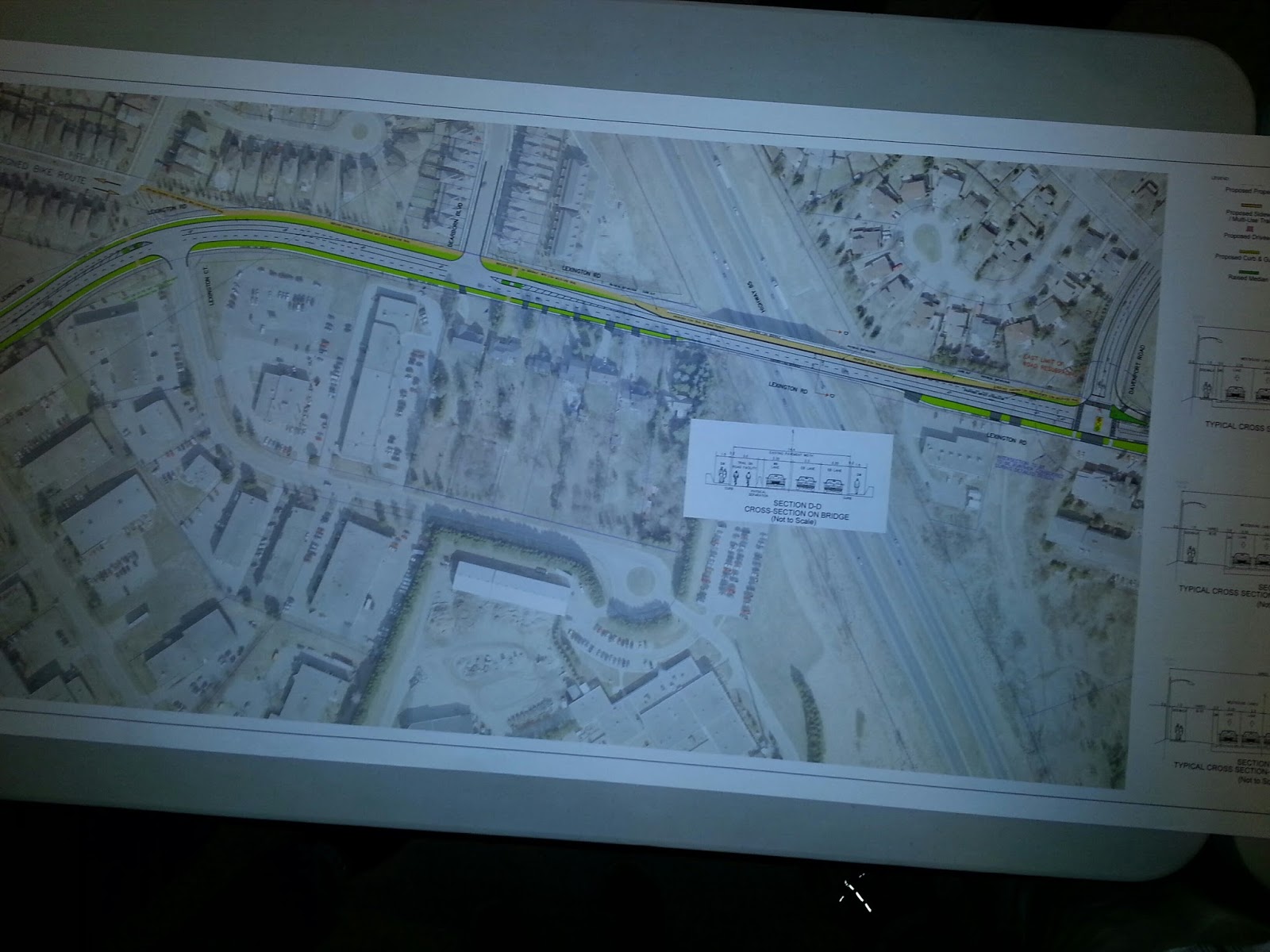
Click to embiggify.


This part of the Lexington corridor would turn into 2 eastbound lanes, and 1 westbound lane. Travelling further west, it opens up to 2 lanes by the time you reach the Dearborn traffic lights at the bottom of the hill. Further west, there are not many changes.


Not to be forgotten are a couple of pedestrian refuges which will make crossing Lexington on foot safer, and catching GRT's route 31 bus on the other side of the street less of a terrifying adventure. (Seriously, I've watched the terrifying game of Frogger that these riders play.)

So, why this plan? What's going on?

The Background


Like I said, this is an interim plan. In ten to fifteen years, this road could be reconstructed. Before then, the city hopes to have acquired the land they need (especially around Weber) to create a permanent cycling solution while not constricting traffic. That's their goal.

The bridge has been, and continues to be the worst problem. Anything the city does to it has to be approved by the MTO. Structural changes are extremely unlikely. Even what's proposed here still needs their blessing. The good news is that the MTO is apparently much more willing to consider this kind of plan now than they were four years ago.

The last time this stretch of road came up, a proposal to reduce lanes to introduce on-street bike lanes further west was rejected and deferred by council. Possibly as a result of that, staff want to maintain 4 road lanes west of Dearborn leading up to Weber.

What staff have presented fits within their budget. This means they don't need extra money to do this. But is it enough?


The verdict


What this proposal does is add a vital, safe cycling link across the expressway to connect Eastbridge to the Waterloop. Filling that gap is critical. So that's very good.

It doesn't complete the Columbia/Lexington east-west corridor. That is a disappointment.

Despite that, I believe we must support this proposal. Here's why:

To "do this right" would require the city to fund a new multi-million dollar plan that will take years, maybe a decade. Recognizing that, City staff rescued the idea of an interim plan from the scrapheap.

They've come up with something that solves the issues that council raised with the previous proposal. They've done it cheaply, and they could have this in front of council for approval this fall, with potential construction in 2016. We need more of this imaginative problem solving. There are so many critical gaps and problem spots in Waterloo region's cycling network that need attention now. But there is only so much money to go around.

If you punish staff for coming up with pragmatic solutions that can be implemented quickly, we will only see improvements when roads come up for full reconstruction, which means our network will only get random improvements going in haphazardly over the coming decades without regard to need.

What this proposal does well is connect Eastbridge to the rest of Waterloo in a way that people of all ages can hop on a bike and use. That is the critical need. It also helps us build cycling numbers and that will in turn increase momentum for other incremental improvements.

And it is a template for future problem-solving. Not every improvement needs to be as polished and completely conceived as Uptown's streetscape. What we need are pilot programs. We need staff and councils willing to engage in low-cost risk taking. We need to fill the gaps in our cycling network now, whatever way we can.

That's why this proposal deserves a thumbs up. It's not the big win some people were hoping for, but it is definitely a win. And small wins over time add up to big gains.


Tuesday, June 2, 2015

Columbia/Lexington road improvements consultation Wednesday!

This is a big one! After a four year wait from the last attempt at addressing Waterloo's great cycling gulf, Lexington Road over the expressway is finally back on the table.


There is a public consultation for Columbia St. E and Lexington (from King to Davenport) Wednesday, June 3rd from 6:00pm to 8:00pm, at the Mennonite Brethren Church, 245 Lexington Road.


If you want to ride a bike in the city of Waterloo, please consider attending. If you can't, then make a point to provide feedback when the material from the consultation goes online.

Let's recap:

  • The city of Waterloo currently has no bike infrastructure that crosses the expressway. It is Waterloo's great cycling gulf.
    • Soon, there will be a multi-use trail underneath the expressway at King St. North, which will provide some access to the Conestoga mall area.
  • Lexington Road is the only crossing in Waterloo without on/off ramps.
  • Lexington Road is the only crossing in Waterloo that is a city street (not a regional road).
  • Lexington Road is the quietest, lowest-traffic crossing point in Waterloo. It also appears to be the busiest cycling crossing point of the expressway.
  • Lexington/Columbia is an as-yet incomplete planned east-west cycling corridor. This study area is the critical missing piece.

In 2011, the city consulted on potential improvements that included on-street bike lanes, and reducing Lexington to 3 lanes between Davenport and Marsland. Despite the fact that the road is overbuilt for the amount of traffic it sees, the proposal drew concerns and unanswered questions from council at the time and the project was deferred in 2012.

Since then, Davenport's road diet has been completed, and so have the bike lanes along Lexington east of Davenport (with some multi-use trail action coming as well.) Hillside Park and Forwell Creek Park are now part of the "Waterloop" and crossing and connectivity points are being improved.

What will staff bring forward at the new consultation? I'm not sure, but it will hopefully provide a good cycling connection to the Waterloop, and reduce the speeding problem along Lexington. Could it even fill the very challenging King-Weber gap? We'll see.

It will need public support! I hope to see you there.

Tuesday, February 25, 2014

For want of a sidewalk

Okay, I admit, I'm not one to tolerate cognitive dissonance in others for very long. I want to dissect it until the internally conflicted belief or viewpoint is cut open for all to see. I can cut pretty deep, too.

And occasionally, I do it to myself (and that's what really hurts, as the song goes.) In a fit of honesty, this time I'll do it out in the open.

Last night, I spoke at Waterloo city council on behalf of TriTAG, generally supporting a plan that will see Lexington Road gain new bike infrastructure, and sidewalks on one side of the road where none exist at all today. I did take some time to talk about how sidewalks on only one side are "a compromise" and "the bare minimum" but generally we gave Waterloo a pass. A mature neighbourhood, after all. Limited budget. It's understandable.

And who wants their kids walking to school along this?

At the same time, mood among TriTAG members has been far less charitable towards the city of Kitchener. In January, city council there decided to go against staff recommendations and cancel plans for adding sidewalks to the unimproved side of Glasgow St. after local residents showed up to make their case against it. Yesterday, council chose to defer an item regarding sidewalks on the bare side of Palmer and Kennedy streets, near the Courtland Ave. Schneiders plant. The item will be revisited on Monday so that local residents have more chance to react.

On their own, these two data points show a disturbing trend: Kitchener city council seems willing to be pushed off sidewalk infill projects on streets that already have some minimal infra.

You probably see where I'm going with this, but I should get one thing out of the way before I get to the meat of the matter. Sidewalks on both sides should be the goal on all city streets. Basic pedestrian infrastructure that accesses all destinations are the first steps to creating a walkable city, and missing sidewalks on one side are a barrier to this. The busier the street (and Glasgow is quite a busy street, complete with transit service!) the more important this becomes. The people who you see satisfied with sidewalks on just one side are not the people who you should be thinking about when you eschew access to the other.

Nothing says "Make transit welcoming" like a bus stop on someone's lawn.


Right! Now that we've got that out of the way, I'll address the elephant at the room: it's not fair to excoriate Kitchener councilors for failing to implement second sidewalks on Glasgow St. when I give a thumbs up to Waterloo for a plan that falls short of providing second sidewalks for Lexington Road. Furthermore, deferral on Kennedy and Palmer is not cancellation.

So to councilors Glenn-Graham & Davey and mayor Zehr: I apologize. In speaking to each of them, I learned that they all intended to uphold the pedestrian charter and approve additional sidewalks unless there are real legitimate reasons not to. Okay then. We'll see how Monday plays out, but I should have given the benefit of the doubt.

Still, I am concerned that Kitchener has opened a Pandora's box, because new sidewalks are always a hot-button issue. One one hand, we need a rich pedestrian network to make a place walkable and we benefit from it. But on the other, sidewalks on our own property are a maintenance burden (because the public will to pay for municipal sidewalk clearing in the winter has not been there) and backfitting sidewalks in mature neighbourhoods often comes at the cost of mature trees, to say nothing of landowners' sense of ownership and privacy.

While Palmer is quieter than Glasgow or Lexington, it does connect to the Iron Horse Trail.

Furthermore, we made a mess of things a couple of decades ago, going through a phase of extreme car-centrism where we talked ourselves out of a lot of sidewalks. So we're playing catch-up more than we should need to.

So there's a strong local incentive to fight sidewalk infill tooth and nail, despite the fact that we benefit as an inclusive, equitable society to get those missing links corrected. If a city government makes its values crystal clear-- we will fill in sidewalks when the opportunities present because we will provide pedestrian access to all parts of the city as a basic right-- then expectations are set, and those who insist that the city compromise its own values for their personal benefit will not be able to disguise their true motives.

If instead, the city seems willing to grant exceptions if pressed, they will be pressed every time this topic comes up. I think Kitchener will see that for Kennedy/Palmer next week, and with other projects in the future.
What's special about this stretch of Stirling, that we kick pedestrians over to the other side?

Councilors who come to the table with the mindset that sidewalks on both sides of the street are not always a necessity are missing the point that even cases they think are marginal may be worth supporting because it will make the entire strategy easier to defend. They should consider sidewalks on both sides of the street as the expected outcome of any project improving the area, and compromise on that principle only under very extraordinary circumstances. Sidewalk infill should not be done only when it's convenient and nobody minds, or we will all lose.

Would that viewpoint make Kitchener councilors view Glasgow St. differently? I don't know. Should we expect it to change the Waterloo plan for Lexington? At least there we saw a concerted effort to mitigate the impact of one-side sidewalks, but fundamentally these two situations are not that different.

I don't think we should be satisfied with either situation. Waterloo got a pass because they demonstrated forward motion, bringing minimal infrastructure where it was completely absent, but that doesn't change the fact that they compromised. And as for Kitchener? We need to trust that councilors will stay true to the city's pedestrian charter, think critically about each project calling for sidewalk infill... and not lose sight of the big picture.

Trust, but verify. The first test will come Monday.

Wednesday, December 4, 2013

Waterloo really does bike!

There's a lot going on in Waterloo for bikes. And I'm not just talking about Waterloo Bikes (though they'll come into it). Maybe when they took the fluorine out of the water, they put something else in, because change is afoot in Waterloo-- real physical change, and change in perspective.

Uptown Protected Bike Lanes?


Let's start with the changing attitudes. I've raised the Uptown Streetscape improvement plan before but this fall it came back to the public with a preferred option. One that included bike lanes and reduced traffic lanes. That on its own really says how far we've come! We can actually talk about converting uptown's King Street away from a 4-line thoroughfare, into a complete street serving all users.

But, as proposals go, it wasn't perfect. It's the barest of concessions to bikes and doesn't really provide a welcome cycling environment to attract serious use. So Graham Roe of Waterloo Bikes, as well as yours truly, both spent some time going over the possibilities of protected bike lanes in uptown Waterloo. I put together a detailed post up on TriTAG's blog, which led to a CBC radio spot to discuss the idea. Also, a lot of great conversations during and around the public consultation.
Protected bike lane on Kinzie in Chicago

Graham has carried it further. He has spoken to the issue on radio as well, and even started and promoted a petition that edges towards one thousand signatures.

I think we've moved the needle on this one. But that is largely because it is an idea we're ready to seriously discuss, and a lot of people are realizing they'd bike if the infrastructure was accommodating. This matches what other cities have discovered-- just how many people would move around by bike if they felt it was safe and convenient.
Courtesy: Transitized

And when you throw in a study which demonstrates the rise of alternative transportation in our uptown core, we can paint a picture of a city in transition, both in thought and action.

I might have accused Waterloo in the past of losing its mojo. It seems reports of its demise were greatly exaggerated.

But wait... there's more.

Waterloo Interior Loop is a Real Thing, except for the Loop part


The city of Waterloo presented its latest public information centre on the so-called Interior Loop that I posted about before. Details and boards from the latest PIC are available on the city's website here.

Options have been condensed to concrete proposals and intentions. While the "Loop" aspect of the Interior Loop is still lacking a key piece on its north side, the rest of the trail has received very detailed, systematic examination.
Just two of two dozen points of improvement.

We see consistent crossing treatments, strong signage, trail infill, realignments and surface improvements. All to create a navigable, accessible trail. It's hard not to like, but easy to underappreciate-- this kind of systematic standard-setting usually just doesn't happen.

Okay, so there's still a failure to address the Weber St. crossing of the Laurel trail north of Lincoln. Only marginal improvements will be delivered there this time round. But on the other hand, we have real improvements that will be delivered in 2014, and are already budgeted.

Some of the expected (by me) local resistance to trail improvements has not emerged. In fact, I've heard support for the all-important resurfacing of Hillside Park trail from local residents along warnings about flooding problems that need to be handled.

Winter maintenance is still not on the cards, though.

Meanwhile...

Columbia St. W and Lexington Road Upgrades


Waterloo continues to knock off deficiencies in its east-west network. Out in the west end, a $10M widening project will add lanes, roundabouts, sidewalks and "raised" bike lanes to Columbia between Fischer-Hallmann and Erbsville. This marks the first use of raised or separated bike lanes in Waterloo. There's some chatter about whether the 4-to-2 lane adjustment makes sense on this stretch, but I'll leave that for others to worry about. Hopefully Waterloo also learned to do bike lanes and roundabouts better than this dangerous setup.
DO NOT WANT

East of the expressway, Lexington Road may see new sidewalks, bike lanes, and a multi-use trail between Davenport and University. The Public Information Centre for this is on Wednesday 11th December at Waterloo Mennonite Brethren Church (details). Can these changes be carried through successfully? It may depend on the reaction of residents on Lexington who may prefer to keep their streetscape as-is, if nobody else shows up.

I'll show up. Preserving "the look" and even a few trees can't trump basic human accessibility on foot. We're talking sidewalk on just one side, after all.

Of course, all this leaves an elephant in the room: the stretch of Lexington/Columbia between Davenport and King-- across the expressway, through four massively overspecced lanes, past a nasty choke point at Marsland and through busy Weber. This will be the hardest to deal with, but as I've pointed out before, the most necessary. Waterloo has already blinked once, but as the rest of this corridor comes together, it gets harder and harder to ignore.

What I'm wondering: with a proposed south-side multi-use trail east of the expressway, has someone tipped their hand? Does the city have something up their sleeve for overpass improvements? Has MTO softened their stance on bridge changes to improve walking and cycling?

What about Kitchener?


That's what's great about living in these twin cities. We have two (or four, including Cambridge and the regional government) chances to see good things done well. Of course, it's also two (or four) times as hard getting broad sweeping improvements through region-wide. You take what you can get.

Today, though, Waterloo gets the spotlight. They're bringing some really positive change forward, and more exciting change seems tantalizingly close.

Let's make it happen.


Thursday, September 20, 2012

Routes and Secrets of east Waterloo

Fall looms

It's that part of September that is still officially summer, but is fall in spirit. It's positively autumnal these last few days. And it feels good! Even if it's a tad wet. I admit that I wussed out of cycling through Tuesday morning's deluge and took transit instead.

I've not blogged much about #loabKW lately, because there hasn't really been anything very interesting to say. I bike during the week. It's normal. The Lexington expressway crossing still sucks, but that's normal too. Groceries get bought, places get visited, life is surprisingly unremarkable.

But I do like the ducks. And the bunnies. I see a lot of each on my rides. Flickers, too, for some reason-- you can recognize them by their white butts as they fly away.

That's one thing I haven't really talked about: the rides, and the routes that I'm on every day. I do try and explore as much of KW as I can on bike, but most of the time I'm going to and from work. Much of these rides are on quiet streets or trails (though some trails have only recently been reopened) and when you're on two wheels, you can take in the scenery a lot more.

Route secrets


If you need to move to and from north-east Waterloo, you move from embarrassment of cycling riches to awful choke points and back again. There is great cycling in the neighbourhoods around Bridge Street, north of University:

<<<< sorry guys, Google doesn't embed maps with the cycling layer turned on, because Bob returned late from lunch last Friday and didn't spend 5 minutes implementing that feature... please click the links to follow along. As for Google, they and I need to have a few words. >>>>

Snippets of trail, lots of cut-through paths (although not on Allenby Court), and cycling lanes on roads like Bridge and Davenport. Even the ward councilor, Diane Freeman, is an avid cyclist.
 
Unfortunately, you can't get there from here. Literally: if you don't have the intestinal fortitude to mix with speeding traffic-- or are willing to flaunt the rules and sensibility by biking a sidewalk perilously close to a low guardrail and a 30 foot drop to the expressway below-- this neighbourhood is entirely cut off from the rest of Waterloo. But we've been here before and we know the solution is: road-diet Lexington. Just waiting on staff and council to see the light.

Still: if you can stomach Lexington, the city is your oyster. Well, maybe not quite-- UW is a major high-traffic gap away (the Columbia/King mess), but you can get to Uptown and to Kitchener if you know where you're going. Dearborn Boulevard is your gateway off Lexington and away from the 80km/h traffic, and connects with the great trail system that is the Forwell Creek and Hillside Park. From here you can ride trails up to Manulife headquarters, over to Canadian Tire, or all the way down to University Avenue near a small street called Carter Avenue.

It's hard to get across University right now, but that will change in a year or two: reconstruction will add a refuge island here. And Carter leads you to Moses Springer Park and into the heart of the bike-navigable Lincoln neighbourhood.

Infill! Infill!


Last night I saw something that piqued my interest: a City of Waterloo planning map that shows a proposed trail extension from Lincoln Park across Weber to connect with a trail leading to Uptown, here at Mackay Crescent. Getting across Weber here is key. I hope discussions between city and region bear fruit.

If you can get across Weber right here (here's a hint: you can't. It's stupid.) then you have almost clear sailing all the way to Uptown Waterloo, the Laurel Trail, the Iron Horse, you name it. Otherwise, there are some options if you filter along Lincoln Ave and through the Sobeys plaza (pick up your groceries while you're there!) and then on down Devitt or Moore. Moore provides access to Duke, which is the best way to downtown Kitchener on a bike if you can't get to the Iron Horse... or it will be, until the Spur Trail is constructed.

(Do you sense a theme? A theme of being close to a great cycling network but for a few critical gaps? Talk to your councilors. Explain to them the wonder of infill. Tell them you're not willing to wait until the gaps get reconstructed.)

Of course, this also passes the Mount Hope cemetery, which is my stomping grounds (or... maybe a little less in the cemetery as near it.) From here you're on your own.

Alternatives


But if you want to make the same trip in a different way, you could try riding past the Canadian Tire, braving a short stretch of Weber and Columbia, and head down Regina. Not too bad, especially if you work the lights right. You still have to cross at Lexington though.

Or you could take a different plot and head down Bridge to Lancaster (possibly avoiding the roundabout by taking this dogleg). This is not pleasant cycling, as it's decades-old infrastructure with no cycling accommodation-- but the widths are generally good, and if you don't mind a brutal hill or two, you could do okay. Lancaster happens to lead right to Queen, which is a great gateway to Kitchener too. But it's a traffic lunatic asylum, so be warned.

Look, what I'm trying to say is that there's some great cycling in the City of Waterloo, especially on the east end. But to enjoy it, you have to deal with the fact that the City of Waterloo is in fact two cycling networks, disconnected by an expressway. Maybe this will be fixed soon, but in the meantime you should ask yourself if you really need to wait for that.

I can't. I have to be out there.

There's ducks, after all. And bunnies. And flickers.

See you on the trails.

Friday, August 3, 2012

[LOABkw] An uneventful week

It's actually a relief that this week's getting around town without a car was uneventful. The two weeks prior provided lots of fodder for blog posts, but it wears down a fella, you know?

One big milestone this week though. I've now cycled 1100km for the year. That matches the high water mark I set in 2010: from now on, every ride is personal-record-setting. I'm confident that I can break 1500km, and considering setting my sights on the 2 megametre mark.

There was some minor, though not unpleasant shifts in the routine this week:

Monday: My company's Habitat for Humanity build day! I was presented with an opportunity to cycle commute somewhere completely different: Howe Drive, near Westmount and Highway 8. That was a pleasant ride, almost all trails and side road, though I did discover that Concordia Park has the same sewer affliction as Hillside Park: trail closure for construction forcing me to detour.

That's me, doing a Here's Johnny under the armpit of the top right orange guy


I'm impressed with trail connectivity on Kitchener's southwest side, though the expressway remains an obstacle. I was glad I didn't have to go any further south along Westmount than the 50m or so it took to get from trailhead to build site.

Also, no lost appendages or broken limbs. A total success!

Tuesday: TriTAG hat on for the afternoon, to have a meeting with Waterloo city government and a developer. Which meant dressing up beyond the usual standards for a software geek, and arriving Uptown without being dripping with sweat.

Which, sadly, meant leaving the bike at home. Fortunately, there's GRT: once again, going car-free means going multi-modal. As demonstrated with the flat tire incident last week, part of good cycling infrastructure is a good transit system.

The rest of the week: The aforementioned Hillside Park sewer construction work is progressing. Over the last couple of weeks, I saw some depressing signs of construction crews taking two steps forward, one step back:

A lovely concrete footing for the new bridge.


The same concrete footing, two days later.

Finally, on Thursday:

We have a bridge!
The Hillside Park work can't end soon enough for me. It's my preferred cycling route (and a great way to get from Lexington to the Lincoln neighbourhood), and it has been closed all year. Originally supposed to be done in Spring 2012, and then in mid-July, I admit I will be surprised if it reopens in August. But it's getting closer.

A few other route alterations from routine: a trip down the Iron Horse to pick up a piccolo from a prescribed piccolo drop-off point (don't ask), and a trip to the chiropractor this morning which meant tackling the Lancaster/Bridge roundabout, and Bridge St (a route that I have grown increasingly unhappy about). At least the construction signs are gone.

Erin returns this afternoon for a weekend off from birdnerding. Two whole days with her this time! Maybe I'll sneak the Matrix out to fill water jugs so I can brew on holiday Monday. That isn't cheating, is it?

Monday, July 23, 2012

[LOABkw] Signalling. Also, black pickup trucks?

Nothing is ever simple. For instance, signalling on a bike.

A cautionary tale


Last year, I was biking up Bridge St. in the bike lanes that weren't officially bike lanes yet, approaching my right turn onto Labrador. I sensed someone coming up behind me, and I made a proper right-turn signal (left arm out, forearm bent up) before starting my turn.

The driver in the black pickup truck (why is it always black pickup trucks?) must have seen my signal, because the alternative doesn't bear thinking about. As I banked into the turn, trying to hold speed, the truck turned with me, also with speed. I was probably doing 20kph on the inner turn, and the truck matched me positionally right through the turn, but at much higher speed on a wider turn. Probably around 40kph. His tires were squeaking as he roared off. One wobble and I would have been under them.

The lesson is that the information you convey by signalling may be used against you. Particularly with right turns, I have seen many situations where maintaining the appearance that you are going straight is the best way to guarantee you'll get to turn without conflict.

Friday's theme


On Friday morning's commute, I biked up Regina towards the Bridgeport intersection. I was passed by (you guessed it) a black pickup truck, who turned his right turn signal on. This gave me pause, and it took a moment for me to realize what felt wrong... Bridgeport is one-way and he was signalling against it. I took my standard defensive position behind the right-turning vehicle though... after all, his destination may be a driveway beyond the intersection. Not to mention that it's usually just a good idea to avoid filtering up the right.

This is one time the air horn was useful. As the light turned green, he began his turn onto Bridgeport, and I started blasting the horn and gesticulating a very non-standard "don't go that way!" signal. Not sure if he reacted to me or not, but he straightened out and roared off. I could almost taste his embarrassment, but all's well that ends well.

No such thing as an overabundance of caution


There was an incident later that same ride that served to remind me that I can still learn to cycle safer. It worked out okay, and whether I was within my rights or not is ambiguous, but I put myself at risk. A new lesson learned.

I crossed the expressway at Lexington, and prepared to shift left to turn at Davenport. I had to wait longer than usual because of a passing heavy truck, but behind him I had plenty of room to clearly signal and make my lane switch. Or so I thought.

The next vehicle was coming up at a speed that had to be close to 80kph. I signaled left, shoulder checked, judged that I had room (but didn't pick up on the rate of closure.) I started angling left, glanced again, and saw that the vehicle was much closer, coming up fast, and planning to pass me on my left. I yanked myself back to the right, the driver realized what my intent was and slowed right down, and after I was sure he was leaving me room, I made my lane switch.

(No, the vehicle was not a black pickup truck. But it was a black SUV.)

Reviewing the incident in my head, I have realized:
  • Lexington is a speedway, with dangerous speeding commonplace; I know this and must not forget it
  • I didn't have to take advantage of that gap: there are other ways across the intersection
  • Signalling and shoulder-checking caused me to veer left earlier than I wanted.
It's not clear I was in the right in that situation, but even if I was: I can be right, and still dead.

 
Yes, the driver was coming up dangerously fast, but that is the fault of Lexington's road design as much it is that of the driver. Waterloo City Council can fix Lexington, if they choose (but so far they have waffled.) It would enable cycling for a lot more people for whom it is too intimidating now. I don't think less of anyone who refuses to bike through this corridor, but there are no alternate routes when it comes to Waterloo's great cycling gulf.


Irony and Irrationality


Friday afternoon, while working through the another miserable gap in our cycling network I must cross on a daily basis (Forwell Creek to Regina via Weber and Columbia), I apparently made an impression on the driver behind me with my signalling (lane-claiming, right turn, left turn.) She called out "nice signalling, buddy!" as I was preparing to turn onto Regina.

I waved, but I was peeved. She may have said "nice signalling, buddy!" but what I heard was "I will allow you to use the road!" I felt the same way I did when another chatty driver said she would give me a pass to go bike on the sidewalk because I was a nice guy. It's the idea that drivers own the road, and it is at their sufferance that those not in a motorized vehicle are permitted.

In retrospect, my reaction was completely irrational. This motorist was probably expressing simple appreciation that I was doing everything I could to be predictable and safe. She gave me room and time and was totally not driving a black pickup truck. So when I compare the morning's incident to the afternoon's, there is no good reason for me to be unhappy about that.

And yet...


The risks of signalling


The best way to be safe on a bike is to be predictable, and signalling is an important part of avoiding surprise. On the other hand, I have mentioned three risks of signalling from a bike:

  • There is a cost: taking a hand off the handlebars robs some of your control.
  • You may think your signal has bought you room to move, while a motorist may not have seen or has ignored it.
  • Your signal may remove ambiguity from your actions, which may cause someone to be less cautious.
(The last one must be balanced against the fact that removing ambiguity is usually a good thing!)

For me, signalling is about making the best use of the small amount of control a cyclist has to influence the behaviour of other road occupants. It is a tool to be used in moderation, and always with a mind towards unintended consequences.

Black pickup trucks??

Early this spring, the driver of a black pickup truck-- whom I delayed for about three and a half seconds at an intersection-- yelled at me to get the hell off the road and onto the sidewalk.

I should acknowledge the possibility that there is only one very confused black pickup truck driver in KW, who perhaps owns a black SUV as a second vehicle, and I have the bad fortune of running across him time and again. It seems unlikely that one style of vehicle should attract less attentive drivers.

And yet...

Friday, August 19, 2011

Waterloo's Great Cycling Gulf

For some years, I have been saying that we have some pretty good cycling routes in Waterloo Region, but they are too disconnected. I've been mulling a question: How do you best show the gaps in our cycling network that need attention?

To answer this question, you must define our cycling network. For instance: while I know some cyclists will brave the major arterial roads such as King, Weber, Northfield, University, and so on, I would not include the portions of those roads that don't provide any cycling infrastructure as part of my cycling network. And in fact, I go to great lengths to avoid them as unpleasant and too dangerous. In general, casual and new cyclists will also do this, unless they have no choice. A lack of alternatives may keep someone from becoming a cyclist at all.

On the other hand, parts of this city that aren't "officially" cycling routes are, in fact, very suitable for cycling-- most of our minor side streets and neighbourhoods are calm enough to be welcoming to cyclists.

I've played a bit with Google Maps, learning how to use its javascript API to visually sift through geographic information. I've focused on the City of Waterloo-- after all, Waterloo (the City) has a silver ranking for cycling friendliness and also where I do most of my commute and utility cycling, despite living just over the border in Kitchener.

I haven't worked out how to get this kind of javascript querying of Google Maps to embed nicely in Blogger, but that's okay. In the end I took information out of two maps and combined them:
  • A map highlighting all minor "local" roads (on the generous assumption that they are bike-friendly enough for casual riders, even without cycling infrastructure)
  • A map using Google's "Bicycling Layer" (which excludes any road-- major or minor-- without cycling infrastructure)
The result is below. I recommend you click through to see the image in all its high-res glory:


Even without zooming in, there should be one thing that's abundantly clear. Do you see it? Viciously cutting an uninterrupted swath across the entire northern corner of the city?

It's Waterloo's biggest cycling problem. It's the Great Conestoga Parkway Chasm. Like the Amazon River, the Parkway snakes its way through our city, and you take your life in your hands to ford it.

By excluding from my map anything that a casual cyclist would reject, I can reveal in stark relief just how big a problem this is for cyclists. In Waterloo, every crossing of the Parkway is an arterial road. None of them have cycling infrastructure. And they look like this:

Northfield Dr.


View Larger Map

King St. N


View Larger Map

Lexington


View Larger Map

University


View Larger Map

Enough to send your sense of self-preservation into a tizzy, and make you think about leaving two wheels behind and taking four.

Two observations to make. One: none of these routes are the kind you'd want your child biking on. And two: Lexington is the least bad of a very bad lot.

As it stands, we have a completely disconnected cycling network. For a city priding itself on its move towards complete streets, this should be Number One on its cycling improvement agenda. Fortunately, providing some small solution to this problem does appear to be on the city's radar.

With the proposed Lexington upgrade, we go from completely disconnected to one imperfect and tenuous connection across the Parkway Gulf. A step in the right direction. It must happen, as soon as possible: the Gulf is a major impediment to the adoption of cycling by young and old.

But it must also be followed by other crossing points for cyclists and pedestrians. I've been over each of these monstrous crossings on foot, and they range from unpleasant to horrifying. I can tell you what Northfield Drive is like, in January after dark as the wind and snow drives down and the speeding headlights are everywhere. I've used the Gulf and Giant River metaphors already, but for pedestrians the Parkway is also a wall.

Dear City of Waterloo council, should you read this: please remember what I've said when the Lexington improvements come before you.

Thursday, June 23, 2011

A cyclist's take on Lexington upgrades


By any standards, cyclists in Waterloo should be pleased that Lexington is getting attention right now. Though, cyclists won't be entirely pleased with the proposed alternatives. How you feel will depend a lot on how you perceive the proverbial half-empty, half-filled cup.

Four alternatives were on display at the PIC session on Lexington Drive tonight. One was a "long-term" preferred plan, and unless the City of Waterloo suddenly realizes it left $7 million in its other pair of jeans, it won't happen for 5-7 years.

Three short-term plans were shown. Their budget is much more modest, closer to $300,000, and one of them will be underway next year if it gets council approval. They are compromises, trying to build a decent cycling and pedestrian connection between Weber and Davenport.

One alternative, a multi-use trail on the south side of Lexington from Weber up to the bridge, was already mostly out of the running. It's a two horse race between two other options.

Alternative 2: North-side Multi-use Trail to Lexington Ct., cycling lanes and "Modified Road Diet" from Lexington Ct. to Davenport

Here, Lexington remains 4 lanes until Lexington Court, at the top of the hill. There, it moves to a 3-lane road diet configuration with bike lanes. Along the 4-lane section a multi-use trail is available. At the Lexington intersection, the trail ends and a crossing to the eastbound bike lane is provided, with a pedestrian refuge island.


Alternative 3(a): North-side Multi-use Trail to the edge of the Highway 85 bridge, cycling lanes, 2 east-bound and 1 westbound lane across bridge to Davenport

In this option, Lexington remains 4 lanes up until the bridge. From Davenport to the west side of the bridge, there is only one lane for westbound traffic. This gives room for bike lanes, which terminate after the bridge. Westbound cyclists move over from the cycling lane onto the trail, while eastbound cyclists would come to the end of the trail and would have to wait to cross over to their bike lane. There is no room for a pedestrian refuge here.


I'm not really happy with either of these options, though both represent an improvement from the status quo. I challenged the representatives on a number of points:

1. Why not cycling lanes all the way through?

Their answer: That is the "long term" plan which requires widening of Lexington and is not expected to be supported due to cost currently. Outlook for the long term plan: 5-7 years.

2. Why not carry the multi-use trail past the bridge?

Their answer: Engineering and drainage issues complicate changing the bridge's surface configuration. Politics as well: Lexington is the city's, the bridge requires going to the MTO.

(I got the impression that anything beyond repainting the bridge's lanes would be a tough sell because of the MTO.)

3. Terminating the trail at the bridge will result in a lot of cyclists crossing on the sidewalk. Potentially very dangerous given the height of the guardrails.

They did not have a good answer for this. Though they did point out that cyclists do this now, which is true.

4. Why no pedestrian refuge on 3(a) like on 2?

Their answer: This can only be done at the intersection where the turn lane shadow exists.

(Not sure I buy this.)

Overall, I had a slight preference for alternative 2, the road diet option: it provides a better crossing point at an existing intersection with the refuge island, and reduces the amount of cyclists who will shortcut on the sidewalk (or worse, in the oncoming bike lane). I'd also really like to see the effect of even this limited road diet.

I had one constructive suggestion for this option: terminate the westbound cycling lane before the Lexington Ct. intersection and provide another ramp there for westbound transfer from bike lane to trail and to connecting paths into the subdivision... and extend the trail to meet that point (leaving the other crossing and bikelane unchanged.) This suggestion was well-received.

Not clear which option will be recommended. One person told me 3(a) was preferred currently but another said that 2 was the leader going into this meeting.

Overall, the possibility that even these imperfect solutions could be acted on next year is something that makes me guardedly optimistic. The reconfiguration really is to the benefit of cyclists and no one else, and even if it isn't ideal, a good plan now is better than waiting for a better plan 7 years hence. And Lexington is the key crossing point for cyclists over Highway 85. Either enhancement would be welcome to me.

What do you think?

Thursday, April 21, 2011

Lexington/Columbia study notice

Something a little different: it's theoretically cycling season, and would be except for the unusual cold outside and the nasty one in my lungs. And with cycling comes the reminder that if you're a cyclist in the City of Waterloo and you need to cross the expressway, your life is nasty, brutish, and potentially short.

So with great interest I learned today that a study is commencing on Columbia Drive/Lexington Road between King St. and Davenport. On the surface, this is great news! This is a vital cycling link across the expressway, and the only one right now that is even close to cycling-friendly (and not much, at that.)

But it's worded in an interesting way-- "City and Regional traffic growth forecasts show the need and justification for operational and capacity improvements to the Columbia Street / Lexington Road corridor." The good folks over at WonderfulWaterloo tell me that this is code for "widening", which is troubling.

What makes a widened Lexington Road troubling from a cyclist's perspective is the overpass on the expressway. Unless the bridge gets widened too, then cycling lanes-- at least continuous cycling lines-- are toast! And the expense of widening the overpass seems... unlikely to get through.

On the other hand, the newly completed Transportation Master Plan makes a lot of references to Lexington being both a key piece of the cycling network, and a recommended recipient of "Road Diet" treatment like Davenport has got. And I believe that Lexington's current car load could be handled as well by two lanes plus turn lanes, as it is by four lanes without. The question is, does Waterloo want it to handle more traffic?

Waterloo desperately needs to connect its sparse, but growing, cycling routes together. If you are a cyclist trying to get across the expressway in Waterloo, Lexington should be of critical importance to you. It could connect the nice bike routes in Eastbridge to the rest of the city.

If this matters to you, let the planners know.