And if you want to speak to council on the matter, please see here for lots of helpful links. Do you think this is the right thing to do? Do you disagree? This is a good time to be heard.
As for my opinion, I'll just put here what I sent to the mayor and city councilors. To sum up, I could be talked into rerouting the trail, if there is an overall public benefit. But no such benefit is in the offing, at best what we have faced is damage control.
I am writing to express my concern
about the city of Waterloo staff recommendation to dispose of a portion
of the Iron Horse trail to allow for the development of 155 Caroline. I
believe that the current plan represents a disregard for the public
realm, and a missed opportunity for Waterloo to show leadership in
developing a better Uptown.
To be clear, I am not advocating that the Iron Horse
trail "must not be altered under any circumstances". Rather, I believe
that the city of Waterloo has failed to ensure that the disposal of a
key piece of public infrastructure results in an overall public benefit.
Developers are free to build within the codes and zoning laws
put in place by the city. But cities routinely use variances and zoning
changes beneficial to development as "carrots" to encourage development
to a higher standard.
The disposal and land transfer of a portion of the Iron Horse
Trail is the mother of all carrots. It creates an incredibly lucrative
opportunity for the developer. In exchange for a favour of this
magnitude, the developer should bring forward a plan that creates a significant improvement for the city of Waterloo and for residents in surrounding neighbourhoods.
Instead, what we have seen is a substandard proposal from a
corporation that wants to do this its own way. Its response to numerous
concerns and complaints have been to make superficial changes to limit
the damage. My own conversations with the developer revealed an
unwillingness to change anything meaningful, only to allay (and
sometimes belittle) people's concerns.
Since city staff have been so accepting of a mediocre outcome,
it falls on your shoulders to reject this proposal and demand better.
There is tremendous opportunity to create a development here that is
beneficial to all, that creates a sense of place, that follows smart
intensification practices, and leverages our investment in active
transportation and transit.
Most of all there is a massive opportunity for the city of Waterloo to raise the bar on what it considers good development.
Please reject the disposal of the Iron Horse trail and zoning changes for 155 Caroline on Monday.
On Monday, I visited Waterloo city council to say a few words in support of zoning changes for a fairly unremarkable new development along King Street between uptown and downtown: 220-226 King Street South. Unremarkable in that the building is a fairly simple 6 story mixed-use building, the kind that we hope to see King lined with in the not-too-distant future.
But one of the reasons I wanted to speak was to compliment the developer for seeking the minimum amount of possible parking under current zoning rules. 49 units, with 49 total parking spaces (minimum 1 per unit, and using a formula to get "credit" for commercial parking spaces they would otherwise need to provide.)
The importance of this needed to be highlighted, because (predictably) council was not concerned about the impact of additional residents and businesses on the traffic load on King Street and uptown, but rather about the spectre of parking infiltration into surrounding neighbourhoods if there is "inadequate" parking on site.
Insufficient parking scares people, especially immediate neighbours. This has led to stringent zoning rules across North America: Thou Shalt Provide Thy Own Parking. It solved the parking problem, but how many new problems has this policy created?
A "solved problem".
Residents in the uptown Waterloo area have another big concern these days, one that uptown ward councilor Melissa Durrell has been so keenly aware of that she is putting together a "summit" to deal with it: traffic. Traffic is exploding in uptown. As the area grows and becomes more vital, there have been a lot of complaints of increasing traffic woes, the threat of traffic infiltrating mature neighbourhoods, and resistance to new developments because of the (in)ability of local roads to sustain the extra trips.
Here's the rub: Parking generates traffic. By solving the parking problem and supplying everyone with abundant free parking on site, we've induced a lot of traffic into existence.
"Induced traffic" usually refers to a the way road expansion tends to generate new trips, thus leading to a vicious circle of traffic congestion that is only briefly solved by each expansion. It has been shown to work in reverse, too: freeway removal has paradoxically improved congestion, as traffic just disappears. Low-value trips that had been induced into existence by high-capacity, high speed roadways were no longer attractive.
But parking, in particular free, abundant parking is also responsible for inducing traffic. This article puts it bluntly: "...the demand for driving is elastic, dependent upon the amount of driving and parking space that is made available"
In four years (or less), King Street outside of this new development will be one lane each way. The centre lanes will be replaced by LRT, which will greatly increase their capacity for moving people... but will remove their ability to move cars.
At the same time, we can and should expect many more mid-rise and high-rise developments to focus on the central transit corridor. People are screaming about traffic now. So what can we do?
We can reduce parking.
Recognize this?
Waterloo should revisit its zoning rules and decide whether it wants parking woes or traffic woes. A first step would be to reduce parking requirements below what they are now. The proposed new regulations for Northdale might be a good starting point, OMB challenges notwithstanding... altering the parking calculations there has already provided a development proposal with a lightened parking burden. But what's good for students within walkable distance of universities is good for the general public within walkable distances of urban cores. We really need break below the floor of 1 parking space per residential unit, and provide ways for commercial development to be possible without devoting swathes of land or bags of money to parking.
And we need to take a long, hard look at core development proposals being built with excessive parking. 155 Uptown's upcoming zoning change and land disposition will push aside the Iron Horse trail for about 190 new units, and over 300 parking spots on a network of streets ill-suited to heavy traffic movement. Or how about the proposed 31 Alexandra Avenue, currently planned with 1.5 parking spots for each of the 152 units it would place within easy stroll of both uptown and LRT.
Pedestrian-hostile "parking podiums" like this Kitchener example may become commonplace in Waterloo.
These high-parking developments will encourage a high rate of car ownership among residents. And while I've heard justifications that "these cars will just sit there" from development representatives' own mouths, I don't know how they intend to enforce this behaviour. We should expect that such an abundance of parking will quickly burn up any semblance of traffic capacity we have in uptown.
Of course, if we have a lower rate of car ownership in uptown, we won't just curb the traffic impact of intensification. We'll also see more people out on the streets, more cyclists and more transit users. Local businesses will benefit, and they in turn will require less parking. Ultimately, the space we would have used (and the costs we would have borne) for creating car storage can go to more productive use, and a denser, more vibrant uptown.
We can follow the patterns of the last 50 years, build more parking than we'll ever need, and live with the congestion and the slow encroachment of cars into every public space. By continuing our car dependence, our attempt to intensify will be derailed, as our road network won't support additional density.
So, Waterloo? What's your poison? Parking woes or traffic woes?
While you're thinking, here's some great graphics about the amount of space parking costs us with new development.
The Atlantic Cities has posted an excellent opinion article called "Cyclists aren't 'special' and shouldn't play by their own rules". The author, Sarah Goodyear, points to Chicago enacting higher fines for dangerous motorist actions, but also for cyclist rule-breaking. Praising its even-handedness, she states the following:
I am truly sick, at this late date, of people wanting to have it both
ways: calling for protected bike lanes and a bike share system,
demanding that cops step up enforcement when it comes to cars, and then
blithely salmoning up a major thoroughfare and expecting everyone look
the other way.
If cycling will truly become mainstream, the author emphasizes, it must shed its renegade/outsider trappings and become a team player in our urban environment. As a cyclist, she sees it as a very personal decision:
I am trying to see myself as an ambassador for bicycling and to break
the bad habits I formed over years of biking on streets designed solely
for cars. If I am going to fight back against the forces that want to
intimidate and marginalize me when I am on my bike, I think that riding
as squeaky clean as possible is my best strategy these days. The balance
has shifted, and with the advent of bike share, modeling good behavior
is going to be more vital than ever. Not just to prove the naysayers
wrong, but also to be truly safer riders.
And I agree. I try very hard to bike legally and cleanly in a civil and accommodating manner. I too have bad habits formed over the years of biking in an environment designed for automobiles that I suppress. I sometimes see that desire to have our cake and eat it too amongst other cycling advocates and I try to avoid it myself. And yet...
No posts for a while, so let's cover a number of topics. Today's topic theme: Science! It's what's for breakfast.
Changing Orbits
I remember the downtown Kitchener of the 90's. Like many long-time residents, this memory has coloured my perception.
In 2007, despite being within walking distance of downtown Kitchener from a house we owned on Cherry St., our lives revolved around uptown Waterloo. Which proved to be an inconvenience because we now faced a 35-40 minute walk to get there. But I remember our first weekend at that place, walking into the downtown, looking for somewhere to enjoy a nice Sunday afternoon... and drawing a complete blank.
In 2009, we decided to move-- not too far away, over to Peltz Avenue. Today is the 4 year anniversary of moving into the house we still live in. Our lives still revolved around uptown Waterloo, but my workplace was now out at Northfield and Bridge (and still is)-- transit options had forced our hand.
In 2012, I observed that we were heading into downtown Kitchener nearly as often as uptown Waterloo. The opening of places like McCabes and Firkin paved the way, we re-discovered the Boathouse, and then later in the year Imbibe became a frequent attraction.
Fast-forward to a Sunday afternoon's walk home from the Boathouse last weekend.
A Sunday lunch and pint overlooking the lake. What's not to like?
On that walk home, we observed that we're now downtown Kitchener for our dining options most of the time. Uptown hasn't quite fallen out of favour, it just has less to offer (apart from patios... so we may see a summer resurgence.)
Then, we stopped off to opportunistically check out an open house on Heins Street, very close to Victoria Park. And it was tempting. And I realized: the constraints to our location (I want to maintain a low car commuting rate to allow us to share just one car) is loosening due to transit improvements! The rerouted 35 (it'll be renamed 6) provides immediate benefit for direct travel to work. The new iXpress routes allow for better connections to Waterloo destinations off the mainline. And, of course, LRT is coming.
Taken together, it made the idea of living closer to downtown Kitchener-- its attractions and its renewal-- much more appealing. We aren't exactly raring to move. But this is an eye-opening realization.
Speaking of LRT...
Charged Particles
It'll be called "ion". Well, what can I say?
I'll say that I really don't care as long as they don't get it wrong. The name is okay.
I'll tell you what I do care about: this result from the branding telephone survey. It's not about the name, it's about 305 random people's perceptions of the Rapid Transit project:
Whoah. That's 47% favourable to 23% unfavourable. People who are still carrying on with the narrative that "nobody wants LRT" need to consider the distinct possibility that they are in an echo chamber, convinced their voices are the only ones.
(Since the theme is Science-- and apparently breakfasts-- I'll point out that this confidence interval calculator shows that 305 random participants is enough for a usual standard in survey confidence: answers are +/- 5%, 95% of the time. Even on a regional population of 550,000. Unless there is something flawed in the sampling method, with margins like this, it is extremely unlikely-- much less than 5%, to be sure-- that unfavourables are greater than favourables, let alone close to it.)
Okay, let's move on from statistics. It is one of my least favourite sciences.
Scientific Principles
Oh irony. Looks like we're still on statistics.
Kitchener has decided to try sharrows on King Street (along with a number of other measures.) These sharrows are an important step to encourage better road sharing between motorists and cyclists.
I spoke to council and wrote about this topic on behalf of TriTAG. The sharrows are important, but what really gets us excited is that Kitchener is going to measure the effects of the change with cycling counts before and after!
And why shouldn't they measure? We want to know if this sort of thing works. We want to know what works well, and what doesn't, so that we can use that information when choosing future improvements... or to fix and correct flaws that are keeping good ideas from reaching their full potential.
Just last week I was cycling on King St. in downtown Kitchener, taking the lane. Sharrows or no, the legal right exists to take the full traffic lane if there is not enough room for a car to safely pass. The sharrows merely remind everyone about the expectation.
The funny part was, traffic was moving so slow that I went to the sidewalk and (also legally) walked my bike to my destination and it was faster. But that's something you can do when your conveyance doesn't weigh two tons or is the size of small room.
Bonus!
I can't make this section title fit with the Science theme, but everyone likes bonus Science. Since starting this post, I discovered that the City of Waterloo is restarting its Uptown Streetscape improvement project. This project is looking at how to fix the situation in Uptown (north of Erb) where traffic lanes are of substandard width and sidewalks are narrow and crappy in the urban core of the city. It could (and in my opinion should) result in the removal of 1 or 2 traffic lanes.
This change makes complete sense to me, because King Street south of the Town Square will only have 2 traffic lanes in just a couple short years due to the Rapid Transit construction. So why continue with this fantasy that we can have a major arterial road through the pedestrian heart of the city?
This project was going through consultations in 2010, but was suspended in 2011 because the details of RT project would affect things so much. But now the project is restarting. We should soon hear news of new public consultations.
Waterloo needs only look a few kilometres down King Street for the inspiration they need. Kitchener has done a fantastic job with their King reconstruction, and the model could work in uptown.
Edit: video was moved to a new location, link fixed.
It's sometimes hard to spot concrete evidence of actual progress in our community on a week-to-week, month-to-month scale. But if you look closely, the signs are there. Kitchener-Waterloo is evolving.
A major obstacle in the face of intensification-- namely, mandatory parking minimums in new development-- is starting to erode. There are two reasons why parking minimums are so damaging to urban areas:
Vehicle use is ultimately a function of the space devoted to vehicle storage. An oversupply of parking encourages car use over other modes, even when that contributes to congestion and when a car is not necessary for certain trips.
People love free parking, but the cost of providing it is high: borne in construction costs for buildings which must provide parking structures to hit their target density, or more often just borne in wasted surface space that spreads a city apart like stretching at a piece of fabric. This decrease in density, in turn, makes the city less navigable without a car.
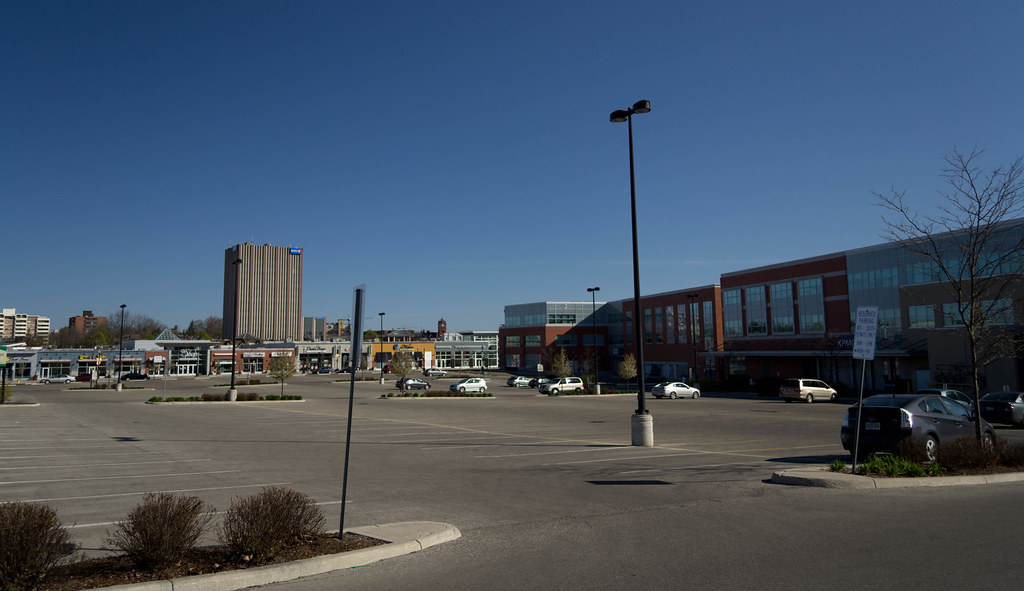
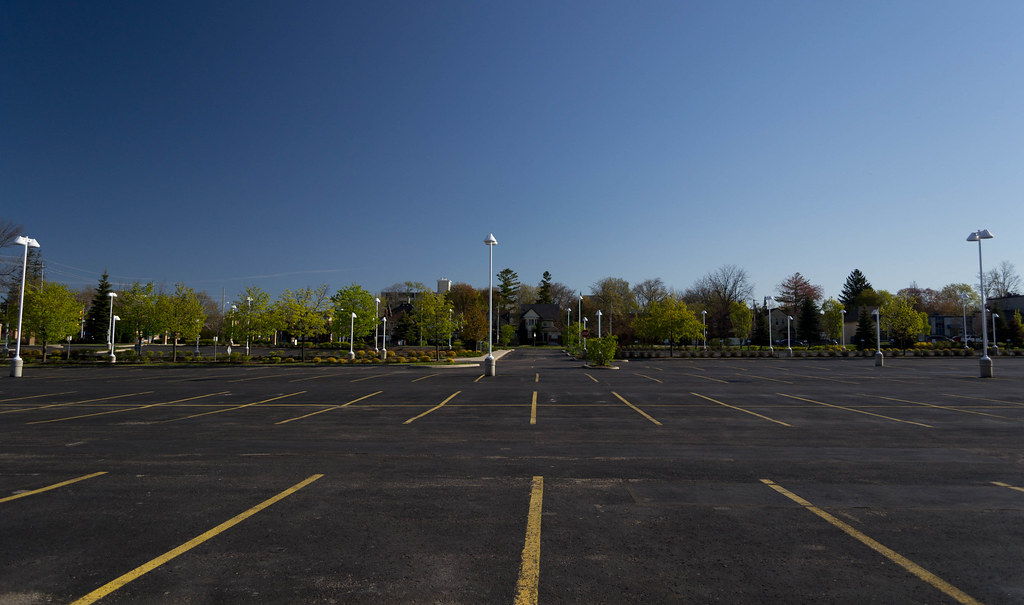
Ever been to the Sunrise centre? Have you parked at one store, shopped, and then driven to your next stop within the same plaza? I know I have. And the reasons are (a) there is an incredible abundance of parking that I can get close to each store, and (b) the incredible abundance of parking pushes all of these stores so far apart around a windswept, concrete expanse that I don't want to walk. These traits apply doubly for the ironically named "Boardwalk".
Cities in North America have mandated parking minimums built into their zoning rules for virtually every use, on the logic that a new development will increase the need for parking (which is often true). But parking is created in such quantities, and for singular purpose, that taken as a whole there is vastly more parking than we need in virtually all parts of our communities. And often when parking is tight, there is still plenty of supply available, but a territoriality (Parking for Customers Only!) that precludes using it.
That's just the supply side, and I'm not going to touch the demand side beyond suggesting you google "The High Cost of Free Parking" by Donald Shoup.
We're not yet at the point where our municipalities are ready to sit down and say "fine, no parking minimums". Our downtowns are (in my opinion) quite ready to let the market drive the amount of parking a new development should provide, but our governments are not ready to make the leap even for our densest, best transit-served areas. But the good news is, we are inching closer.
The Transit Hub at Victoria & King
Aiming to combine LRT, bus, GO, VIA and Greyhound all at the same
location-- along with residential and commercial uses, the block
bordered by King, Victoria, Duke and the CN tracks has (I believe) now
been zoned with a reduced parking minimum of 0.7 spots per dwelling unit
for the residential use. (There will also be parking for other purposes
at the site.)
This is important, because it will mean that many new residents at this location-- possibly the most accessible location without a car anywhere west of the GTA in Ontario-- will purchase units without a parking spot at all.
It also sets a precedent that Kitchener is open to negotiating on parking minimums. If the market doesn't justify a certain level of parking, developers will be happy to forgo the expense of it, and it appears that at King and Victoria at least, these conditions are expected to exist.
Interestingly, diagonally across the street is the One Victoria development. The company building this, too, is seeking reductions in parking minimums. If there's anywhere in KW this is justifiable, this corner that has access to All The Transit has got to be that place.
Now all the downtown needs is a supermarket.
Meanwhile, what's going on north of the border? Last we checked, Waterloo seemed to be struggling with its priorities, as the 155 Caroline project edges ever closer to approval, bringing to Uptown an overabundance of parking and a rerouting of the Iron Horse trail. In addition, the University neighbourhoods are sporting many a stucco-clad monstrosity, building after building of 5-bedroom student slums driven by existing zoning rules that drives a 1 parking spot per apartment minimum.
But wait... change is afoot. The first fruit of Waterloo's new Northdale zoning rules (which aren't properly in effect thanks to appeals to our ever-meddling OMB) are on the horizon.
300 Phillip Street, Waterloo
A new development is being proposed at the Ontario Seed location for a property package along Phillip that also reaches to Columbia Street. Four buildings are planned, along with significant surface parking. It doesn't look very inspiring, but it manages to do a lot of things right:
Mixed use, providing some actual street presence
Mixed unit sizes, with 1, 2 and 3 bedroom units that will have much broader appeal than 5-bedroom dormitory apartments
A reduced parking requirement of ~0.65 spots per unit.
Waterloo! I'm impressed! But how is this development possible?
The new zoning rules which (as I mentioned) are not in effect yet allow for a per-bed parking rate of 0.25. This allows for developments that are much more healthy than one full of five-bedroom units. Unfortunately, the 5br buildings we have accumulated will be a legacy we must live with for the next few decades.
The city and the developer have worked together to craft this proposal so that it could be considered as a zoning change. The result is a couple hundred fewer parking spots, as well as a design which brings a good street presence to Phillip and a mix of apartments that are in woefully short supply in this area. Bravo Waterloo.
The Community Building Strategy
The Central Transit Corridor project has published a draft Community Building Strategy report (available on their website). It is an impressive and comprehensive document, covering many aspects of how we can transform our city. A necessary component of the CBS is Transit Oriented Development (TOD), a set of guidelines that will allow central areas to intensify with better environments and a reduced emphasis on automobile travel. This includes reduced parking.
And it is not a moment too soon. The rapid transit project, as soon as it was passed by regional council in 2011, unleashed a lot of pent-up demand for development that had been holding its breath and waiting for a final decision.
Since then we have seen many interesting new developments, but also a few examples that aren't so flattering in light of what our goals are. The aforementioned 155 Caroline, as well as the "Northfield Station" project, are examples of Transit Proximate Development: denser development that fails to take advantage of transit, or contribute to making the place pedestrian friendly or accessible.
The CBS is badly needed: it must become a reality, and survive the transition from strategy to implementation. The sooner, the better.
Crossroads
The municipal staff and councils of Kitchener and Waterloo deserve a pat on the back and congratulation for the positive steps they have taken, but this is only the beginning.
We run the risk of intensifying in ways that undermine our urban environment, and leave us with a city that is still lacking at the human scale. We are in a period of precedent setting, where the pattern of future development can still be influenced by what we do now.
There are many positive steps being taken, and our local governments show they understand the challenge they face. And yet, there is still considerable danger that we will not rise to the challenge, that we let past habits and status quo bind us to obsolete and misguided goals.
Parking is just one small aspect of the complex interconnectedness of a modern city. Our need for it will not go away, but we must learn the difference between feeding this need, and legislated gluttony. All things in moderation, and that definitely includes parking. Otherwise, we are going to have a lot of trouble staying in shape... and getting around.
Heads up: the previous post on this topic contained a description of the proposed 2013 GRT improvements that has since been modified.
Here's the new map:
You may need to click through to see it in detail, or view the original PDF.
One big change: the 201 iXpress will not run to Blackberry campus. Instead the 202 iXpress will extend from RIM campus to Conestoga Mall.
This is a bit of a surprise, but the lesson is never assume something is final until it is final. Even this plan may be subject to change, based on public feedback, online or at one of the PCCs:
Monday, March 1812 p.m. to 4 p.m.
University of Waterloo
Student Life Centre, Great Hall
200 University Ave. W., Waterloo
Tuesday, March 194 p.m. to 8 p.m.
Kitchener Waterloo Bilingual School, Gymnasium
600 Erb St. W., Waterloo
Thursday, March 21 (This PCC will include information on the proposed 2013 Fare Change)
4 p.m. to 8 p.m.
Waterloo Mennonite Brethren Church, Chapel
245 Lexington Rd., Waterloo
Friday, March 22 (This PCC will include information on the proposed 2013 Fare Change)
12 p.m. to 4 p.m.
Wilfrid Laurier University
Fred Nichols Campus Centre, Concourse
75 University Ave. W., Waterloo
Attention: Details of this post are now out of date. Please see the updated details here.
The latest regional council Planning & Works agenda contain details of GRT's proposed service improvements for later this year. I wrote about this previously when multiple options were being presented to the public. They've taken in the feedback, and are now coming back with a single proposal for public consultation.
And, it is good. Very, very good.
(You'll probably need to click through to see it legibly.)
Grand River Transit has taken feedback to heart, especially from those of us who encourage them to look for opportunities to move our transit routing strategy away from hub-and-spoke and towards grids. Here's how they have done so:
Route 35 provides very direct north-south service along Bridge and Lancaster, with time-wasting loops cut out.
Route 6 trades its Downtown Kitchener destination for Uptown Waterloo, and interlined with the 5, it provides a solid east-west gridline.
Route 31 runs virtually all of Columbia/Lexington right across town: it no longer enters U of W campus.
Of course, there is also the major addition of the University Avenue express, which doesn't quite stick to University Ave in the west end but still cuts an easily understood path across town. 201 iXpress is also extended, to cover the densest portions of Columbia before turning towards Conestoga Mall and Northfield. This route is a little ideosyncratic but may improve the usefulness of this route that currently looped back at the universities.
And crucially, each will cross the LRT line, though some work must be done to provide a sensible transfer at U of W campus.
Overall, this is a solid set of improvements. But like all route changes, it will inconvenience some who may have located themselves to benefit from the existing route structure. Still, many of them will still have access to transit, and new alternatives available. And many more will be in a position to take advantage of transit. For instance, one coworker of mine has already happily observed that his home near Columbia/Westmount now has transit options to our workplace near Bridge/Northfield.
(These improvements are extremely good news for Bridge/Northfield, especially in light of plans to develop a multi-use node at this location. Large portions of the surrounding area will have transit access to this point, though it remains to be seen if people will take advantage of it in this very car-oriented suburban part of Waterloo.)
Good job GRT!
If you want to read more, TriTAG has a writeup on the proposal here. Also, here is the list of proposed stop locations for both iXpress routes, mostly sticking to their 400m stop placement minimum: