Well, it's approved.
Committees, lawsuits, submarine motions and council votes. Letters to the editor, blog posts, newsletters, emails to reps, calls to action. Misinformation, disinformation, feet in mouths and FUD. Meetings, phone calls, rumours and mysteries.
Done. For now, at least.
All of this is about establishing the foundation for a better transit system, the basis for moving around the region for the next half a century. That's all. Seems like so much struggle for such a comparatively simple thing. Why is it such a fight? How are we so conflicted about this?
With everything happening around us, how can we look each other in the eye and say "no, we don't want to react to change"? How do we consistently get stuck on this simple topic of how to move people around and make a war out of it, while we give a free pass to all the other monumental costs that come with civilized society?
What makes us so mad about transit?
We need to work this one out. Today we've cleared the hurdle, but it was a close run thing. We face many of the same hurdles to come.
How can we keep making progress on this track if we are at war with ourselves?

Wednesday, March 19, 2014

Thursday, March 13, 2014
Transit for Cambridge: everyone's on board, almost.
Councillor Jane Mitchell recently laid out why Cambridge is where it is when it comes to transit, and why Mayor Craig's motion to area-rate Cambridge out of paying for LRT (rationalized as Cambridge isn't "getting anything out of it") displays an astonishingly selective memory on his part.
As Mitchell points out, Cambridge's transit has been pulled up by its metaphorical bootstraps since the region took it over. Before then, according to Cambridge regional councillor Brewer, it was raided for funds whenever things were tight. Since the formation of GRT as a regional transit entity, Cambridge has seen a huge service increase (more than doubled) while ridership in Cambridge has more than tripled.
It seems like Cambridge residents are interested in transit. It seems like the region is interested in bringing transit to the residents of Cambridge. But is Cambridge's own leadership interested?
Read Councillor Mitchell's post.
As Mitchell points out, Cambridge's transit has been pulled up by its metaphorical bootstraps since the region took it over. Before then, according to Cambridge regional councillor Brewer, it was raided for funds whenever things were tight. Since the formation of GRT as a regional transit entity, Cambridge has seen a huge service increase (more than doubled) while ridership in Cambridge has more than tripled.
It seems like Cambridge residents are interested in transit. It seems like the region is interested in bringing transit to the residents of Cambridge. But is Cambridge's own leadership interested?
Read Councillor Mitchell's post.
Thursday, March 6, 2014
Reading for comprehension
First off, I Am Not a Lawyer. I do, however, practice reading for comprehension.
For those of you wondering about a certain Waterloo businessman's threat of legal challenge against LRT, based on the claim that it violates the region's current official plan, I offer you this:
That's from "Amendment No. 26 - Introduction of New Transit and Rapid Transit Policies and Mapping" to the Regional Official Policies Plan. This is the plan in effect right now, as the new regional official plan (which also provides for rapid transit) is in legal limbo due to the appeal of an OMB challenge. The amendment was approved and adopted in 2007.
The claim against the region is that this rapid transit project violates Section 24 of the Ontario Planning Act which basically says all public works must conform with the official plan. The claim seems built on the fact that the new 2009 plan provides for rapid transit but it's not in effect, along with an impression that the old plan does not provide for rapid transit.
So what's the deal? Is there something else up this person's sleeve? Hard to rule out the possibility that sufficiently motivated lawyers may dredge up some loophole, but at the same time it beggars belief that a public project could be so easily tied up by a single disgruntled citizen with lawyers in tow. Especially a public project like this, more than a decade in the making.
What's worse, this person can still attempt to pursue this case, and our tax money will be spent defending it.
Well, the regional government is acting like there's nothing to be concerned about. I hope they're right. We've waited too long for this.
Edit: this CBC article includes a legal letter that states,
I'm sure lawyers will be getting a workout.
Edit again: Waterloo Chronicle has a statement from Chair Seiling regarding the region's opinion.
For those of you wondering about a certain Waterloo businessman's threat of legal challenge against LRT, based on the claim that it violates the region's current official plan, I offer you this:
11.2.3 The Regional Municipality of Waterloo, in conjunction with Area Municipalities as appropriate, will promote increased transit ridership, walking and cycling and reduce the need to make trips by automobile through such means as:
a) the provision of rapid transit service within the Central Transit Corridor with linkages to other transit corridors and nodes;
(...)
That's from "Amendment No. 26 - Introduction of New Transit and Rapid Transit Policies and Mapping" to the Regional Official Policies Plan. This is the plan in effect right now, as the new regional official plan (which also provides for rapid transit) is in legal limbo due to the appeal of an OMB challenge. The amendment was approved and adopted in 2007.
The claim against the region is that this rapid transit project violates Section 24 of the Ontario Planning Act which basically says all public works must conform with the official plan. The claim seems built on the fact that the new 2009 plan provides for rapid transit but it's not in effect, along with an impression that the old plan does not provide for rapid transit.
So what's the deal? Is there something else up this person's sleeve? Hard to rule out the possibility that sufficiently motivated lawyers may dredge up some loophole, but at the same time it beggars belief that a public project could be so easily tied up by a single disgruntled citizen with lawyers in tow. Especially a public project like this, more than a decade in the making.
What's worse, this person can still attempt to pursue this case, and our tax money will be spent defending it.
Well, the regional government is acting like there's nothing to be concerned about. I hope they're right. We've waited too long for this.
Edit: this CBC article includes a legal letter that states,
"The ROPPA 26 rapid transit policies currently in effect contemplates a further official plan amendment. Accordingly, entering into a contract which commits the Region to the construction and operation of the LRT does not conform to the existing policy framework."So they're claiming that this part of the plan can't be pursued without the contemplated amendments, and the new plan is not in effect. I took a look. Amendment 26 says:
"This amendment will be implemented through the future approval of further amendments to this plan, amendments to the affected area municipal official plans and the approvals process for development applications in areas where application of the new and/or revised policies is appropriate." (emphasis mine)Does that mean we need more amendments before rapid transit is enshrined in the official plan? The lawyers writing that letter seem to think so. But arguments about Oxford Commas aside, there's a lot of wiggle room in the bolded text above.
I'm sure lawyers will be getting a workout.
Edit again: Waterloo Chronicle has a statement from Chair Seiling regarding the region's opinion.
Tuesday, February 25, 2014
For want of a sidewalk
Okay, I admit, I'm not one to tolerate cognitive dissonance in others for very long. I want to dissect it until the internally conflicted belief or viewpoint is cut open for all to see. I can cut pretty deep, too.
And occasionally, I do it to myself (and that's what really hurts, as the song goes.) In a fit of honesty, this time I'll do it out in the open.
Last night, I spoke at Waterloo city council on behalf of TriTAG, generally supporting a plan that will see Lexington Road gain new bike infrastructure, and sidewalks on one side of the road where none exist at all today. I did take some time to talk about how sidewalks on only one side are "a compromise" and "the bare minimum" but generally we gave Waterloo a pass. A mature neighbourhood, after all. Limited budget. It's understandable.
At the same time, mood among TriTAG members has been far less charitable towards the city of Kitchener. In January, city council there decided to go against staff recommendations and cancel plans for adding sidewalks to the unimproved side of Glasgow St. after local residents showed up to make their case against it. Yesterday, council chose to defer an item regarding sidewalks on the bare side of Palmer and Kennedy streets, near the Courtland Ave. Schneiders plant. The item will be revisited on Monday so that local residents have more chance to react.
On their own, these two data points show a disturbing trend: Kitchener city council seems willing to be pushed off sidewalk infill projects on streets that already have some minimal infra.
You probably see where I'm going with this, but I should get one thing out of the way before I get to the meat of the matter. Sidewalks on both sides should be the goal on all city streets. Basic pedestrian infrastructure that accesses all destinations are the first steps to creating a walkable city, and missing sidewalks on one side are a barrier to this. The busier the street (and Glasgow is quite a busy street, complete with transit service!) the more important this becomes. The people who you see satisfied with sidewalks on just one side are not the people who you should be thinking about when you eschew access to the other.
Right! Now that we've got that out of the way, I'll address the elephant at the room: it's not fair to excoriate Kitchener councilors for failing to implement second sidewalks on Glasgow St. when I give a thumbs up to Waterloo for a plan that falls short of providing second sidewalks for Lexington Road. Furthermore, deferral on Kennedy and Palmer is not cancellation.
So to councilors Glenn-Graham & Davey and mayor Zehr: I apologize. In speaking to each of them, I learned that they all intended to uphold the pedestrian charter and approve additional sidewalks unless there are real legitimate reasons not to. Okay then. We'll see how Monday plays out, but I should have given the benefit of the doubt.
Still, I am concerned that Kitchener has opened a Pandora's box, because new sidewalks are always a hot-button issue. One one hand, we need a rich pedestrian network to make a place walkable and we benefit from it. But on the other, sidewalks on our own property are a maintenance burden (because the public will to pay for municipal sidewalk clearing in the winter has not been there) and backfitting sidewalks in mature neighbourhoods often comes at the cost of mature trees, to say nothing of landowners' sense of ownership and privacy.
Furthermore, we made a mess of things a couple of decades ago, going through a phase of extreme car-centrism where we talked ourselves out of a lot of sidewalks. So we're playing catch-up more than we should need to.
So there's a strong local incentive to fight sidewalk infill tooth and nail, despite the fact that we benefit as an inclusive, equitable society to get those missing links corrected. If a city government makes its values crystal clear-- we will fill in sidewalks when the opportunities present because we will provide pedestrian access to all parts of the city as a basic right-- then expectations are set, and those who insist that the city compromise its own values for their personal benefit will not be able to disguise their true motives.
If instead, the city seems willing to grant exceptions if pressed, they will be pressed every time this topic comes up. I think Kitchener will see that for Kennedy/Palmer next week, and with other projects in the future.
Councilors who come to the table with the mindset that sidewalks on both sides of the street are not always a necessity are missing the point that even cases they think are marginal may be worth supporting because it will make the entire strategy easier to defend. They should consider sidewalks on both sides of the street as the expected outcome of any project improving the area, and compromise on that principle only under very extraordinary circumstances. Sidewalk infill should not be done only when it's convenient and nobody minds, or we will all lose.
Would that viewpoint make Kitchener councilors view Glasgow St. differently? I don't know. Should we expect it to change the Waterloo plan for Lexington? At least there we saw a concerted effort to mitigate the impact of one-side sidewalks, but fundamentally these two situations are not that different.
I don't think we should be satisfied with either situation. Waterloo got a pass because they demonstrated forward motion, bringing minimal infrastructure where it was completely absent, but that doesn't change the fact that they compromised. And as for Kitchener? We need to trust that councilors will stay true to the city's pedestrian charter, think critically about each project calling for sidewalk infill... and not lose sight of the big picture.
Trust, but verify. The first test will come Monday.
And occasionally, I do it to myself (and that's what really hurts, as the song goes.) In a fit of honesty, this time I'll do it out in the open.
Last night, I spoke at Waterloo city council on behalf of TriTAG, generally supporting a plan that will see Lexington Road gain new bike infrastructure, and sidewalks on one side of the road where none exist at all today. I did take some time to talk about how sidewalks on only one side are "a compromise" and "the bare minimum" but generally we gave Waterloo a pass. A mature neighbourhood, after all. Limited budget. It's understandable.
 |
| And who wants their kids walking to school along this? |
At the same time, mood among TriTAG members has been far less charitable towards the city of Kitchener. In January, city council there decided to go against staff recommendations and cancel plans for adding sidewalks to the unimproved side of Glasgow St. after local residents showed up to make their case against it. Yesterday, council chose to defer an item regarding sidewalks on the bare side of Palmer and Kennedy streets, near the Courtland Ave. Schneiders plant. The item will be revisited on Monday so that local residents have more chance to react.
On their own, these two data points show a disturbing trend: Kitchener city council seems willing to be pushed off sidewalk infill projects on streets that already have some minimal infra.
You probably see where I'm going with this, but I should get one thing out of the way before I get to the meat of the matter. Sidewalks on both sides should be the goal on all city streets. Basic pedestrian infrastructure that accesses all destinations are the first steps to creating a walkable city, and missing sidewalks on one side are a barrier to this. The busier the street (and Glasgow is quite a busy street, complete with transit service!) the more important this becomes. The people who you see satisfied with sidewalks on just one side are not the people who you should be thinking about when you eschew access to the other.
 |
| Nothing says "Make transit welcoming" like a bus stop on someone's lawn. |
Right! Now that we've got that out of the way, I'll address the elephant at the room: it's not fair to excoriate Kitchener councilors for failing to implement second sidewalks on Glasgow St. when I give a thumbs up to Waterloo for a plan that falls short of providing second sidewalks for Lexington Road. Furthermore, deferral on Kennedy and Palmer is not cancellation.
So to councilors Glenn-Graham & Davey and mayor Zehr: I apologize. In speaking to each of them, I learned that they all intended to uphold the pedestrian charter and approve additional sidewalks unless there are real legitimate reasons not to. Okay then. We'll see how Monday plays out, but I should have given the benefit of the doubt.
Still, I am concerned that Kitchener has opened a Pandora's box, because new sidewalks are always a hot-button issue. One one hand, we need a rich pedestrian network to make a place walkable and we benefit from it. But on the other, sidewalks on our own property are a maintenance burden (because the public will to pay for municipal sidewalk clearing in the winter has not been there) and backfitting sidewalks in mature neighbourhoods often comes at the cost of mature trees, to say nothing of landowners' sense of ownership and privacy.
 |
| While Palmer is quieter than Glasgow or Lexington, it does connect to the Iron Horse Trail. |
Furthermore, we made a mess of things a couple of decades ago, going through a phase of extreme car-centrism where we talked ourselves out of a lot of sidewalks. So we're playing catch-up more than we should need to.
So there's a strong local incentive to fight sidewalk infill tooth and nail, despite the fact that we benefit as an inclusive, equitable society to get those missing links corrected. If a city government makes its values crystal clear-- we will fill in sidewalks when the opportunities present because we will provide pedestrian access to all parts of the city as a basic right-- then expectations are set, and those who insist that the city compromise its own values for their personal benefit will not be able to disguise their true motives.
If instead, the city seems willing to grant exceptions if pressed, they will be pressed every time this topic comes up. I think Kitchener will see that for Kennedy/Palmer next week, and with other projects in the future.
 |
| What's special about this stretch of Stirling, that we kick pedestrians over to the other side? |
Councilors who come to the table with the mindset that sidewalks on both sides of the street are not always a necessity are missing the point that even cases they think are marginal may be worth supporting because it will make the entire strategy easier to defend. They should consider sidewalks on both sides of the street as the expected outcome of any project improving the area, and compromise on that principle only under very extraordinary circumstances. Sidewalk infill should not be done only when it's convenient and nobody minds, or we will all lose.
Would that viewpoint make Kitchener councilors view Glasgow St. differently? I don't know. Should we expect it to change the Waterloo plan for Lexington? At least there we saw a concerted effort to mitigate the impact of one-side sidewalks, but fundamentally these two situations are not that different.
I don't think we should be satisfied with either situation. Waterloo got a pass because they demonstrated forward motion, bringing minimal infrastructure where it was completely absent, but that doesn't change the fact that they compromised. And as for Kitchener? We need to trust that councilors will stay true to the city's pedestrian charter, think critically about each project calling for sidewalk infill... and not lose sight of the big picture.
Trust, but verify. The first test will come Monday.
Saturday, February 1, 2014
Light Rail approaches its last big hurdle
In 2011, I blogged extensively about the decision-making process that led to the approval of Light Rail in Waterloo region. That decision set in motion years of groundwork required before construction could start in earnest. But planning and preparation is almost complete. It's almost time to build!
 The bids for construction are in. On March 4th, the rapid transit team will bring their recommendation to the Planning and Works committee. This will be the point at which we find out who the preferred bidder was, and what construction cost will be, and whether council intends to approve it.
There has been a vocal element in our community who has campaigned non-stop to derail this plan. While some of them are simply concerned about the amount of money being spent, a considerable number will say pretty much anything to tarnish the case for LRT, including outright misrepresentation of how the system works and welcoming cancellation penalties some kind of perverse morality object lesson.
And yet, as I wrote for TriTAG recently, the fundamentals supporting LRT have never looked stronger. Go ahead and read that if you'd like to learn more about the change that has happened so far. Basically, the short version is: service is expanding. Ridership is booming. This is working.
But it's also important to remember that LRT is a key element in a multi-faceted plan to grow Waterloo region in a smart and sustainable way. The affordability of our community in the future depends on how we build now. We face a decision: grow up, or grow out. The Active Transportation Master Plan is up for council approval this month, and it is focused on providing the region with better walkability, and the ability to make short trips on foot and by bike. The broader Regional Transporation Master Plan, which includes a transit network redesign to coincide with LRT, aims to flesh out a transportation network to give thousands an alternative to driving.
But LRT is the single biggest (and admittedly, most costly) piece of the puzzle, and the one with the highest level of expectation tied to it. It is not meant to just serve demand, but also to shape our city to generate it. By providing a high quality level of service, convenience and permanence, Light Rail is already drawing lots of interest for people to live and work along its route and closer to downtowns.
This growth in our core translates into fewer greenfield subdivisions, which directly improves our traffic situation within existing suburban areas. It also lowers the overall reliance on transportation by car, which again means less demand on our road infrastructure, and fewer costly expansions. By shaping our growth in this way, LRT will cost less than doing nothing at all because we don't actually have an option to "do nothing at all".
Now, this one light rail line is not perfect (I've criticized aspects of it before) and it will not change the world on its own. As I said before, there are other pieces to this puzzle. They are all important. But it's safe to say that LRT is the linchpin. Without it, everything else we do will have much more muted success. If we blink now, it will be many years before we get a do over. We'll eventually find ourselves drawn back to something like it, because of the fundamentals and the way our region is laid out. But it will inevitably cost more, and we will be fearful of taking the steps we have to, because of our failure to face the future.
I, for one, would like to stop talking about LRT. Having approved it twice, there's no good reason for council to change their minds this third time. But the vocal minority grows more vocal and strident, and they still offer no real solution of their own, only the false reassurance that nothing will change. Someone has to say something. But I look forward to having construction underway, and to be able to step back and tackle new challenges.
So, if you support this plan, please, contact your councilors and tell them.
If you're on the fence, or wonder why I keep going on about this, I urge you to recognize this: We have a thoughtful and progressive regional government that are trying very hard to prepare Waterloo region for the future, with a vision that very few other cities aspire to. It's part of our culture here, to be industrious, to adapt, and to innovate. Ultimately, we have to be ready to sign off on the plan, and take the next step.
LRT is our next step. It's a big one. Come with us.
There has been a vocal element in our community who has campaigned non-stop to derail this plan. While some of them are simply concerned about the amount of money being spent, a considerable number will say pretty much anything to tarnish the case for LRT, including outright misrepresentation of how the system works and welcoming cancellation penalties some kind of perverse morality object lesson.
 |
| Transit crowd at Conestoga mall wait for a train "from nowhere to nowhere" |
 |
| The new reality along our central transit corridor |
But it's also important to remember that LRT is a key element in a multi-faceted plan to grow Waterloo region in a smart and sustainable way. The affordability of our community in the future depends on how we build now. We face a decision: grow up, or grow out. The Active Transportation Master Plan is up for council approval this month, and it is focused on providing the region with better walkability, and the ability to make short trips on foot and by bike. The broader Regional Transporation Master Plan, which includes a transit network redesign to coincide with LRT, aims to flesh out a transportation network to give thousands an alternative to driving.
But LRT is the single biggest (and admittedly, most costly) piece of the puzzle, and the one with the highest level of expectation tied to it. It is not meant to just serve demand, but also to shape our city to generate it. By providing a high quality level of service, convenience and permanence, Light Rail is already drawing lots of interest for people to live and work along its route and closer to downtowns.
 |
| 1 Victoria, one of many developments green-lit after LRT approval |
This growth in our core translates into fewer greenfield subdivisions, which directly improves our traffic situation within existing suburban areas. It also lowers the overall reliance on transportation by car, which again means less demand on our road infrastructure, and fewer costly expansions. By shaping our growth in this way, LRT will cost less than doing nothing at all because we don't actually have an option to "do nothing at all".
Now, this one light rail line is not perfect (I've criticized aspects of it before) and it will not change the world on its own. As I said before, there are other pieces to this puzzle. They are all important. But it's safe to say that LRT is the linchpin. Without it, everything else we do will have much more muted success. If we blink now, it will be many years before we get a do over. We'll eventually find ourselves drawn back to something like it, because of the fundamentals and the way our region is laid out. But it will inevitably cost more, and we will be fearful of taking the steps we have to, because of our failure to face the future.
 |
| Public support of LRT in 2011 |
I, for one, would like to stop talking about LRT. Having approved it twice, there's no good reason for council to change their minds this third time. But the vocal minority grows more vocal and strident, and they still offer no real solution of their own, only the false reassurance that nothing will change. Someone has to say something. But I look forward to having construction underway, and to be able to step back and tackle new challenges.
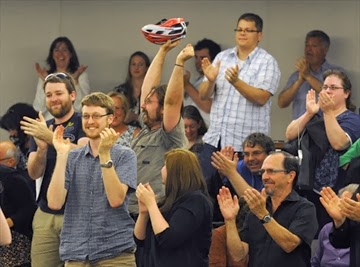 |
| Council approved LRT in 2009, and as seen here, in 2011 (to great appluase) |
So, if you support this plan, please, contact your councilors and tell them.
If you're on the fence, or wonder why I keep going on about this, I urge you to recognize this: We have a thoughtful and progressive regional government that are trying very hard to prepare Waterloo region for the future, with a vision that very few other cities aspire to. It's part of our culture here, to be industrious, to adapt, and to innovate. Ultimately, we have to be ready to sign off on the plan, and take the next step.
LRT is our next step. It's a big one. Come with us.
Thursday, January 16, 2014
The tragic problem of local speeders
There's been some friction regarding Auburn Street in Waterloo between the city and the local residents regarding traffic calming measures. This post is not about that.
This is about Councilor Mark Whaley's quote at the end of the linked article, regarding the problem of drivers speeding along this residential street:
This touches off something I remember from a Kitchener city council discussion on raised crosswalks for Williamsburg Road. Council observed that because 92% of traffic was local, the speeders must be among the same local residents calling for traffic calming. Some people have expressed the sentiment that instead of calling for traffic calming, local residents should just drive slower in their own neighbourhood.
It's obvious, isn't it? It's despicable that someone would speed in their own neighbourhood, on the same streets their own kids may be crossing. If we could only get people to see that, they'd drive slower and more carefully, at least on their home turf. Right?
But that idea leaves me feeling a little hollow. Why, for instance, is there not a similar outrage to drivers who speed through the neighbourhoods of others? If it's despicable to endanger your own kids, why is it not considered as bad (or worse) to endanger a stranger's family?
And then, of course, there's the troublesome issue that asking people to drive more slowly... doesn't work. Nor does arbitrarily reducing speed limits (at least, not without taking other steps.) We tend to drive on streets at the speed we feel comfortable at. On wide open roads with no parked cars, gentle sweeping turns and few obstructions, we naturally drive fast-- often faster than the posted limit.
It doesn't matter where we are, and whose kids are crossing the road. Perhaps near home, our comfort level goes up with familiarity, and we speed up a little, take corners we've taken a hundred times before a little faster. But we can't stop that by wishing it away.
Unfortunately, as the cliche goes, speed kills. If we could reduce vehicle speeds, especially on neighbourhood roads, not only would accidents be more avoidable, but they'd also be less lethal. So how do we really get people to slow down?
The answer lies mainly in the design of our streets, and the ways that design can influence our behaviour. Some design measures, like speed bumps, have serious unintentional effects in impeding and damaging transit and fire vehicles. But other measures exist: steps like narrowing the roadway, providing crossing islands, or reducing crossing distances at intersections with neckdowns can cause us to unconsciously drive a little slower.
The presence of on-street parking in a tighter environment also contributes to an instinctive lightening of the gas pedal. Unfortunately, in suburban neighbourhoods, that can be impeded by the design of the houses themselves reducing the amount of room to park along the curb.
It's important to note that these measures can all help, but we don't really have a silver bullet. There has been growing talk in North American cities that we'd be better off with a 30km/h speed limit (as well as the predictable knee-jerk reactions against it) but that's the cart, not the horse. To actually be able to change a city speed limit, the streets in our city must first bring traffic down to that number by design. Which helps explain why complete streets, and rightsizing of overbuilt roadways, are all important.
So it's good to note that while some measures have been rolled back due to residents' objections, some of the Auburn Street calming measures (such as raised crosswalks) will still proceed.
Even then, traffic calming won't be enough on its own. A family member has pointed out his tree-lined, parking-lined, narrowed and speed humped street with a 30km/h speed limit as a place where, despite all these measures, some people still drive like idiots. Maybe these measures help to alleviate the problem, but they can't solve it.
So maybe, for lack of any magic bullet improvement, we should still ask people to drive safely. It can't hurt. Can it?
This is about Councilor Mark Whaley's quote at the end of the linked article, regarding the problem of drivers speeding along this residential street:
"We know that most of the speeders are those who live in the neighbourhood. It's frustrating."
 |
| How could anyone be speeding past that obvious "children playing" sign? |
This touches off something I remember from a Kitchener city council discussion on raised crosswalks for Williamsburg Road. Council observed that because 92% of traffic was local, the speeders must be among the same local residents calling for traffic calming. Some people have expressed the sentiment that instead of calling for traffic calming, local residents should just drive slower in their own neighbourhood.
It's obvious, isn't it? It's despicable that someone would speed in their own neighbourhood, on the same streets their own kids may be crossing. If we could only get people to see that, they'd drive slower and more carefully, at least on their home turf. Right?
But that idea leaves me feeling a little hollow. Why, for instance, is there not a similar outrage to drivers who speed through the neighbourhoods of others? If it's despicable to endanger your own kids, why is it not considered as bad (or worse) to endanger a stranger's family?
And then, of course, there's the troublesome issue that asking people to drive more slowly... doesn't work. Nor does arbitrarily reducing speed limits (at least, not without taking other steps.) We tend to drive on streets at the speed we feel comfortable at. On wide open roads with no parked cars, gentle sweeping turns and few obstructions, we naturally drive fast-- often faster than the posted limit.
It doesn't matter where we are, and whose kids are crossing the road. Perhaps near home, our comfort level goes up with familiarity, and we speed up a little, take corners we've taken a hundred times before a little faster. But we can't stop that by wishing it away.
 |
| (UK DOT 1987, via SRTS) |
Unfortunately, as the cliche goes, speed kills. If we could reduce vehicle speeds, especially on neighbourhood roads, not only would accidents be more avoidable, but they'd also be less lethal. So how do we really get people to slow down?
The answer lies mainly in the design of our streets, and the ways that design can influence our behaviour. Some design measures, like speed bumps, have serious unintentional effects in impeding and damaging transit and fire vehicles. But other measures exist: steps like narrowing the roadway, providing crossing islands, or reducing crossing distances at intersections with neckdowns can cause us to unconsciously drive a little slower.
 |
| Neckdowns make crossing easier and turning vehicles slower. (via Streetsblog) |
The presence of on-street parking in a tighter environment also contributes to an instinctive lightening of the gas pedal. Unfortunately, in suburban neighbourhoods, that can be impeded by the design of the houses themselves reducing the amount of room to park along the curb.
It's important to note that these measures can all help, but we don't really have a silver bullet. There has been growing talk in North American cities that we'd be better off with a 30km/h speed limit (as well as the predictable knee-jerk reactions against it) but that's the cart, not the horse. To actually be able to change a city speed limit, the streets in our city must first bring traffic down to that number by design. Which helps explain why complete streets, and rightsizing of overbuilt roadways, are all important.
So it's good to note that while some measures have been rolled back due to residents' objections, some of the Auburn Street calming measures (such as raised crosswalks) will still proceed.
Even then, traffic calming won't be enough on its own. A family member has pointed out his tree-lined, parking-lined, narrowed and speed humped street with a 30km/h speed limit as a place where, despite all these measures, some people still drive like idiots. Maybe these measures help to alleviate the problem, but they can't solve it.
 | |
| It looks pretty nice. Maybe there's a Reckless Drivers Anonymous up the road? |
So maybe, for lack of any magic bullet improvement, we should still ask people to drive safely. It can't hurt. Can it?
Wednesday, December 4, 2013
Waterloo really does bike!
There's a lot going on in Waterloo for bikes. And I'm not just talking about Waterloo Bikes (though they'll come into it). Maybe when they took the fluorine out of the water, they put something else in, because change is afoot in Waterloo-- real physical change, and change in perspective.
Let's start with the changing attitudes. I've raised the Uptown Streetscape improvement plan before but this fall it came back to the public with a preferred option. One that included bike lanes and reduced traffic lanes. That on its own really says how far we've come! We can actually talk about converting uptown's King Street away from a 4-line thoroughfare, into a complete street serving all users.
But, as proposals go, it wasn't perfect. It's the barest of concessions to bikes and doesn't really provide a welcome cycling environment to attract serious use. So Graham Roe of Waterloo Bikes, as well as yours truly, both spent some time going over the possibilities of protected bike lanes in uptown Waterloo. I put together a detailed post up on TriTAG's blog, which led to a CBC radio spot to discuss the idea. Also, a lot of great conversations during and around the public consultation.
Graham has carried it further. He has spoken to the issue on radio as well, and even started and promoted a petition that edges towards one thousand signatures.
I think we've moved the needle on this one. But that is largely because it is an idea we're ready to seriously discuss, and a lot of people are realizing they'd bike if the infrastructure was accommodating. This matches what other cities have discovered-- just how many people would move around by bike if they felt it was safe and convenient.
And when you throw in a study which demonstrates the rise of alternative transportation in our uptown core, we can paint a picture of a city in transition, both in thought and action.
I might have accused Waterloo in the past of losing its mojo. It seems reports of its demise were greatly exaggerated.
But wait... there's more.
The city of Waterloo presented its latest public information centre on the so-called Interior Loop that I posted about before. Details and boards from the latest PIC are available on the city's website here.
Options have been condensed to concrete proposals and intentions. While the "Loop" aspect of the Interior Loop is still lacking a key piece on its north side, the rest of the trail has received very detailed, systematic examination.
We see consistent crossing treatments, strong signage, trail infill, realignments and surface improvements. All to create a navigable, accessible trail. It's hard not to like, but easy to underappreciate-- this kind of systematic standard-setting usually just doesn't happen.
Okay, so there's still a failure to address the Weber St. crossing of the Laurel trail north of Lincoln. Only marginal improvements will be delivered there this time round. But on the other hand, we have real improvements that will be delivered in 2014, and are already budgeted.
Some of the expected (by me) local resistance to trail improvements has not emerged. In fact, I've heard support for the all-important resurfacing of Hillside Park trail from local residents along warnings about flooding problems that need to be handled.
Winter maintenance is still not on the cards, though.
Meanwhile...
Waterloo continues to knock off deficiencies in its east-west network. Out in the west end, a $10M widening project will add lanes, roundabouts, sidewalks and "raised" bike lanes to Columbia between Fischer-Hallmann and Erbsville. This marks the first use of raised or separated bike lanes in Waterloo. There's some chatter about whether the 4-to-2 lane adjustment makes sense on this stretch, but I'll leave that for others to worry about. Hopefully Waterloo also learned to do bike lanes and roundabouts better than this dangerous setup.
East of the expressway, Lexington Road may see new sidewalks, bike lanes, and a multi-use trail between Davenport and University. The Public Information Centre for this is on Wednesday 11th December at Waterloo Mennonite Brethren Church (details). Can these changes be carried through successfully? It may depend on the reaction of residents on Lexington who may prefer to keep their streetscape as-is, if nobody else shows up.
I'll show up. Preserving "the look" and even a few trees can't trump basic human accessibility on foot. We're talking sidewalk on just one side, after all.
Of course, all this leaves an elephant in the room: the stretch of Lexington/Columbia between Davenport and King-- across the expressway, through four massively overspecced lanes, past a nasty choke point at Marsland and through busy Weber. This will be the hardest to deal with, but as I've pointed out before, the most necessary. Waterloo has already blinked once, but as the rest of this corridor comes together, it gets harder and harder to ignore.
What I'm wondering: with a proposed south-side multi-use trail east of the expressway, has someone tipped their hand? Does the city have something up their sleeve for overpass improvements? Has MTO softened their stance on bridge changes to improve walking and cycling?
That's what's great about living in these twin cities. We have two (or four, including Cambridge and the regional government) chances to see good things done well. Of course, it's also two (or four) times as hard getting broad sweeping improvements through region-wide. You take what you can get.
Today, though, Waterloo gets the spotlight. They're bringing some really positive change forward, and more exciting change seems tantalizingly close.
Let's make it happen.
Uptown Protected Bike Lanes?
Let's start with the changing attitudes. I've raised the Uptown Streetscape improvement plan before but this fall it came back to the public with a preferred option. One that included bike lanes and reduced traffic lanes. That on its own really says how far we've come! We can actually talk about converting uptown's King Street away from a 4-line thoroughfare, into a complete street serving all users.
But, as proposals go, it wasn't perfect. It's the barest of concessions to bikes and doesn't really provide a welcome cycling environment to attract serious use. So Graham Roe of Waterloo Bikes, as well as yours truly, both spent some time going over the possibilities of protected bike lanes in uptown Waterloo. I put together a detailed post up on TriTAG's blog, which led to a CBC radio spot to discuss the idea. Also, a lot of great conversations during and around the public consultation.
 |
| Protected bike lane on Kinzie in Chicago |
Graham has carried it further. He has spoken to the issue on radio as well, and even started and promoted a petition that edges towards one thousand signatures.
I think we've moved the needle on this one. But that is largely because it is an idea we're ready to seriously discuss, and a lot of people are realizing they'd bike if the infrastructure was accommodating. This matches what other cities have discovered-- just how many people would move around by bike if they felt it was safe and convenient.
 |
| Courtesy: Transitized |
And when you throw in a study which demonstrates the rise of alternative transportation in our uptown core, we can paint a picture of a city in transition, both in thought and action.
I might have accused Waterloo in the past of losing its mojo. It seems reports of its demise were greatly exaggerated.
But wait... there's more.
Waterloo Interior Loop is a Real Thing, except for the Loop part
The city of Waterloo presented its latest public information centre on the so-called Interior Loop that I posted about before. Details and boards from the latest PIC are available on the city's website here.
Options have been condensed to concrete proposals and intentions. While the "Loop" aspect of the Interior Loop is still lacking a key piece on its north side, the rest of the trail has received very detailed, systematic examination.
 |
| Just two of two dozen points of improvement. |
We see consistent crossing treatments, strong signage, trail infill, realignments and surface improvements. All to create a navigable, accessible trail. It's hard not to like, but easy to underappreciate-- this kind of systematic standard-setting usually just doesn't happen.
Okay, so there's still a failure to address the Weber St. crossing of the Laurel trail north of Lincoln. Only marginal improvements will be delivered there this time round. But on the other hand, we have real improvements that will be delivered in 2014, and are already budgeted.
Some of the expected (by me) local resistance to trail improvements has not emerged. In fact, I've heard support for the all-important resurfacing of Hillside Park trail from local residents along warnings about flooding problems that need to be handled.
Winter maintenance is still not on the cards, though.
Meanwhile...
Columbia St. W and Lexington Road Upgrades
Waterloo continues to knock off deficiencies in its east-west network. Out in the west end, a $10M widening project will add lanes, roundabouts, sidewalks and "raised" bike lanes to Columbia between Fischer-Hallmann and Erbsville. This marks the first use of raised or separated bike lanes in Waterloo. There's some chatter about whether the 4-to-2 lane adjustment makes sense on this stretch, but I'll leave that for others to worry about. Hopefully Waterloo also learned to do bike lanes and roundabouts better than this dangerous setup.
 | |
| DO NOT WANT |
East of the expressway, Lexington Road may see new sidewalks, bike lanes, and a multi-use trail between Davenport and University. The Public Information Centre for this is on Wednesday 11th December at Waterloo Mennonite Brethren Church (details). Can these changes be carried through successfully? It may depend on the reaction of residents on Lexington who may prefer to keep their streetscape as-is, if nobody else shows up.
I'll show up. Preserving "the look" and even a few trees can't trump basic human accessibility on foot. We're talking sidewalk on just one side, after all.
Of course, all this leaves an elephant in the room: the stretch of Lexington/Columbia between Davenport and King-- across the expressway, through four massively overspecced lanes, past a nasty choke point at Marsland and through busy Weber. This will be the hardest to deal with, but as I've pointed out before, the most necessary. Waterloo has already blinked once, but as the rest of this corridor comes together, it gets harder and harder to ignore.
What I'm wondering: with a proposed south-side multi-use trail east of the expressway, has someone tipped their hand? Does the city have something up their sleeve for overpass improvements? Has MTO softened their stance on bridge changes to improve walking and cycling?
What about Kitchener?
That's what's great about living in these twin cities. We have two (or four, including Cambridge and the regional government) chances to see good things done well. Of course, it's also two (or four) times as hard getting broad sweeping improvements through region-wide. You take what you can get.
Today, though, Waterloo gets the spotlight. They're bringing some really positive change forward, and more exciting change seems tantalizingly close.
Let's make it happen.
Subscribe to:
Posts (Atom)