I haven't posted here in a long while, because as the election got rolling, most of my energy went towards TriTAG, who I have been working with since 2012. Once again, we have a big LRT fight.
In the last few months, we've seen the rise of a well-funded anti-LRT crusade led by Jay Aissa. And as a result, it's the same old battles, the same old wounds reopened, and a lot more vitriol and no small amount of misinformation and unfounded arguments.
TriTAG's efforts this election were meant to be focused on the 2014 Election Candidate Survey, which has been very successful so far. That was back in the optimistic early days when we thought the election might be about tackling new issues. As time went on, it became clear that we needed to "mythbust the election" to deal directly with some of the myths being peddled by the crusaders.
On the eve of the election, I thought I would say a few words about why I got engaged with the LRT issue years ago, and why it continues to be the most important battle to win.
In 2011, we faced a choice between two very different solutions for "higher order transit". One was bus-based, and the other was rail-based. Despite the fact that LRT is more expensive, it appears to achieve its goals better: namely, shifting more people to public transit and also shifting development to focus on intensifying the core. It also provides better long term value by providing the capacity we'll need in a couple of decades.
I agreed that LRT was the better option, and that formed a large basis for my support. I also knew that to be successful, LRT alone isn't enough, but we need an entirely redesigned transit network supporting it. The fact that ION is not meant to stand alone and knowing what the central corridor would need to properly support a better bus network also made me favour it. But I also knew something else: that Light Rail would become a symbol for Waterloo Region. A symbol whose importance should not be dismissed.
We have a big problem in North America. We just don't really believe in transit. The car is king, and we can't really even conceive of how that will ever change. But time moves quickly, and as we've spent the last 60 years sprawling our cities ever outward, we need to spend the next 60 reshaping them to be viable, livable places.
Much more so than a rapid busway, light rail is a visible sign that we can alter a city's trajectory. It will be on almost every stock photo for the region, for UW, for Uptown and Downtown. It will quickly become an indelible part of our identity, and we will not tolerate anything less than success for it. Which means that LRT will open up the region to ongoing transit improvements. It will shift the attitudes of the entire population. That shift in mindset will also translate into ridership.
Whereas-- and here's the kicker-- it's unlikely that Bus Rapid Transit would be allowed to succeed.
Had we chosen BRT in 2011, I would be supporting it today. But it would face an uphill battle. The problem with BRT is its flexibility: a busway is a busway, sure... but too often, BRT systems are often watered down during the design phase. I have no doubt we'd face pressure here to cut the dedicated busway where it would be needed most. It's possible that the very definition of BRT, as a rapid bus operating on its own right of way, might even be rewritten by politicians unwilling to displace cars at all.
LRT, on the other hand, is much harder to erode. It stands a better chance of surviving to deliver on its promise.
I doubt that many of the anti-LRT crusaders are anything but just anti-transit. They'll tolerate what's there now, but if they can kill LRT while talking up BRT as "a much better option", I have no confidence they'll deliver anything like "gold standard" Bus Rapid Transit.
Helping Waterloo Region make a shift towards better mass transit is why I've been fighting so hard. We're really the first city in Ontario rolling out what transit expert Vukan Vuchic (see his Waterloo speech here) calls "medium capacity transit". LRT can bridge the gap (in terms of capacity, speed, and cost) between buses and subways, and there are half a dozen cities in Ontario that could benefit from it. But Toronto, which needs to get on building multiple LRT lines as the only affordable way to address its transit woes, has really poisoned the discussion with "Subways, subways, subways" and muddying the difference between LRT and mixed-traffic streetcars.
So it's on us. We can show the cities like London and Hamilton and Mississauga and Scarborough just how LRT can work. We can give form and value to something that some just can't imagine until they see it in action.
But first we have to finish building it.
Please vote on Monday. Vote for leaders who will make LRT a reality. A lot is riding on this train.

Showing posts with label rapid transit. Show all posts
Showing posts with label rapid transit. Show all posts
Sunday, October 26, 2014

Wednesday, March 19, 2014
Why is it a war?
Well, it's approved.
Committees, lawsuits, submarine motions and council votes. Letters to the editor, blog posts, newsletters, emails to reps, calls to action. Misinformation, disinformation, feet in mouths and FUD. Meetings, phone calls, rumours and mysteries.
Done. For now, at least.
All of this is about establishing the foundation for a better transit system, the basis for moving around the region for the next half a century. That's all. Seems like so much struggle for such a comparatively simple thing. Why is it such a fight? How are we so conflicted about this?
With everything happening around us, how can we look each other in the eye and say "no, we don't want to react to change"? How do we consistently get stuck on this simple topic of how to move people around and make a war out of it, while we give a free pass to all the other monumental costs that come with civilized society?
What makes us so mad about transit?
We need to work this one out. Today we've cleared the hurdle, but it was a close run thing. We face many of the same hurdles to come.
How can we keep making progress on this track if we are at war with ourselves?
Committees, lawsuits, submarine motions and council votes. Letters to the editor, blog posts, newsletters, emails to reps, calls to action. Misinformation, disinformation, feet in mouths and FUD. Meetings, phone calls, rumours and mysteries.
Done. For now, at least.
All of this is about establishing the foundation for a better transit system, the basis for moving around the region for the next half a century. That's all. Seems like so much struggle for such a comparatively simple thing. Why is it such a fight? How are we so conflicted about this?
With everything happening around us, how can we look each other in the eye and say "no, we don't want to react to change"? How do we consistently get stuck on this simple topic of how to move people around and make a war out of it, while we give a free pass to all the other monumental costs that come with civilized society?
What makes us so mad about transit?
We need to work this one out. Today we've cleared the hurdle, but it was a close run thing. We face many of the same hurdles to come.
How can we keep making progress on this track if we are at war with ourselves?
Thursday, March 13, 2014
Transit for Cambridge: everyone's on board, almost.
Councillor Jane Mitchell recently laid out why Cambridge is where it is when it comes to transit, and why Mayor Craig's motion to area-rate Cambridge out of paying for LRT (rationalized as Cambridge isn't "getting anything out of it") displays an astonishingly selective memory on his part.
As Mitchell points out, Cambridge's transit has been pulled up by its metaphorical bootstraps since the region took it over. Before then, according to Cambridge regional councillor Brewer, it was raided for funds whenever things were tight. Since the formation of GRT as a regional transit entity, Cambridge has seen a huge service increase (more than doubled) while ridership in Cambridge has more than tripled.
It seems like Cambridge residents are interested in transit. It seems like the region is interested in bringing transit to the residents of Cambridge. But is Cambridge's own leadership interested?
Read Councillor Mitchell's post.
As Mitchell points out, Cambridge's transit has been pulled up by its metaphorical bootstraps since the region took it over. Before then, according to Cambridge regional councillor Brewer, it was raided for funds whenever things were tight. Since the formation of GRT as a regional transit entity, Cambridge has seen a huge service increase (more than doubled) while ridership in Cambridge has more than tripled.
It seems like Cambridge residents are interested in transit. It seems like the region is interested in bringing transit to the residents of Cambridge. But is Cambridge's own leadership interested?
Read Councillor Mitchell's post.
Thursday, March 6, 2014
Reading for comprehension
First off, I Am Not a Lawyer. I do, however, practice reading for comprehension.
For those of you wondering about a certain Waterloo businessman's threat of legal challenge against LRT, based on the claim that it violates the region's current official plan, I offer you this:
That's from "Amendment No. 26 - Introduction of New Transit and Rapid Transit Policies and Mapping" to the Regional Official Policies Plan. This is the plan in effect right now, as the new regional official plan (which also provides for rapid transit) is in legal limbo due to the appeal of an OMB challenge. The amendment was approved and adopted in 2007.
The claim against the region is that this rapid transit project violates Section 24 of the Ontario Planning Act which basically says all public works must conform with the official plan. The claim seems built on the fact that the new 2009 plan provides for rapid transit but it's not in effect, along with an impression that the old plan does not provide for rapid transit.
So what's the deal? Is there something else up this person's sleeve? Hard to rule out the possibility that sufficiently motivated lawyers may dredge up some loophole, but at the same time it beggars belief that a public project could be so easily tied up by a single disgruntled citizen with lawyers in tow. Especially a public project like this, more than a decade in the making.
What's worse, this person can still attempt to pursue this case, and our tax money will be spent defending it.
Well, the regional government is acting like there's nothing to be concerned about. I hope they're right. We've waited too long for this.
Edit: this CBC article includes a legal letter that states,
I'm sure lawyers will be getting a workout.
Edit again: Waterloo Chronicle has a statement from Chair Seiling regarding the region's opinion.
For those of you wondering about a certain Waterloo businessman's threat of legal challenge against LRT, based on the claim that it violates the region's current official plan, I offer you this:
11.2.3 The Regional Municipality of Waterloo, in conjunction with Area Municipalities as appropriate, will promote increased transit ridership, walking and cycling and reduce the need to make trips by automobile through such means as:
a) the provision of rapid transit service within the Central Transit Corridor with linkages to other transit corridors and nodes;
(...)
That's from "Amendment No. 26 - Introduction of New Transit and Rapid Transit Policies and Mapping" to the Regional Official Policies Plan. This is the plan in effect right now, as the new regional official plan (which also provides for rapid transit) is in legal limbo due to the appeal of an OMB challenge. The amendment was approved and adopted in 2007.
The claim against the region is that this rapid transit project violates Section 24 of the Ontario Planning Act which basically says all public works must conform with the official plan. The claim seems built on the fact that the new 2009 plan provides for rapid transit but it's not in effect, along with an impression that the old plan does not provide for rapid transit.
So what's the deal? Is there something else up this person's sleeve? Hard to rule out the possibility that sufficiently motivated lawyers may dredge up some loophole, but at the same time it beggars belief that a public project could be so easily tied up by a single disgruntled citizen with lawyers in tow. Especially a public project like this, more than a decade in the making.
What's worse, this person can still attempt to pursue this case, and our tax money will be spent defending it.
Well, the regional government is acting like there's nothing to be concerned about. I hope they're right. We've waited too long for this.
Edit: this CBC article includes a legal letter that states,
"The ROPPA 26 rapid transit policies currently in effect contemplates a further official plan amendment. Accordingly, entering into a contract which commits the Region to the construction and operation of the LRT does not conform to the existing policy framework."So they're claiming that this part of the plan can't be pursued without the contemplated amendments, and the new plan is not in effect. I took a look. Amendment 26 says:
"This amendment will be implemented through the future approval of further amendments to this plan, amendments to the affected area municipal official plans and the approvals process for development applications in areas where application of the new and/or revised policies is appropriate." (emphasis mine)Does that mean we need more amendments before rapid transit is enshrined in the official plan? The lawyers writing that letter seem to think so. But arguments about Oxford Commas aside, there's a lot of wiggle room in the bolded text above.
I'm sure lawyers will be getting a workout.
Edit again: Waterloo Chronicle has a statement from Chair Seiling regarding the region's opinion.
Saturday, February 1, 2014
Light Rail approaches its last big hurdle
In 2011, I blogged extensively about the decision-making process that led to the approval of Light Rail in Waterloo region. That decision set in motion years of groundwork required before construction could start in earnest. But planning and preparation is almost complete. It's almost time to build!
 The bids for construction are in. On March 4th, the rapid transit team will bring their recommendation to the Planning and Works committee. This will be the point at which we find out who the preferred bidder was, and what construction cost will be, and whether council intends to approve it.
There has been a vocal element in our community who has campaigned non-stop to derail this plan. While some of them are simply concerned about the amount of money being spent, a considerable number will say pretty much anything to tarnish the case for LRT, including outright misrepresentation of how the system works and welcoming cancellation penalties some kind of perverse morality object lesson.
And yet, as I wrote for TriTAG recently, the fundamentals supporting LRT have never looked stronger. Go ahead and read that if you'd like to learn more about the change that has happened so far. Basically, the short version is: service is expanding. Ridership is booming. This is working.
But it's also important to remember that LRT is a key element in a multi-faceted plan to grow Waterloo region in a smart and sustainable way. The affordability of our community in the future depends on how we build now. We face a decision: grow up, or grow out. The Active Transportation Master Plan is up for council approval this month, and it is focused on providing the region with better walkability, and the ability to make short trips on foot and by bike. The broader Regional Transporation Master Plan, which includes a transit network redesign to coincide with LRT, aims to flesh out a transportation network to give thousands an alternative to driving.
But LRT is the single biggest (and admittedly, most costly) piece of the puzzle, and the one with the highest level of expectation tied to it. It is not meant to just serve demand, but also to shape our city to generate it. By providing a high quality level of service, convenience and permanence, Light Rail is already drawing lots of interest for people to live and work along its route and closer to downtowns.
This growth in our core translates into fewer greenfield subdivisions, which directly improves our traffic situation within existing suburban areas. It also lowers the overall reliance on transportation by car, which again means less demand on our road infrastructure, and fewer costly expansions. By shaping our growth in this way, LRT will cost less than doing nothing at all because we don't actually have an option to "do nothing at all".
Now, this one light rail line is not perfect (I've criticized aspects of it before) and it will not change the world on its own. As I said before, there are other pieces to this puzzle. They are all important. But it's safe to say that LRT is the linchpin. Without it, everything else we do will have much more muted success. If we blink now, it will be many years before we get a do over. We'll eventually find ourselves drawn back to something like it, because of the fundamentals and the way our region is laid out. But it will inevitably cost more, and we will be fearful of taking the steps we have to, because of our failure to face the future.
I, for one, would like to stop talking about LRT. Having approved it twice, there's no good reason for council to change their minds this third time. But the vocal minority grows more vocal and strident, and they still offer no real solution of their own, only the false reassurance that nothing will change. Someone has to say something. But I look forward to having construction underway, and to be able to step back and tackle new challenges.
So, if you support this plan, please, contact your councilors and tell them.
If you're on the fence, or wonder why I keep going on about this, I urge you to recognize this: We have a thoughtful and progressive regional government that are trying very hard to prepare Waterloo region for the future, with a vision that very few other cities aspire to. It's part of our culture here, to be industrious, to adapt, and to innovate. Ultimately, we have to be ready to sign off on the plan, and take the next step.
LRT is our next step. It's a big one. Come with us.
There has been a vocal element in our community who has campaigned non-stop to derail this plan. While some of them are simply concerned about the amount of money being spent, a considerable number will say pretty much anything to tarnish the case for LRT, including outright misrepresentation of how the system works and welcoming cancellation penalties some kind of perverse morality object lesson.
 |
| Transit crowd at Conestoga mall wait for a train "from nowhere to nowhere" |
 |
| The new reality along our central transit corridor |
But it's also important to remember that LRT is a key element in a multi-faceted plan to grow Waterloo region in a smart and sustainable way. The affordability of our community in the future depends on how we build now. We face a decision: grow up, or grow out. The Active Transportation Master Plan is up for council approval this month, and it is focused on providing the region with better walkability, and the ability to make short trips on foot and by bike. The broader Regional Transporation Master Plan, which includes a transit network redesign to coincide with LRT, aims to flesh out a transportation network to give thousands an alternative to driving.
But LRT is the single biggest (and admittedly, most costly) piece of the puzzle, and the one with the highest level of expectation tied to it. It is not meant to just serve demand, but also to shape our city to generate it. By providing a high quality level of service, convenience and permanence, Light Rail is already drawing lots of interest for people to live and work along its route and closer to downtowns.
 |
| 1 Victoria, one of many developments green-lit after LRT approval |
This growth in our core translates into fewer greenfield subdivisions, which directly improves our traffic situation within existing suburban areas. It also lowers the overall reliance on transportation by car, which again means less demand on our road infrastructure, and fewer costly expansions. By shaping our growth in this way, LRT will cost less than doing nothing at all because we don't actually have an option to "do nothing at all".
Now, this one light rail line is not perfect (I've criticized aspects of it before) and it will not change the world on its own. As I said before, there are other pieces to this puzzle. They are all important. But it's safe to say that LRT is the linchpin. Without it, everything else we do will have much more muted success. If we blink now, it will be many years before we get a do over. We'll eventually find ourselves drawn back to something like it, because of the fundamentals and the way our region is laid out. But it will inevitably cost more, and we will be fearful of taking the steps we have to, because of our failure to face the future.
 |
| Public support of LRT in 2011 |
I, for one, would like to stop talking about LRT. Having approved it twice, there's no good reason for council to change their minds this third time. But the vocal minority grows more vocal and strident, and they still offer no real solution of their own, only the false reassurance that nothing will change. Someone has to say something. But I look forward to having construction underway, and to be able to step back and tackle new challenges.
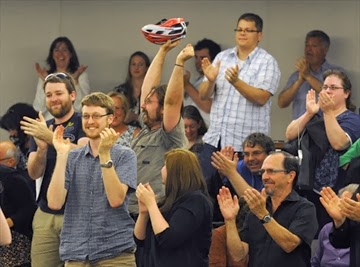 |
| Council approved LRT in 2009, and as seen here, in 2011 (to great appluase) |
So, if you support this plan, please, contact your councilors and tell them.
If you're on the fence, or wonder why I keep going on about this, I urge you to recognize this: We have a thoughtful and progressive regional government that are trying very hard to prepare Waterloo region for the future, with a vision that very few other cities aspire to. It's part of our culture here, to be industrious, to adapt, and to innovate. Ultimately, we have to be ready to sign off on the plan, and take the next step.
LRT is our next step. It's a big one. Come with us.
Thursday, August 22, 2013
Saturday, July 13, 2013
Ions and Anions
It's been a long journey, but Waterloo is getting its trains.
With the signing of a $92.5M deal that was approved by Council on
Wednesday, we are seeing the first really big commitment of funds to the
rapid transit project. This brings a sense of relief: the project is
becoming real.
The project is not without its detractors, of course. Back before the 2011 approval, we had T4ST-- a group of Taxpayers, ostensibly "4" Sensible Transit, but some of whom just seemed to be "4" No Transit, or anything that costs money-- that they could see, of course. Billions on roads pass by uncriticized, but the rapid transit project was a very visible target.
Still, since the 2011 vote, they've largely fallen quiet.
The news, lately, has been about a certain Ted Livingston, founder of Kik and born-again rapid transit opponent. Ted is an intelligent and passionate man, with a progressive bent and a desire to see a walkable Waterloo (though it's not clear if he means Waterloo the region, or Waterloo the city.) He is strongly opposed to LRT. And his concerns should not be dismissed.
But they should also not be garnering quite as much press as they have. Ted's qualifications are that he's an intelligent and passionate man, and that he's founded a tech company in the region-- well, that puts him one up (well, maybe two up) on me, but it doesn't make him an expert in urban planning.
So far, Ted's approach to the walkability problem has been a very tech-startup approach. In other words, every problem is a technical problem, and every problem can be tackled from scratch. A central thesis of Ted's approach to walkability is to focus all development on a single core within the region, and the expense of everywhere else. Within this single core, everything is in reach on foot, and both driving and transit are unnecessary. So why spend money on LRT?
On top of this, he demands that an investment in LRT should be mathematically justifiable. Now... this may be possible, but it requires agreeing with the goals and strategy driving this decision and that reflect the reality of our region. If those goals are dismissed, the justification holds no weight for you. And Ted is quick to dismiss goals that are based on mobility in a region with multiple nodes and corridors. A region like... ours.
But perhaps Ted has a point. What if we could take a startup approach to city building? With all constraints thrown aside, we could achieve something truly innovative...
... Slight problem: startups usually fail. Startups test risky solutions to problems, and when a solution is a good one, things turn out fantastic for those involved, but everyone is really, really surprised... because it just doesn't happen very often. Success is the exception.
So I hope I can be forgiven for being suspicious of any argument that doesn't allow for who we are and what we have now. Waterloo is an incubator of startups, a place where ideas can be rapidly tested in an environment that welcomes and encourages innovation. As a city or a region, though, it can't be run like a startup gamble. There's a lot more than venture capital at stake.
But still-- business acumen is business acumen, and Ted has it. This lends his words weight. (And we do like a good controversy and narrative, so media has fanned the small flame he has lit.)
But we should also acknowledge all of the other voices of the business community who have spoken for LRT and rapid transit. Google. Agfa. Open Text. Desire2Learn. The Perimeter Institute. Colliers. The KW Chamber of Commerce. Communitech-- the same Communitech that works to create the right conditions for companies like Kik to come into existence and thrive. Even plucky startups like Snapsort, who produced a strongly positive and evocative (and, to be fair, sometimes wildly inaccurate) infographic supporting LRT, proving that it's not just the big fish who have this opinion.
So... that's Ted. Someone who is making a sincere attempt to boil the LRT project down to a single metric, but won't hold still long enough to listen to a chain of reasoning that leads him away from it, and hasn't learned that running a city is not the same as running a startup that can bankrupt and be discarded the moment it goes disfunctional. None the less, I'm still trying to reach out to him. Being for walkability, and seeking to understand complexity (or at least going through the motions), makes him different from other more one-dimensional LRT opponents.
Now, let's move on to someone else: Mayor Brenda Halloran. On Wednesday, she chose to vote "no" to a train order that had come in $2.5M under budget. Citing concerns about the cost and our ability to fund social programs, Halloran has decided to keep carrying the anti-LRT torch she held aloft in 2011.
In 2011, that was fine. In 2011, I seem to recall her saying that she would not be obstructive if council decided to proceed with rapid transit. In 2011, she made a decision to listen to her constituents, and there were enough voices to make her vote no. She took a reasonable position in 2011, even if I don't agree with it.
Fast forward to 2013, and on the table is a vehicle order, procured with imagination and daring, for a price millions under budget. And Halloran voted: no. Even as Councillor Brewer of Cambridge voted yes to bring this project forward while expressing Cambridge's unhappiness about their LRT being relegated to a future stage 2, Waterloo's mayor expressed a desire to stop this process in its tracks.
There is no way to interpret this except as a decision by the mayor to be seen opposing this project. And in doing so-- on a motion that is a shining example of a well-run project-- she has abdicated the ability to hold this project to a high standard of fiscal management and restraint. By voting "no" when things are done well, she will have no influence at all when she perceives something is not meeting her standard. (Unless she can somehow vote "no" twice?)
In other words, I believe she has decided that opposing the project all the way down is better than being a steward of the biggest project in Waterloo region history.
Better for who, though?
Still. It's 2013, over two years since this blog started, and over two years since the big issue that got me interested in local affairs was given the green light to proceed. Today I got to see a tangible piece of the real deal on a trailer in front of regional headquarters; I got to hear the vision and determination of many of our local leaders; I felt like Waterloo region really has seized the opportunity to pull itself out of the sprawl trap that so many other cities struggle in.
We are, after all, a city-- a region-- of innovation. But we're also a city-- a region-- of history and tradition. We build on our rich pasts. We get things done here. And we move forward.
Bring on the Ion.
 | |
| Like this train. Only bigger, and not made of cardboard. |
The project is not without its detractors, of course. Back before the 2011 approval, we had T4ST-- a group of Taxpayers, ostensibly "4" Sensible Transit, but some of whom just seemed to be "4" No Transit, or anything that costs money-- that they could see, of course. Billions on roads pass by uncriticized, but the rapid transit project was a very visible target.
Still, since the 2011 vote, they've largely fallen quiet.
 |
| Quiet, like an efficient light rail system whooshing by in a cloud of delicious urbanism. |
The news, lately, has been about a certain Ted Livingston, founder of Kik and born-again rapid transit opponent. Ted is an intelligent and passionate man, with a progressive bent and a desire to see a walkable Waterloo (though it's not clear if he means Waterloo the region, or Waterloo the city.) He is strongly opposed to LRT. And his concerns should not be dismissed.
But they should also not be garnering quite as much press as they have. Ted's qualifications are that he's an intelligent and passionate man, and that he's founded a tech company in the region-- well, that puts him one up (well, maybe two up) on me, but it doesn't make him an expert in urban planning.
So far, Ted's approach to the walkability problem has been a very tech-startup approach. In other words, every problem is a technical problem, and every problem can be tackled from scratch. A central thesis of Ted's approach to walkability is to focus all development on a single core within the region, and the expense of everywhere else. Within this single core, everything is in reach on foot, and both driving and transit are unnecessary. So why spend money on LRT?
On top of this, he demands that an investment in LRT should be mathematically justifiable. Now... this may be possible, but it requires agreeing with the goals and strategy driving this decision and that reflect the reality of our region. If those goals are dismissed, the justification holds no weight for you. And Ted is quick to dismiss goals that are based on mobility in a region with multiple nodes and corridors. A region like... ours.
 |
| A region that puts its best face forward? |
But perhaps Ted has a point. What if we could take a startup approach to city building? With all constraints thrown aside, we could achieve something truly innovative...
... Slight problem: startups usually fail. Startups test risky solutions to problems, and when a solution is a good one, things turn out fantastic for those involved, but everyone is really, really surprised... because it just doesn't happen very often. Success is the exception.
So I hope I can be forgiven for being suspicious of any argument that doesn't allow for who we are and what we have now. Waterloo is an incubator of startups, a place where ideas can be rapidly tested in an environment that welcomes and encourages innovation. As a city or a region, though, it can't be run like a startup gamble. There's a lot more than venture capital at stake.
But still-- business acumen is business acumen, and Ted has it. This lends his words weight. (And we do like a good controversy and narrative, so media has fanned the small flame he has lit.)
But we should also acknowledge all of the other voices of the business community who have spoken for LRT and rapid transit. Google. Agfa. Open Text. Desire2Learn. The Perimeter Institute. Colliers. The KW Chamber of Commerce. Communitech-- the same Communitech that works to create the right conditions for companies like Kik to come into existence and thrive. Even plucky startups like Snapsort, who produced a strongly positive and evocative (and, to be fair, sometimes wildly inaccurate) infographic supporting LRT, proving that it's not just the big fish who have this opinion.
 |
| All sorts of people do. |
So... that's Ted. Someone who is making a sincere attempt to boil the LRT project down to a single metric, but won't hold still long enough to listen to a chain of reasoning that leads him away from it, and hasn't learned that running a city is not the same as running a startup that can bankrupt and be discarded the moment it goes disfunctional. None the less, I'm still trying to reach out to him. Being for walkability, and seeking to understand complexity (or at least going through the motions), makes him different from other more one-dimensional LRT opponents.
 |
| "You remember that one person who wanted us to never invest any money at all for any reason ever?" |
Now, let's move on to someone else: Mayor Brenda Halloran. On Wednesday, she chose to vote "no" to a train order that had come in $2.5M under budget. Citing concerns about the cost and our ability to fund social programs, Halloran has decided to keep carrying the anti-LRT torch she held aloft in 2011.
In 2011, that was fine. In 2011, I seem to recall her saying that she would not be obstructive if council decided to proceed with rapid transit. In 2011, she made a decision to listen to her constituents, and there were enough voices to make her vote no. She took a reasonable position in 2011, even if I don't agree with it.
 |
| Nor, I suspect, did he. |
Fast forward to 2013, and on the table is a vehicle order, procured with imagination and daring, for a price millions under budget. And Halloran voted: no. Even as Councillor Brewer of Cambridge voted yes to bring this project forward while expressing Cambridge's unhappiness about their LRT being relegated to a future stage 2, Waterloo's mayor expressed a desire to stop this process in its tracks.
There is no way to interpret this except as a decision by the mayor to be seen opposing this project. And in doing so-- on a motion that is a shining example of a well-run project-- she has abdicated the ability to hold this project to a high standard of fiscal management and restraint. By voting "no" when things are done well, she will have no influence at all when she perceives something is not meeting her standard. (Unless she can somehow vote "no" twice?)
In other words, I believe she has decided that opposing the project all the way down is better than being a steward of the biggest project in Waterloo region history.
Better for who, though?
 |
| Better for this dufus pressing the red button marked "DO NOT PRESS". |
Still. It's 2013, over two years since this blog started, and over two years since the big issue that got me interested in local affairs was given the green light to proceed. Today I got to see a tangible piece of the real deal on a trailer in front of regional headquarters; I got to hear the vision and determination of many of our local leaders; I felt like Waterloo region really has seized the opportunity to pull itself out of the sprawl trap that so many other cities struggle in.
We are, after all, a city-- a region-- of innovation. But we're also a city-- a region-- of history and tradition. We build on our rich pasts. We get things done here. And we move forward.
Bring on the Ion.
 |
| ION LOADING... [---> 40% ] |
Tuesday, April 30, 2013
Changing Orbits, Charged Particles and Scientific Principles
No posts for a while, so let's cover a number of topics. Today's topic theme: Science! It's what's for breakfast.
In 2007, despite being within walking distance of downtown Kitchener from a house we owned on Cherry St., our lives revolved around uptown Waterloo. Which proved to be an inconvenience because we now faced a 35-40 minute walk to get there. But I remember our first weekend at that place, walking into the downtown, looking for somewhere to enjoy a nice Sunday afternoon... and drawing a complete blank.
In 2009, we decided to move-- not too far away, over to Peltz Avenue. Today is the 4 year anniversary of moving into the house we still live in. Our lives still revolved around uptown Waterloo, but my workplace was now out at Northfield and Bridge (and still is)-- transit options had forced our hand.
In 2012, I observed that we were heading into downtown Kitchener nearly as often as uptown Waterloo. The opening of places like McCabes and Firkin paved the way, we re-discovered the Boathouse, and then later in the year Imbibe became a frequent attraction.
Fast-forward to a Sunday afternoon's walk home from the Boathouse last weekend.
On that walk home, we observed that we're now downtown Kitchener for our dining options most of the time. Uptown hasn't quite fallen out of favour, it just has less to offer (apart from patios... so we may see a summer resurgence.)
Then, we stopped off to opportunistically check out an open house on Heins Street, very close to Victoria Park. And it was tempting. And I realized: the constraints to our location (I want to maintain a low car commuting rate to allow us to share just one car) is loosening due to transit improvements! The rerouted 35 (it'll be renamed 6) provides immediate benefit for direct travel to work. The new iXpress routes allow for better connections to Waterloo destinations off the mainline. And, of course, LRT is coming.
Taken together, it made the idea of living closer to downtown Kitchener-- its attractions and its renewal-- much more appealing. We aren't exactly raring to move. But this is an eye-opening realization.
Speaking of LRT...
I'll say that I really don't care as long as they don't get it wrong. The name is okay.
I'll tell you what I do care about: this result from the branding telephone survey. It's not about the name, it's about 305 random people's perceptions of the Rapid Transit project:

Whoah. That's 47% favourable to 23% unfavourable. People who are still carrying on with the narrative that "nobody wants LRT" need to consider the distinct possibility that they are in an echo chamber, convinced their voices are the only ones.
(Since the theme is Science-- and apparently breakfasts-- I'll point out that this confidence interval calculator shows that 305 random participants is enough for a usual standard in survey confidence: answers are +/- 5%, 95% of the time. Even on a regional population of 550,000. Unless there is something flawed in the sampling method, with margins like this, it is extremely unlikely-- much less than 5%, to be sure-- that unfavourables are greater than favourables, let alone close to it.)
Okay, let's move on from statistics. It is one of my least favourite sciences.
Kitchener has decided to try sharrows on King Street (along with a number of other measures.) These sharrows are an important step to encourage better road sharing between motorists and cyclists.

I spoke to council and wrote about this topic on behalf of TriTAG. The sharrows are important, but what really gets us excited is that Kitchener is going to measure the effects of the change with cycling counts before and after!
And why shouldn't they measure? We want to know if this sort of thing works. We want to know what works well, and what doesn't, so that we can use that information when choosing future improvements... or to fix and correct flaws that are keeping good ideas from reaching their full potential.
Just last week I was cycling on King St. in downtown Kitchener, taking the lane. Sharrows or no, the legal right exists to take the full traffic lane if there is not enough room for a car to safely pass. The sharrows merely remind everyone about the expectation.
The funny part was, traffic was moving so slow that I went to the sidewalk and (also legally) walked my bike to my destination and it was faster. But that's something you can do when your conveyance doesn't weigh two tons or is the size of small room.

This change makes complete sense to me, because King Street south of the Town Square will only have 2 traffic lanes in just a couple short years due to the Rapid Transit construction. So why continue with this fantasy that we can have a major arterial road through the pedestrian heart of the city?
This project was going through consultations in 2010, but was suspended in 2011 because the details of RT project would affect things so much. But now the project is restarting. We should soon hear news of new public consultations.
Waterloo needs only look a few kilometres down King Street for the inspiration they need. Kitchener has done a fantastic job with their King reconstruction, and the model could work in uptown.
And on that note, I'll wrap this post up.
Changing Orbits
I remember the downtown Kitchener of the 90's. Like many long-time residents, this memory has coloured my perception.In 2007, despite being within walking distance of downtown Kitchener from a house we owned on Cherry St., our lives revolved around uptown Waterloo. Which proved to be an inconvenience because we now faced a 35-40 minute walk to get there. But I remember our first weekend at that place, walking into the downtown, looking for somewhere to enjoy a nice Sunday afternoon... and drawing a complete blank.
In 2009, we decided to move-- not too far away, over to Peltz Avenue. Today is the 4 year anniversary of moving into the house we still live in. Our lives still revolved around uptown Waterloo, but my workplace was now out at Northfield and Bridge (and still is)-- transit options had forced our hand.
In 2012, I observed that we were heading into downtown Kitchener nearly as often as uptown Waterloo. The opening of places like McCabes and Firkin paved the way, we re-discovered the Boathouse, and then later in the year Imbibe became a frequent attraction.
Fast-forward to a Sunday afternoon's walk home from the Boathouse last weekend.
 |
| A Sunday lunch and pint overlooking the lake. What's not to like? |
On that walk home, we observed that we're now downtown Kitchener for our dining options most of the time. Uptown hasn't quite fallen out of favour, it just has less to offer (apart from patios... so we may see a summer resurgence.)
Then, we stopped off to opportunistically check out an open house on Heins Street, very close to Victoria Park. And it was tempting. And I realized: the constraints to our location (I want to maintain a low car commuting rate to allow us to share just one car) is loosening due to transit improvements! The rerouted 35 (it'll be renamed 6) provides immediate benefit for direct travel to work. The new iXpress routes allow for better connections to Waterloo destinations off the mainline. And, of course, LRT is coming.
Taken together, it made the idea of living closer to downtown Kitchener-- its attractions and its renewal-- much more appealing. We aren't exactly raring to move. But this is an eye-opening realization.
Speaking of LRT...
Charged Particles
It'll be called "ion". Well, what can I say?I'll say that I really don't care as long as they don't get it wrong. The name is okay.
I'll tell you what I do care about: this result from the branding telephone survey. It's not about the name, it's about 305 random people's perceptions of the Rapid Transit project:

Whoah. That's 47% favourable to 23% unfavourable. People who are still carrying on with the narrative that "nobody wants LRT" need to consider the distinct possibility that they are in an echo chamber, convinced their voices are the only ones.
(Since the theme is Science-- and apparently breakfasts-- I'll point out that this confidence interval calculator shows that 305 random participants is enough for a usual standard in survey confidence: answers are +/- 5%, 95% of the time. Even on a regional population of 550,000. Unless there is something flawed in the sampling method, with margins like this, it is extremely unlikely-- much less than 5%, to be sure-- that unfavourables are greater than favourables, let alone close to it.)
Okay, let's move on from statistics. It is one of my least favourite sciences.
Scientific Principles
Oh irony. Looks like we're still on statistics.Kitchener has decided to try sharrows on King Street (along with a number of other measures.) These sharrows are an important step to encourage better road sharing between motorists and cyclists.

I spoke to council and wrote about this topic on behalf of TriTAG. The sharrows are important, but what really gets us excited is that Kitchener is going to measure the effects of the change with cycling counts before and after!
And why shouldn't they measure? We want to know if this sort of thing works. We want to know what works well, and what doesn't, so that we can use that information when choosing future improvements... or to fix and correct flaws that are keeping good ideas from reaching their full potential.
Just last week I was cycling on King St. in downtown Kitchener, taking the lane. Sharrows or no, the legal right exists to take the full traffic lane if there is not enough room for a car to safely pass. The sharrows merely remind everyone about the expectation.
The funny part was, traffic was moving so slow that I went to the sidewalk and (also legally) walked my bike to my destination and it was faster. But that's something you can do when your conveyance doesn't weigh two tons or is the size of small room.
Bonus!
I can't make this section title fit with the Science theme, but everyone likes bonus Science. Since starting this post, I discovered that the City of Waterloo is restarting its Uptown Streetscape improvement project. This project is looking at how to fix the situation in Uptown (north of Erb) where traffic lanes are of substandard width and sidewalks are narrow and crappy in the urban core of the city. It could (and in my opinion should) result in the removal of 1 or 2 traffic lanes.
This change makes complete sense to me, because King Street south of the Town Square will only have 2 traffic lanes in just a couple short years due to the Rapid Transit construction. So why continue with this fantasy that we can have a major arterial road through the pedestrian heart of the city?
This project was going through consultations in 2010, but was suspended in 2011 because the details of RT project would affect things so much. But now the project is restarting. We should soon hear news of new public consultations.
Waterloo needs only look a few kilometres down King Street for the inspiration they need. Kitchener has done a fantastic job with their King reconstruction, and the model could work in uptown.
And on that note, I'll wrap this post up.
Friday, May 18, 2012
Exploring the Midtown, present and future
A real treat for me today (beyond the simple enjoyment of walking downtown on a sunny morning as a nice change of pace). As part of the Central Transit Corridor project, the CTC folks invited me (and many others) to spend the day studying and exploring a part of the future rapid transit corridor that they are referring to as "Midtown".
It is an area I can claim a certain familiarity with. Over the last 10 years I have lived at four addresses which bracket the area. Its centre, and future LRT station at Grand River Hospital, has been an orbital attractor ever since iXpress started taking me to work from it in 2005. I have been up and down almost every single street on foot or bike. It is the closest thing to a home turf as I have ever had.
Today's exercise was about what it is, and what it could (or should) be. What it is at the moment, to be quite frank, is not a whole lot. The hospital is of course of major importance, and Sun Life is a big employer. A number of small medical offices are scattered around. There is fantastic (regionally speaking) transit access and new development is happening down near the future Hub and near Uptown. But there is very little supporting business.
There is an almost criminal amount of surface parking. And as loathe as I am to admit it, an ongoing need for that parking, but also opportunities to control it and provide it in built structures which may serve both hospital and Sun Life. The lot pictured in that link (edit: link has been added) is a major parcel of land buffered from residential and it could be used much more effectively. Other opportunities are the cut off, paved and otherwise wasted spaces that are inaccessible now and hidden next to Mount Hope cemetery. And the defunct Uniroyal property looms, a massive brownfield waiting to be reclaimed.
The biggest opportunity, and the mission of the CTC effort, is to see the new development done in a way that fits with what exists, maximizes the rapid transit asset, and creates vibrant neighbourhoods and quality places.
So, a bunch of planners from both cities and the region, plus a lot of motivated citizens, poured over maps all day. We tackled many issues at different levels of scale: specific visioning of the King St. corridor, examining mobility by all modes, and even coming up with ideas for Uniroyal. Throughout this effort, modelers were busy creating a scale representation of the existing buildings and possible future additions for a giant map, based on the information we provided.
The results, pictured below, are impressive. The scale models give a great sense of what the new streetscapes might look like. And, hopefully this effort will help the cities and the region identify the gaps in their plan, shape their own vision and set priorities to guide development and solve the problems we brought up.
Hopefully, I said, and hopefully I meant. The next steps are out of my hands. But there was a great amount of local knowledge connecting with the ideas and understanding of how to solve urban challenges. I hope it is not wasted.
A cautionary note about these images: while the white blocks are existing buildings, nothing about the blue ones are meant to be taken literally. Some are even facetious (like the 82-story monster that was placed below to make a point, nothing more.) This is all possibilities.

It is an area I can claim a certain familiarity with. Over the last 10 years I have lived at four addresses which bracket the area. Its centre, and future LRT station at Grand River Hospital, has been an orbital attractor ever since iXpress started taking me to work from it in 2005. I have been up and down almost every single street on foot or bike. It is the closest thing to a home turf as I have ever had.
Today's exercise was about what it is, and what it could (or should) be. What it is at the moment, to be quite frank, is not a whole lot. The hospital is of course of major importance, and Sun Life is a big employer. A number of small medical offices are scattered around. There is fantastic (regionally speaking) transit access and new development is happening down near the future Hub and near Uptown. But there is very little supporting business.
There is an almost criminal amount of surface parking. And as loathe as I am to admit it, an ongoing need for that parking, but also opportunities to control it and provide it in built structures which may serve both hospital and Sun Life. The lot pictured in that link (edit: link has been added) is a major parcel of land buffered from residential and it could be used much more effectively. Other opportunities are the cut off, paved and otherwise wasted spaces that are inaccessible now and hidden next to Mount Hope cemetery. And the defunct Uniroyal property looms, a massive brownfield waiting to be reclaimed.
The biggest opportunity, and the mission of the CTC effort, is to see the new development done in a way that fits with what exists, maximizes the rapid transit asset, and creates vibrant neighbourhoods and quality places.
So, a bunch of planners from both cities and the region, plus a lot of motivated citizens, poured over maps all day. We tackled many issues at different levels of scale: specific visioning of the King St. corridor, examining mobility by all modes, and even coming up with ideas for Uniroyal. Throughout this effort, modelers were busy creating a scale representation of the existing buildings and possible future additions for a giant map, based on the information we provided.
The results, pictured below, are impressive. The scale models give a great sense of what the new streetscapes might look like. And, hopefully this effort will help the cities and the region identify the gaps in their plan, shape their own vision and set priorities to guide development and solve the problems we brought up.
Hopefully, I said, and hopefully I meant. The next steps are out of my hands. But there was a great amount of local knowledge connecting with the ideas and understanding of how to solve urban challenges. I hope it is not wasted.
A cautionary note about these images: while the white blocks are existing buildings, nothing about the blue ones are meant to be taken literally. Some are even facetious (like the 82-story monster that was placed below to make a point, nothing more.) This is all possibilities.

Above, the aforementioned 82-story monster. It looks ridiculous, but buildings this size exist. It hints at what can happen with unchecked development. However, the same block looks much less out of place when laid on its side next to King St. Obviously not as a contiguous unit, but the same building area can be provided in 5-6 story structures oriented towards the street, providing mixed use and more flexibility in finding parking.

The Transit Hub district takes shape. Actually, it's not a bad mock-up of the (as yet undesigned) hub! Starting digging, folks... this project is shovel-ready...
Meanwhile, planners envision the future corporate headquarters of Uhu Inc:

Below, something much closer to the final product, looking from Waterloo south... At the end of the day, the Sun Life surface parking is now a collection of uses, including a parking garage to address both Sun Life's and GRH's needs. The CKCO block has been redeveloped to the 5-6 story level at the front, and on the back townhouses front an extended Mary St.

A lot to unpack in the last image below, from Kitchener looking north. Most obvious, the hub-- becoming the point of greatest mobility in the region, and possibly anywhere in Ontario west of Toronto-- has attracted a lot of attention. Further west, the old factory building at Uniroyal stands proud with new development next to it, and Belmont Village has grown up a little. New roads and trails line the CN corridor, and on the east side, connect Green to Pine, allowing reclamation of cut-off space next to Mount Hope cemetery.


The Transit Hub district takes shape. Actually, it's not a bad mock-up of the (as yet undesigned) hub! Starting digging, folks... this project is shovel-ready...
Meanwhile, planners envision the future corporate headquarters of Uhu Inc:

Below, something much closer to the final product, looking from Waterloo south... At the end of the day, the Sun Life surface parking is now a collection of uses, including a parking garage to address both Sun Life's and GRH's needs. The CKCO block has been redeveloped to the 5-6 story level at the front, and on the back townhouses front an extended Mary St.

A lot to unpack in the last image below, from Kitchener looking north. Most obvious, the hub-- becoming the point of greatest mobility in the region, and possibly anywhere in Ontario west of Toronto-- has attracted a lot of attention. Further west, the old factory building at Uniroyal stands proud with new development next to it, and Belmont Village has grown up a little. New roads and trails line the CN corridor, and on the east side, connect Green to Pine, allowing reclamation of cut-off space next to Mount Hope cemetery.

Thursday, December 8, 2011
It's the System, stupid!
I could have called this article "Dissecting LRT Procurement Options", but I figured this might grab your attention. "Procurement".. what a snoozer, huh? Snore.
Bear with me, and you might be surprised. But I'll warn you, this is a long one! Here we go:
Region staff are promoting, essentially, a privatized LRT system within Waterloo Region through a "Public-Private Partnership" (or 3P). They have put together nice bulleted lists of why some privatization is good, but more privatization is better, and all privatization? That's the cat's meow. You can sift through the gory details here.
But I'll try and boil it down for you.
Gimme a D!... Gimme a B!
There's a number of procurement options, which include a private company (or more likely, consortium) taking on various parts of the procurement and operation of our LRT system. Each of these parts is referred to by letter, according to the guide below-- most of which should be self-explanatory:
Region staff believe DBFOM is the way to go. They view it as a way to transfer construction and operation risk to the private company, insulating us all from construction cost overruns, and the difficulties of maintaining, staffing and operating this line.
I respectfully disagree: I believe private operation works against us.
Where does this train lead?
Let's take a moment to remind ourselves why we have LRT coming to Waterloo Region:
So we need to place transit in a position to succeed. The core of the system may be LRT, but buses will still, largely, be left holding the bag anywhere off the main line. To move effectively, riders will need a well-integrated transit system as they shift from bus to train, route to route.
We already have obstacles to good integration in the form of compromises in LRT line length (cutting Cambridge out of phase 1) and in station placement (route splitting in Uptown-- discussed here at length-- and in Downtown, and a criminally poor station placement around the University of Waterloo that seems to go out of its way-- literally-- to make connections harder.)
So given a goal of making our transit system effective and attractive, we need to take a critical eye to the Region's idea of privatization. Privatization is not about making a good system, it is about mitigating risk at the expense of a good system.
And unfortunately, for our goals: it's the system, stupid! It needs to work well as a whole. It needs to grow. It should be intuitively obvious that privatizing part of the system will detract from the whole.
Everything in Moderation
The Region hasn't built an LRT system before, so we're probably in a position to benefit from someone who can design and build us up one before we start drafting our own detailed construction plans. And you know what? That's cool.
But the Region also has no experience running an LRT system, and this is one of the reasons why privatized operation is attractive. However, if we're aiming at growing LRT later, and making it a part of a well-integrated system that responds to ridership growth, the Region needs to learn by doing.
Suspect Logic
Let's talk about what staff sees that is so attractive about privately operated LRT:
Cost and Risk: A private company will have to shoulder risks of construction and operation. The Region retains ridership risk, but is insulated from operating expense and complexity. A private corporation will keep costs down by being more efficient.
The Reality: Private sector efficiency requires competition. Competition is not found in a 30-year monopoly. Ultimately, if things go bad, private companies come back hat in hand for greater subsidies-- or they walk. This was demonstrated in Melbourne.
Line Quality: A private company that will operate a system will design one with efficiencies that will make it better. Over time it will run it better.
The Reality: The system will be designed to do precisely what we spec it to do now, with no eye towards the future. Contracts designed to tie payments to metrics, make sure the private company "owns up" on performance, can have unintended side effects like buses that speed and refuse to pick up passengers in Auckland. Operation will aim to maximize profit, not transit availability or frequency. An LRT line to be operated privately will be built to extract subsidy out of government first and foremost.
Experience: A private company will have more experience operating a system. They can better handle a small system's pool of drivers for scheduling vacation.
The Reality: When it comes to staffing, six weeks of YRT/Viva strikes (and counting!) suggest that maybe private handling of staffing isn't a strength. And when things go south, the local government has a figleaf to hide behind instead of solving the issue. It sits saving $70K a day in withheld operator fees and stonewalling its angry citizens. Veolia and First Transit, the involved companies, have combined profit of over a billion dollars a year around the world: they can afford to wait, to bring a recalcitrant union in line. Meanwhile, York Region chokes.
Also, it's unlikely that vacation scheduling is some kind of critical advantage we need to pursue. Besides, a private company is hardly going to fly in drivers from other cities to fill its Christmas-time roster gaps.
Finally, hire consultants to advise on system startup. A good consultant is a wonderful thing: brings ready experience when you need it, and goes away when you are done.
Forgetting ourselves, and forgetting Cambridge
The transit system of Waterloo Region is a work in progress, with some ambitious goals to transform how we move and the shape of our community in the coming decades.
We need to be committed to growing that system, and that requires full control over its most critical aspect. Having LRT at arm's length makes every schedule adjustment, bus realignment, and policy change subject to the whims of a company whose goals are very different from ours.
Private operation will also make negotiation for expansion all the harder. Staff almost admits this: they suggest "choice for integration and expansion" will be "impacted". I would say that we would have abandoned control of our own fate in creating an effective, attractive transit system. We will make it harder to expand and adapt the whole system for the public good.
Cambridge, are you listening? How do you see a hand off of a half-built LRT line to a private company affecting its completion?
Not alone in fearing 3P
London (UK) had to take back control of its own privatized tube in a privatization that backfired when it came to "cost reduction".
This transit consultant points out that efficiency only comes from competition, that integration with 3P pieces is hard, and that a private operator's focus on revenue can come at the expense of service and ridership.
The Public Transit Coalition explains why they oppose privatization in Toronto, nailing the high points. And here are fears about private LRT in Toronto.
Here is a good deconstruction of the seedy underbelly of the successful, but crippled and costly Canada Line in Vancouver where the operator underbuilt the line to save itself money.
The Fallacy
Here's why private operation of city transit generally doesn't work: It's not profitable. It's not meant to be.
Most transit systems are subsidized. Privately operated systems are only viable if they receive a subsidy for operation. They aren't motivated by the desires of the government providing the subsidy in any way that isn't clearly spelt out in contract.
So governments try to codify their desires in contract. But transit is complex, and that makes for very complex contracts. You can only write clauses for what you know, not for what you may learn in the future.
A transit system, like a road network, is best when provided as a public good. If we are dissatisfied with it, ultimately we can take action at the political level. A private transit system, on the other hand, is operated as a cost centre, and if we are dissatisfied in it, all we can do is... not use it.
And that would be missing the point.
Bear with me, and you might be surprised. But I'll warn you, this is a long one! Here we go:
Region staff are promoting, essentially, a privatized LRT system within Waterloo Region through a "Public-Private Partnership" (or 3P). They have put together nice bulleted lists of why some privatization is good, but more privatization is better, and all privatization? That's the cat's meow. You can sift through the gory details here.
But I'll try and boil it down for you.
Gimme a D!... Gimme a B!
There's a number of procurement options, which include a private company (or more likely, consortium) taking on various parts of the procurement and operation of our LRT system. Each of these parts is referred to by letter, according to the guide below-- most of which should be self-explanatory:
- Design
- Build
- Finance - securing short-term financing during construction
- Operate - System operation on a 30-year contract
- Maintain
Region staff believe DBFOM is the way to go. They view it as a way to transfer construction and operation risk to the private company, insulating us all from construction cost overruns, and the difficulties of maintaining, staffing and operating this line.
I respectfully disagree: I believe private operation works against us.
Where does this train lead?
Let's take a moment to remind ourselves why we have LRT coming to Waterloo Region:
- Population is exploding.
- The cities will choke on traffic and sprawl past their borders unless they intensify and reduce the percentage of travel by car.
- Our goal is to move transit from less than 5% to around 14% of trips by 2031. (Though more is better.)
- LRT has greater capacity, attracts greater ridership, and promotes intensification.
- The current plan is to put LRT along the "spine" in Kitchener and Waterloo, and provide express buses and Bus Rapid Transit to Cambridge and along the major routes.
- The long-term plan is to expand LRT to Cambridge.
So we need to place transit in a position to succeed. The core of the system may be LRT, but buses will still, largely, be left holding the bag anywhere off the main line. To move effectively, riders will need a well-integrated transit system as they shift from bus to train, route to route.
We already have obstacles to good integration in the form of compromises in LRT line length (cutting Cambridge out of phase 1) and in station placement (route splitting in Uptown-- discussed here at length-- and in Downtown, and a criminally poor station placement around the University of Waterloo that seems to go out of its way-- literally-- to make connections harder.)
So given a goal of making our transit system effective and attractive, we need to take a critical eye to the Region's idea of privatization. Privatization is not about making a good system, it is about mitigating risk at the expense of a good system.
And unfortunately, for our goals: it's the system, stupid! It needs to work well as a whole. It needs to grow. It should be intuitively obvious that privatizing part of the system will detract from the whole.
Everything in Moderation
The Region hasn't built an LRT system before, so we're probably in a position to benefit from someone who can design and build us up one before we start drafting our own detailed construction plans. And you know what? That's cool.
But the Region also has no experience running an LRT system, and this is one of the reasons why privatized operation is attractive. However, if we're aiming at growing LRT later, and making it a part of a well-integrated system that responds to ridership growth, the Region needs to learn by doing.
Suspect Logic
Let's talk about what staff sees that is so attractive about privately operated LRT:
Cost and Risk: A private company will have to shoulder risks of construction and operation. The Region retains ridership risk, but is insulated from operating expense and complexity. A private corporation will keep costs down by being more efficient.
The Reality: Private sector efficiency requires competition. Competition is not found in a 30-year monopoly. Ultimately, if things go bad, private companies come back hat in hand for greater subsidies-- or they walk. This was demonstrated in Melbourne.
Line Quality: A private company that will operate a system will design one with efficiencies that will make it better. Over time it will run it better.
The Reality: The system will be designed to do precisely what we spec it to do now, with no eye towards the future. Contracts designed to tie payments to metrics, make sure the private company "owns up" on performance, can have unintended side effects like buses that speed and refuse to pick up passengers in Auckland. Operation will aim to maximize profit, not transit availability or frequency. An LRT line to be operated privately will be built to extract subsidy out of government first and foremost.
Experience: A private company will have more experience operating a system. They can better handle a small system's pool of drivers for scheduling vacation.
The Reality: When it comes to staffing, six weeks of YRT/Viva strikes (and counting!) suggest that maybe private handling of staffing isn't a strength. And when things go south, the local government has a figleaf to hide behind instead of solving the issue. It sits saving $70K a day in withheld operator fees and stonewalling its angry citizens. Veolia and First Transit, the involved companies, have combined profit of over a billion dollars a year around the world: they can afford to wait, to bring a recalcitrant union in line. Meanwhile, York Region chokes.
Also, it's unlikely that vacation scheduling is some kind of critical advantage we need to pursue. Besides, a private company is hardly going to fly in drivers from other cities to fill its Christmas-time roster gaps.
Finally, hire consultants to advise on system startup. A good consultant is a wonderful thing: brings ready experience when you need it, and goes away when you are done.
Forgetting ourselves, and forgetting Cambridge
The transit system of Waterloo Region is a work in progress, with some ambitious goals to transform how we move and the shape of our community in the coming decades.
We need to be committed to growing that system, and that requires full control over its most critical aspect. Having LRT at arm's length makes every schedule adjustment, bus realignment, and policy change subject to the whims of a company whose goals are very different from ours.
Private operation will also make negotiation for expansion all the harder. Staff almost admits this: they suggest "choice for integration and expansion" will be "impacted". I would say that we would have abandoned control of our own fate in creating an effective, attractive transit system. We will make it harder to expand and adapt the whole system for the public good.
Cambridge, are you listening? How do you see a hand off of a half-built LRT line to a private company affecting its completion?
Not alone in fearing 3P
London (UK) had to take back control of its own privatized tube in a privatization that backfired when it came to "cost reduction".
This transit consultant points out that efficiency only comes from competition, that integration with 3P pieces is hard, and that a private operator's focus on revenue can come at the expense of service and ridership.
The Public Transit Coalition explains why they oppose privatization in Toronto, nailing the high points. And here are fears about private LRT in Toronto.
Here is a good deconstruction of the seedy underbelly of the successful, but crippled and costly Canada Line in Vancouver where the operator underbuilt the line to save itself money.
The Fallacy
Here's why private operation of city transit generally doesn't work: It's not profitable. It's not meant to be.
Most transit systems are subsidized. Privately operated systems are only viable if they receive a subsidy for operation. They aren't motivated by the desires of the government providing the subsidy in any way that isn't clearly spelt out in contract.
So governments try to codify their desires in contract. But transit is complex, and that makes for very complex contracts. You can only write clauses for what you know, not for what you may learn in the future.
A transit system, like a road network, is best when provided as a public good. If we are dissatisfied with it, ultimately we can take action at the political level. A private transit system, on the other hand, is operated as a cost centre, and if we are dissatisfied in it, all we can do is... not use it.
And that would be missing the point.
Thursday, November 10, 2011
LRT Uptown Routing Change
I've said in the past that the Uptown loop was an awkward compromise.
Back in June, Regional Councillor Strickland (to the dismay of Waterloo
City Councillor Scian) challenged the suitability of the route
alignment-- in particular the Erb St. counterflow hook that the
North-bound line would make-- and pushed for an amendment to review this
decision. The city was incensed, because they endorsed the existing
2009 plan.
** Edit: Ms. Scian has clarified that the City reacted to not being consulted on this proposal. Read her comment below.
Well, what a difference a few months make. Region staff engaged the citizenry and the city and proposed some fairly significant alterations (link note: see page 12 onward).
This proposal has been conditionally endorsed by the city, and passed unanimously by the Region. Which is good, because it is a definite improvement. But some think it just didn't go far enough. And while I don't want to take away from the accomplishment that has been made, I would be inclined to agree. Here's where the new plan falls short:
Usability
The new station positions mean Southbound and Northbound uptown stations are hidden from each other, and fairly distant. This is one of the biggest problems the loops present: they make the system more confusing, and are an obstacle to these stations attracting riders. Virtually every rider who visits uptown will do so as part of a return journey.
Connectivity
I also see a problem for route connections. As it stands, the King St. face of the public square is a minor transit node, with the various 7's and the 5/35 all stopping here. And yet, the split LRT route makes it impossible to do anything but partially serve these connections.
(I should note that downtown Kitchener's loop also presents this problem in spades.)
Spacing
The new Allen St. station position means there is a scant 500m separation between the two southbound stations.
So how can we address this?
In the link above, TriTAG proposes moving the southbound station up Caroline to be near the Erb St. intersection. I've urged the Region to consider this proposal carefully, as it would provide some partial solutions to each of the problems I mentioned above.
But an Erb/Caroline position is its own tradeoff. The Erb intersection is much busier than Willis Way, and it is already complicated. (Cyclists in particular regard it as one of the blights in this city.) The C.I.G.I. building (originally built as part of the Seagram's complex, I believe) crowds the intersection and limits the space available for a station. And, this corner is less of a destination than Caroline/Willis is.
It may be that in the balance, there is no better loop alignment than the current plan.
But the reality is, there are so many constraints in play that prevent a unified alignment through the area. We can't infringe on the square. We can't eliminate two-way traffic on any street. We don't want to rip out any existing buildings (like, say, the bridal shop at Caroline and William) and we can't steal space from parking lots (e.g. Rec Centre.)
Where does that leave us?
As a region, we have a choice: we can settle, having come up with a decent compromise that seems to be generally acceptable. (Though don't ask the folks in the Catalina townhomes, because they're spitting nails about the Caroline side switch.) Or, we could recognize that LRT is the backbone of our whole plan to provide alternatives to driving in Waterloo Region, and make the hard decisions needed to fix its routing properly.
These decisions would result in much screaming and gnashing of teeth, but... in ten years, nobody will remember the fallout that will inevitably come from giving LRT the priority it deserves. Not if the system works. And it needs to work. The compromises that keep it from offending various interests are deficiencies we will have to live with forever, and each of them takes away from the viability of the whole.
** Edit: Ms. Scian has clarified that the City reacted to not being consulted on this proposal. Read her comment below.
Well, what a difference a few months make. Region staff engaged the citizenry and the city and proposed some fairly significant alterations (link note: see page 12 onward).
- Move the Northbound connection to the existing rail spur that crosses the parking lot north of Waterloo Town(e) Square (by sharing track, an option we believed was impossible in 2009)
- Move the Northbound station off King and onto the spur, next to the public square
- Create a new station at King and Allen
- Move the Southbound tracks from east side of Caroline to west.
 |
| New Uptown Route Alignment |
This proposal has been conditionally endorsed by the city, and passed unanimously by the Region. Which is good, because it is a definite improvement. But some think it just didn't go far enough. And while I don't want to take away from the accomplishment that has been made, I would be inclined to agree. Here's where the new plan falls short:
Usability
The new station positions mean Southbound and Northbound uptown stations are hidden from each other, and fairly distant. This is one of the biggest problems the loops present: they make the system more confusing, and are an obstacle to these stations attracting riders. Virtually every rider who visits uptown will do so as part of a return journey.
Connectivity
I also see a problem for route connections. As it stands, the King St. face of the public square is a minor transit node, with the various 7's and the 5/35 all stopping here. And yet, the split LRT route makes it impossible to do anything but partially serve these connections.
(I should note that downtown Kitchener's loop also presents this problem in spades.)
Spacing
The new Allen St. station position means there is a scant 500m separation between the two southbound stations.
So how can we address this?
In the link above, TriTAG proposes moving the southbound station up Caroline to be near the Erb St. intersection. I've urged the Region to consider this proposal carefully, as it would provide some partial solutions to each of the problems I mentioned above.
But an Erb/Caroline position is its own tradeoff. The Erb intersection is much busier than Willis Way, and it is already complicated. (Cyclists in particular regard it as one of the blights in this city.) The C.I.G.I. building (originally built as part of the Seagram's complex, I believe) crowds the intersection and limits the space available for a station. And, this corner is less of a destination than Caroline/Willis is.
It may be that in the balance, there is no better loop alignment than the current plan.
But the reality is, there are so many constraints in play that prevent a unified alignment through the area. We can't infringe on the square. We can't eliminate two-way traffic on any street. We don't want to rip out any existing buildings (like, say, the bridal shop at Caroline and William) and we can't steal space from parking lots (e.g. Rec Centre.)
Where does that leave us?
As a region, we have a choice: we can settle, having come up with a decent compromise that seems to be generally acceptable. (Though don't ask the folks in the Catalina townhomes, because they're spitting nails about the Caroline side switch.) Or, we could recognize that LRT is the backbone of our whole plan to provide alternatives to driving in Waterloo Region, and make the hard decisions needed to fix its routing properly.
These decisions would result in much screaming and gnashing of teeth, but... in ten years, nobody will remember the fallout that will inevitably come from giving LRT the priority it deserves. Not if the system works. And it needs to work. The compromises that keep it from offending various interests are deficiencies we will have to live with forever, and each of them takes away from the viability of the whole.
Subscribe to:
Posts (Atom)