Showing posts with label waterloo region. Show all posts

Wednesday, July 20, 2016

The Green Belt needs to include Waterloo Region

The fine folks at Smart Growth Waterloo have pointed out a huge opportunity to help strengthen Waterloo Region's countryside line: a provincial review of the Green Belt in the GTHA is underway. Read more about that here.

So now is the time to be heard! Let our local leaders know how important this is.

The following is what I provided (minus some unfortunate typos thanks to writing on mobile):

Here in Waterloo region, we've seen the positive impact of an urban boundary: provincial goals for infill and intensification are being met and exceeded here better than anywhere else in Ontario.

But we've also seen mounting pressure by private developers against this boundary. Growth limits were challenged by private interest at the OMB and took years to settle. As WR continues to grow, the city line will see more and more pressure from developers who look at our farmland and water recharge areas as opportunities for profit rather than assets to protect for future generations.

That's why WR needs to be part of the Green Belt. As connections to the GTHA improve, WR will become a defacto part of a larger Toronto megacity, and we will need to protect our rural land with the force of provincial legislation rather than municipal bylaw that can be overturned by an unelected OMB.

Please help secure Waterloo region's future as a dynamic, progressive and sustainable place. Extend Green Belt protection to our rural land.

Thank you.

Thursday, October 29, 2015

Bikelash arrives in Waterloo Region


There’s a scourge on our roads, folks. Our comfort and safety is being threatened by road users who bend and break the rules, who fail in their duty of care, and who often move in casual disregard for their own safety or that of others.

Cyclists!

Oh, and drivers! And also, pedestrians!

Actually, all of us human beings, regardless of whether we're -ists or -ers or -ians.

Despite decades of regulation and good intentions, it doesn’t matter whether we’re behind the wheel, behind the handlebars or just simply on foot: we still get it wrong. People speed. People jaywalk. People ride on the sidewalk. And sometimes, people commit mistakes of judgement that have tragic, fatal consequences.

But lately, the Record’s columnists have taken it upon themselves to single out one group of road users for special attention: those darned cyclists. In doing so, they’re reinforcing the myth that we’re all in our own warring camps: the drivers against the cyclists against the pedestrians. Never shall they mix!

This myth ignores the reality that the “cyclist” you pass in your car is just a person on a bike, today. Tomorrow, they may be driving down your street as you walk to the bus. You would hope that when they do, they obey the speed limit. Today, they are hoping you give them at least one metre and pass carefully.

Maybe we should stop saying "cyclist" or "driver" or "pedestrian" and start talking about people getting around in different ways.

You may have heard about a bylaw review where the region is trying to sort out some of the rules that leave us tied up when we try and get around. It will rationalize rules about the use of rollerblades on trails and how automobiles and light rail will interact, for instance. The region also has a bylaw prohibiting side-by-side cycling which is redundant in the face of the Highway Traffic Act, which has clear rules that slower traffic should turn out to the right to allow passing. Cities like Toronto and Ottawa have long since removed such a rule from the book without problems. (Toronto has a great guide on when you should, and shouldn't, consider riding beside someone else.) Region staff proposes tidying this up as well.

But, it's that one proposed rule change has provoked quite a reaction. If ever there was a tempest in a teacup, this is it.

Record columnist Luisa D’Amato decries this and paints “cyclists” as overprivileged one-percenters who are “wagging the dog”. Peter Shawn Taylor has reached all the way around the world to an Australian study years ago that opined side-by-side cycling might create some kind of aggressive cyclist menace, like some kind of “Reefer Madness” awaits us if we don’t keep our society’s bike users in check.

It’s been a the week since that column was published. Every week, 40 people die on the road in Canada alone, the vast majority because of cars. The idea of bikes stealing away the road and threatening us all whips us into a lather. But dozens of real deaths every week get a shrug and a pass. Accidents happen.

For all I talk about riding a bike, I don't see myself as a "cyclist". Like many others, I ride my bike on our region’s roads. I also drive my car on those same roads. The difference is that when I ride, some people have already judged me with all the sins and offences of every bad cyclist they have seen, and they have found me guilty. If I'm behind the wheel, I carry no such burden.

And yet it’s behind the wheel that we, as human beings, are the most dangerous.

These latest developments are part of a new wave of bikelash in Waterloo region. (Some would say that's a good sign.) After Kitchener traffic calming projects brought bike lanes to a couple of streets in the face of street residents' objections, there's a sense that we're somehow doing too much for "those people". But there are no "those people" involved. There's just all of us, trying to get around.

And if more of us are able to get around by bike, is that really so bad? We're much, much less likely to accidentally kill someone on the way.

Saturday, February 1, 2014

Light Rail approaches its last big hurdle

In 2011, I blogged extensively about the decision-making process that led to the approval of Light Rail in Waterloo region. That decision set in motion years of groundwork required before construction could start in earnest. But planning and preparation is almost complete. It's almost time to build!

The bids for construction are in. On March 4th, the rapid transit team will bring their recommendation to the Planning and Works committee. This will be the point at which we find out who the preferred bidder was, and what construction cost will be, and whether council intends to approve it.

There has been a vocal element in our community who has campaigned non-stop to derail this plan. While some of them are simply concerned about the amount of money being spent, a considerable number will say pretty much anything to tarnish the case for LRT, including outright misrepresentation of how the system works and welcoming cancellation penalties some kind of  perverse morality object lesson.

Transit crowd at Conestoga mall wait for a train "from nowhere to nowhere"
And yet, as I wrote for TriTAG recently, the fundamentals supporting LRT have never looked stronger. Go ahead and read that if you'd like to learn more about the change that has happened so far. Basically, the short version is: service is expanding. Ridership is booming. This is working.


The new reality along our central transit corridor


But it's also important to remember that LRT is a key element in a multi-faceted plan to grow Waterloo region in a smart and sustainable way. The affordability of our community in the future depends on how we build now. We face a decision: grow up, or grow out. The Active Transportation Master Plan is up for council approval this month, and it is focused on providing the region with better walkability, and the ability to make short trips on foot and by bike. The broader Regional Transporation Master Plan, which includes a transit network redesign to coincide with LRT, aims to flesh out a transportation network to give thousands an alternative to driving.

But LRT is the single biggest (and admittedly, most costly) piece of the puzzle, and the one with the highest level of expectation tied to it. It is not meant to just serve demand, but also to shape our city to generate it. By providing a high quality level of service, convenience and permanence, Light Rail is already drawing lots of interest for people to live and work along its route and closer to downtowns.

1 Victoria, one of many developments green-lit after LRT approval

This growth in our core translates into fewer greenfield subdivisions, which directly improves our traffic situation within existing suburban areas. It also lowers the overall reliance on transportation by car, which again means less demand on our road infrastructure, and fewer costly expansions. By shaping our growth in this way, LRT will cost less than doing nothing at all because we don't actually have an option to "do nothing at all".

Now, this one light rail line is not perfect (I've criticized aspects of it before) and it will not change the world on its own. As I said before, there are other pieces to this puzzle. They are all important. But it's safe to say that LRT is the linchpin. Without it, everything else we do will have much more muted success. If we blink now, it will be many years before we get a do over. We'll eventually find ourselves drawn back to something like it, because of the fundamentals and the way our region is laid out. But it will inevitably cost more, and we will be fearful of taking the steps we have to, because of our failure to face the future.

Public support of LRT in 2011

I, for one, would like to stop talking about LRT. Having approved it twice, there's no good reason for council to change their minds this third time. But the vocal minority grows more vocal and strident, and they still offer no real solution of their own, only the false reassurance that nothing will change. Someone has to say something. But I look forward to having construction underway, and to be able to step back and tackle new challenges.

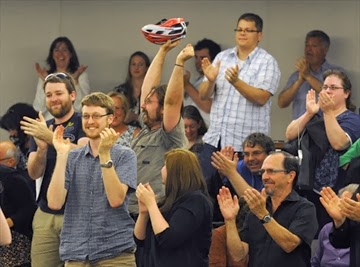
Council approved LRT in 2009, and as seen here, in 2011 (to great appluase)

So, if you support this plan, please, contact your councilors and tell them.

If you're on the fence, or wonder why I keep going on about this, I urge you to recognize this: We have a thoughtful and progressive regional government that are trying very hard to prepare Waterloo region for the future, with a vision that very few other cities aspire to. It's part of our culture here, to be industrious, to adapt, and to innovate. Ultimately, we have to be ready to sign off on the plan, and take the next step.

LRT is our next step. It's a big one. Come with us.

Saturday, July 13, 2013

Ions and Anions

It's been a long journey, but Waterloo is getting its trains.

Like this train. Only bigger, and not made of cardboard.


With the signing of a $92.5M deal that was approved by Council on Wednesday, we are seeing the first really big commitment of funds to the rapid transit project. This brings a sense of relief: the project is becoming real.

The project is not without its detractors, of course. Back before the 2011 approval, we had T4ST-- a group of Taxpayers, ostensibly "4" Sensible Transit, but some of whom just seemed to be "4" No Transit, or anything that costs money-- that they could see, of course. Billions on roads pass by uncriticized, but the rapid transit project was a very visible target.

Still, since the 2011 vote, they've largely fallen quiet.

Quiet, like an efficient light rail system whooshing by in a cloud of delicious urbanism.


The news, lately, has been about a certain Ted Livingston, founder of Kik and born-again rapid transit opponent. Ted is an intelligent and passionate man, with a progressive bent and a desire to see a walkable Waterloo (though it's not clear if he means Waterloo the region, or Waterloo the city.) He is strongly opposed to LRT. And his concerns should not be dismissed.

But they should also not be garnering quite as much press as they have. Ted's qualifications are that he's an intelligent and passionate man, and that he's founded a tech company in the region-- well, that puts him one up (well, maybe two up) on me, but it doesn't make him an expert in urban planning.


So far, Ted's approach to the walkability problem has been a very tech-startup approach. In other words, every problem is a technical problem, and every problem can be tackled from scratch. A central thesis of Ted's approach to walkability is to focus all development on a single core within the region, and the expense of everywhere else. Within this single core, everything is in reach on foot, and both driving and transit are unnecessary. So why spend money on LRT?

On top of this, he demands that an investment in LRT should be mathematically justifiable. Now... this may be possible, but it requires agreeing with the goals and strategy driving this decision and that reflect the reality of our region. If those goals are dismissed, the justification holds no weight for you. And Ted is quick to dismiss goals that are based on mobility in a region with multiple nodes and corridors. A region like... ours.

A region that puts its best face forward?


But perhaps Ted has a point. What if we could take a startup approach to city building? With all constraints thrown aside, we could achieve something truly innovative...

... Slight problem: startups usually fail. Startups test risky solutions to problems, and when a solution is a good one, things turn out fantastic for those involved, but everyone is really, really surprised... because it just doesn't happen very often. Success is the exception.

So I hope I can be forgiven for being suspicious of any argument that doesn't allow for who we are and what we have now. Waterloo is an incubator of startups, a place where ideas can be rapidly tested in an environment that welcomes and encourages innovation. As a city or a region, though, it can't be run like a startup gamble. There's a lot more than venture capital at stake.

But still-- business acumen is business acumen, and Ted has it. This lends his words weight. (And we do like a good controversy and narrative, so media has fanned the small flame he has lit.)

But we should also acknowledge all of the other voices of the business community who have spoken for LRT and rapid transit. Google. Agfa. Open Text. Desire2Learn. The Perimeter Institute. Colliers. The KW Chamber of Commerce. Communitech-- the same Communitech that works to create the right conditions for companies like Kik to come into existence and thrive. Even plucky startups like Snapsort, who produced a strongly positive and evocative (and, to be fair, sometimes wildly inaccurate) infographic supporting LRT, proving that it's not just the big fish who have this opinion.

All sorts of people do.


So... that's Ted. Someone who is making a sincere attempt to boil the LRT project down to a single metric, but won't hold still long enough to listen to a chain of reasoning that leads him away from it, and hasn't learned that running a city is not the same as running a startup that can bankrupt and be discarded the moment it goes disfunctional. None the less, I'm still trying to reach out to him. Being for walkability, and seeking to understand complexity (or at least going through the motions), makes him different from other more one-dimensional LRT opponents.

"You remember that one person who wanted us to never invest any money at all for any reason ever?"


Now, let's move on to someone else: Mayor Brenda Halloran. On Wednesday, she chose to vote "no" to a train order that had come in $2.5M under budget. Citing concerns about the cost and our ability to fund social programs, Halloran has decided to keep carrying the anti-LRT torch she held aloft in 2011.

In 2011, that was fine. In 2011, I seem to recall her saying that she would not be obstructive if council decided to proceed with rapid transit. In 2011, she made a decision to listen to her constituents, and there were enough voices to make her vote no. She took a reasonable position in 2011, even if I don't agree with it.

Nor, I suspect, did he.

Fast forward to 2013, and on the table is a vehicle order, procured with imagination and daring, for a price millions under budget. And Halloran voted: no. Even as Councillor Brewer of Cambridge voted yes to bring this project forward while expressing Cambridge's unhappiness about their LRT being relegated to a future stage 2, Waterloo's mayor expressed a desire to stop this process in its tracks.

There is no way to interpret this except as a decision by the mayor to be seen opposing this project. And in doing so-- on a motion that is a shining example of a well-run project-- she has abdicated the ability to hold this project to a high standard of fiscal management and restraint. By voting "no" when things are done well, she will have no influence at all when she perceives something is not meeting her standard. (Unless she can somehow vote "no" twice?)

In other words, I believe she has decided that opposing the project all the way down is better than being a steward of the biggest project in Waterloo region history.

Better for who, though?

Better for this dufus pressing the red button marked "DO NOT PRESS".


Still. It's 2013, over two years since this blog started, and over two years since the big issue that got me interested in local affairs was given the green light to proceed. Today I got to see a tangible piece of the real deal on a trailer in front of regional headquarters; I got to hear the vision and determination of many of our local leaders; I felt like Waterloo region really has seized the opportunity to pull itself out of the sprawl trap that so many other cities struggle in.

We are, after all, a city-- a region-- of innovation. But we're also a city-- a region-- of history and tradition. We build on our rich pasts. We get things done here. And we move forward.

Bring on the Ion.

ION LOADING... [---> 40%            ]


Tuesday, January 29, 2013

Celebrating Waterloo the Good

It's very easy to write a post when something gets up in my urbanist junk. I see red and the words flow. Recently I've been pretty critical of our municipal governments.

But here's the thing: by and large, and more so than most anywhere else in this province the region of Waterloo gets it so very, very right. I'm proud to live here, and it is the general positive direction we are in, and the vision this place has, that makes me happy to get involved. Because a man has hope living here.

Here's a couple of things, just from today.

The region got hammered by a ruling from the Ontario Municipal Board, the entity that former BC premier Mike Harcourt has called a "medieval abomination". The OMB has sided with developers-- who often direct much more legal resources at OMB hearings and seem to (almost) always come away with the upper hand-- against the region in its bid to limit greenfield development (i.e. sprawl.)

But the region is not going to take it lying down, and will appeal the ruling. I don't know if they'll win, but it will cast a stark light on the OMB's heavy, undemocratic hand in municipal planning. If nothing else, we'll go down fighting for principles.

Let's not forget, as quoted in the appeal article: the region of Waterloo has maybe the most aggressive growth management strategy in Ontario. It is the only municipality that is defining a countryside line to limit sprawl (and this, too, is going to be the subject of an OMB ruling.) We are blazing a trail. The Ontario "Places to Grow" act is based in no small part on the work done by local governments here in this region.

Along these very lines, today the Central Transit Corridor project presented to regional council on its draft community building strategy, apparently published just a few days ago. (I got listed as a stakeholder, thanks to one day in May I got to work with them on the Midtown vision.) It is pretty inspiring stuff, not exactly a prescriptive document but a descriptive one of where we can go from here. And it's heady stuff. The stuff cities are made of.

On a much smaller scale, today council decided to put aside the quantitative analysis by staff and support a pedestrian signal crossing at Weber and Wilhelm, where some major widening is happening and the Spur Trail will eventually intersect. The Mount Hope - Breithaupt Park neighbourhood association went to bat, and councilors took a more strategic view of the situation and almost unanimously supported aiding pedestrian movement across a widened Weber.

As a bonus to all of this, some measured progress is also being made on pedestrian infrastructure for the vision impaired.

So, let's not all be doom and gloom? I want to compliment the region for getting it right and heading in a positive direction.

Thursday, January 17, 2013

Budget Pain and Bad Decisions


This is a tough year for budgeting, and the mantra must be "everybody feels the pain". While I, personally, would willingly sustain a higher tax hike to keep moving forward, many disagree. Council had to strike a balance between the two. Certain regrettable, but understandable moves have been made, like the delay of the long-awaited Spur Line trail ($3M in capital savings).

Other decisions are less understandable.

The "200 iXpress" is the kind of transit success story that is the wet dream of municipalities struggling with road expenses. It has grown in ridership from a couple of thousand a day when it launched seven years ago, to over 14,000 a day last year. Ridership has driven repeated frequency improvements, from half hour to 15 minutes to 10 minutes, and these frequency improvements in turn have driven ridership growth. It's a virtuous cycle, and a beautiful example of the critical importance of frequency in transit.


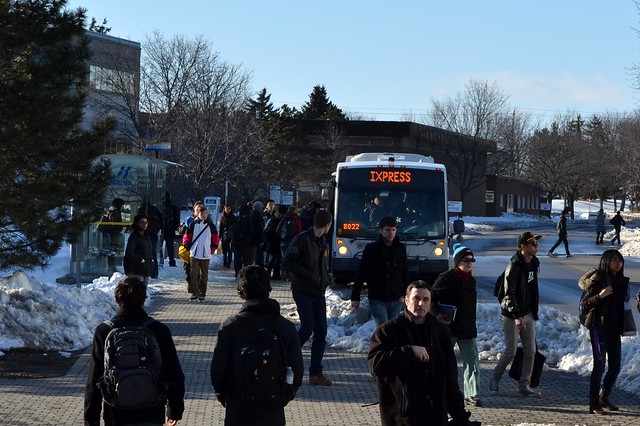
A typical busy day for iXpress

The 200 is a route that has been noted as seeing not only high peak volumes, but healthy off-peak ridership. Because many (if not most) of its buses are standing-room only for at least part of its route, it must be financially a star performer. It sees strong student ridership, obviously, but also strong "choice" ridership from people who recognize a good service and will adopt it over other alternatives.

And it serves a route that will become rail-based in less than five years. An ambitious step by the region in search of a better way for its citizens to move about.

In the face of this blistering, searing success, last night regional council voted to cool things down. For July and August, iXpress frequency will drop back from 10 minutes to 15. This move will save the average household a whopping $1.46. (estimate TriTAG)

There are two negative consequences we must consider from this move.

Virtuous to Vicious 


The justification for lower frequency is lower summer ridership. There lies the temptation to "optimize" the line for these months, to trim a few hundred G's from the cost of providing the service. But that justification ignores the effect of frequency on ridership. We're breaking the virtuous cycle in place, and possibly running it backwards. 

Reduced frequency will reduce ridership, because the service is not so attractive. For some, it will not be there when they need it, without looking for a schedule, and this will turn them off. This, in turn, will offer justification to further frequency reductions if you are looking for short-term cost cutting measures.


We've seen this penny-wise, pound-foolish tendency before: bus wraps.
 
The region has stated in master plans and megaprojects that it wants to not only increase transit use but multiply it. It needs to keep its eyes on this goal, but budget pressures this year have caused its attention to wander. After implementing plans that will increase household tax levies by $20 a year, why put the success of those plans at risk for the price of a Tim's medium coffee?

Capacity


Another justification for lower frequency has been put forward (pp.76-77):

In July and August 2012, during the midday period, iXpress trips experienced peak passenger loads greater than 35 approximately 3 times per day (4% of trips) and did not experience loads greater than 60 passengers (maximum capacity).
(...)By reducing the frequency of service from 10 minutes to 15 minutes on Route 200 iXpress during the midday in July and August, 24% of midday trips would exceed the GRT off-peak service standard of a full seated load (35 passengers). In some cases buses would leave passengers waiting for the next bus. This would occur on average twice a week (0.5% of trips).
In fact, as I understand it (from Councilor Mitchell's tweeted clarification) the approved cut was in fact all day and staff indicated that buses would leave passengers behind twice a day.

In other words, at the one point of the year where iXpress is providing enough capacity to not fail its passengers, council has decided to "optimize" service so that it provides an acceptable level of failure.

No rider left behind?

This is deeply troubling on two counts. Firstly, unreliability is one of the most costly flaws in transit, that has a disproportionate effect on turning people off using it:

One statistic in the study stands out in particular and should give transit agencies pause: More than half of the riders said they had reduced their use of public transportation specifically because of its unreliability. Most of them didn't just make fewer trips overall; rather, they switched to other modes of transportation to fill the void.
These words should freeze councilors' hearts. But the second troubling evidence is that council seems to discount this deliberate unreliability as an issue. They seem to believe there is an acceptable level of service that involves leaving people behind every day.

These would-be passengers will get a clear message that the region has little regard for its transit users. And they will abandon transit, if they can.

Silver Lining


It seems as if council has lost the plot. When the pressure is on, the region's long term strategy to shift itself towards a more sustainable (i.e. affordable) future model is put in jeopardy by short sighted penny-pinching. But all is not lost.

I would expect that the consequences of council's decision should be obvious and easy to demonstrate. In fact, the councilors who voted for this cut should be prepared to get an earful from the transit users denied service. There should be no surprises, or ambiguity about cause and effect. We should see ridership negatively affected, complaints increase, and no small amount of public ire directed towards this decision.

And then we can remind council of their goals, the LRT system they have hung their hat on, and that their small cost-cutting victory of today is putting their large victory of tomorrow at risk. I hope we will see good sense eventually prevail. Neither council nor the people of Waterloo can afford to damage the conditions that will make LRT successful, the same conditions that have doubled transit ridership in the last ten years.

If nothing else, we will be shown that, when attracting people to transit, there is no room for an "acceptable level of failure".


Tuesday, March 13, 2012

Cask Ale makes a (brief) appearance in Waterloo

This post is a change from the usual fare.

I have a confession: I am a massive beer geek, and a homebrewer. As such, the latter helps me deal with a fact that affects the former: that Ontario, and to a greater degree Kitchener-Waterloo, are backwards when it comes to quality craft-brewed suds. We've seen some good progress in the fight for good beer in Ontario, but KW took a major step backwards when the Castle on King closed in 2008.

I am a big fan of something called Cask Ale (also known as "real ale" in certain parts of the world, notably those where CAMRA holds sway). Actually, it's not so much a style of beer so much as an aspect of its production and serving. Cask ales undergo secondary fermentation in, and are served directly from, the casks that give them their name. These containers, once made of wood but now usually stainless steel or plastic, are not force-carbonated like normal beer kegs. Instead the beer naturally carbonates by the action of live yeast. They are usually served by hand-pump ("beer engine") or gravity feed (directly from the cask).

To the neophyte, cask beer tastes warmer and flatter than refrigerated, force-carbonated, filtered beer. However, the reason why Erin and I seek out cask ale is that it is unequaled in flavour. If you care about how your beer tastes, you owe it to yourself to seek out cask ale and try it. And don't be put off when the waitron snaps its gum at you and drawls, "D'ya know it's warm and flat, right?"

Down the highway, Toronto is becoming a hotbed for cask ale, with a growing number of establishments that will have a cask of something available at least part of the time. Personal favourites like the legendary Bar Volo and C'est What have led the way-- I highly recommend either if you find yourself downtown on Yonge or Front.

Closer to home, the Woolwich Arrow in Guelph usually has two or three different casks at any time, and Gambrinus in London has popped onto my radar. But Waterloo Region is home to no cask-serving establishment that I know of. As previously mentioned, the late lamented Castle would often serve cask, but we have been without Harold's cask ale stewardship for over three years now.

But, this past weekend, cask ale made a Waterloo appearance. One day only, the Perimeter Institute Black Hole Bistro hosted Bask in the Cask, a ticketed event which featured casked product from Grand River Brewing (Curmudgeon IPA), Muskoka Brewing (Double Chocolate & Cranberry Stout), the ever-improving Flying Monkeys (Netherworlds Cascadian dark IPA) and Stonehammer (Coffee Stout, and a Maple Red Ale.) Of the offerings, the Curmudgeon and the Maple Red were standouts, but every beer was interesting. And the event was well attended, with over 100 people willing to pay $25 for 4 8oz samples.

Unfortunately, even as I asked around, none of the brewers could tell me about establishments willing to carry cask.

And there's a reason, unfortunately. Casks' shelf-life may be in the order of a couple of months, but once tapped they need to be consumed within a few short days... and that's with the bartender taking certain end-of-day precautions to keep the beer from spoiling. That's because the cask isn't sealed... air is drawn into the cask as beer is drawn out, and oxygen (as well as airborne microbes) are death to beer.

In fact, that's a part of casks' charm. Their character does evolve over the lifetime of the cask, as the beer is a living, changing entity. But as a bartender, you need to be able to serve it out fast enough, and you need to know how to handle it. And these are not trivial things.

Still, change is afoot. Oncask may not have an active website, but they are actively promoting beer served "on cask in Ontario" (get it?) They have a very active account on twitter (@oncask) and encourage you to follow the hashtag #oncask to get the latest on who is serving what.

On the local front, I'm pretty sure we could see a number of places be willing to experiment with casks, if enough people start asking them about it. I plan on leaning hard on Beertown when they open up-- one does not call oneself a "beer town" without also being a justifiable prime beer spot, unless one wishes to invite criticism and mockery.

But I suspect that one of the local craft-beer-friendly watering holes (Kickoff? Borealis? Lancaster Smokehouse?) are going to clue in to the fact that they could create a unique draw for a small, but growing, number of beer drinkers by offering up the occasional cask. And when they do, Oncask will be there to help them get their message out.

And I will be first in line.


Wednesday, February 29, 2012

Between a rock and a hard place

Did you know that Guelph Transit revamped its entire route structure on January 1st? I have been hearing tidbits about the pain that this redesign has caused, and the Mercury chronicles the changes with articles [1] [2] [3], editorials and oh! the opinions! [1] [2] [3] [4] [5] [6]

Here in Waterloo region, we should pay attention. Grand River Transit will face the need to revamp part or all of its network over the next decade. With twice the ridership as GT and active expansion in routes and ridership expected, GRT needs to move away its current hub-and-spoke design, and towards a decentralized, grid-based system.
 
Reboot the System


There are two big strategies to cutting out existing bus routes. Guelph has demonstrated one: go cold turkey and simply shift buses around, and damn the consequences.

A second strategy is to starve existing routes by first providing more attractive service. This is one of the ideas behind the GRT express bus plan: a roughly grid-like network of limited-stop buses, with LRT along the corridor of heaviest demand, which will run regularly, at decent frequency, and provide quicker cross-town travel. These will draw riders away from some of the lower-frequency neighbourhood wanderers we have accumulated over so many years, allow those resources to eventually be shifted.

Still, Guelph reveals a problem that we will also face: in a community that is underserved by transit, any attempt to rationalize routes will cause pain. The reason for this is that existing transit users have trip needs that already cluster along our existing routes. Those who have simple trip needs that could be easily served by a grid network may not use transit simply because the current network doesn't provide.

Crazy Eights

So in shifting towards a more efficient, intuitive network that can draw greater ridership, there will be pain for existing users. GRT Route 8 [pdf] is an interesting example to look at. This is an impenetrable double-loop passing through the downtown terminal, and even after almost 20 years, I still need to refer to the route map-- or more recently, blindly rely on Google Maps' directions-- to have any idea if it will get me where I need to go. It has bizarre mid-loop terminations at certain times of the day, leaving confused riders stranded.

And yet, it serves certain corridors where nothing else does (Weber St. in Waterloo, and the Belmont Village corridor, to name a couple) and happens to provide direct trip options for both of these areas to the University of Waterloo and Laurier. So despite its incredible unintuitive opaqueness, it's fairly popular among existing transit users. Even with better bus service (12) along Westmount, and new University Avenue express in 2013, fixing a route like the 8 is daunting because it will leave dense areas along Weber and the entire Belmont Village area unserved.

Horse precedes Cart

Making this kind of network alteration palatable to transit users will require that they are presented with useful options first. To do that, we must provide more service, overlaying the new routes on top of the old, before we can reallocate the old routes' resources.

More service will require more funding, and the expectation that fare-box recover will lag as a result of higher subsidies. In fact, any reasonable transit growth strategy will probably see low fare-box recovery rates until new ridership catches up to the very system improvements that attract them!

Tough Love?

So if existing transit users' needs are the "rock", regional council's recent decision to aim for 50% fare-box recovery presents a "hard place". And our transit planners are stuck between them.

I know I've harped on this senseless, counterproductive decision before, but it smacks of politics winning out over the region's needs. The region still says it wants to triple the transit share of an ever growing number of trips within two decades.


But after making a series of high-profile moves to improve transit, council decided to smack transit around a little as if they were scared to show too much favouritism to one particular child. To "keep it in its place".

It will only hold us all back.


Thursday, December 8, 2011

It's the System, stupid!

I could have called this article "Dissecting LRT Procurement Options", but I figured this might grab your attention.  "Procurement".. what a snoozer, huh?  Snore.

Bear with me, and you might be surprised.  But I'll warn you, this is a long one!  Here we go:

 Region staff are promoting, essentially, a privatized LRT system within Waterloo Region through a "Public-Private Partnership" (or 3P).  They have put together nice bulleted lists of why some privatization is good, but more privatization is better, and all privatization? That's the cat's meow.  You can sift through the gory details here.

But I'll try and boil it down for you.

Gimme a D!... Gimme a B!

There's a number of procurement options, which include a private company (or more likely, consortium) taking on various parts of the procurement and operation of our LRT system.  Each of these parts is referred to by letter, according to the guide below-- most of which should be self-explanatory:
  • Design
  • Build
  • Finance - securing short-term financing during construction
  • Operate - System operation on a 30-year contract
  • Maintain
So DB is Design-Build.  A company is contracted to conduct both final design and construction of the system.  DBFOM is Design-Build-Finance-Operate-Maintain: A company or consortium sees the system from the very start, and ends up running it, employing drivers and maintaining its own vehicle stock.  A few options in between like DBFM, DBf, DBOM... also "DBB", which is Design-Bid-Build, where the Region does its own design and then seeks a builder. (I guess that should be just "B".)

Region staff believe DBFOM is the way to go.  They view it as a way to transfer construction and operation risk to the private company, insulating us all from construction cost overruns, and the difficulties of maintaining, staffing and operating this line.

I respectfully disagree: I believe private operation works against us.


Where does this train lead?

Let's take a moment to remind ourselves why we have LRT coming to Waterloo Region:
  • Population is exploding.
  • The cities will choke on traffic and sprawl past their borders unless they intensify and reduce the percentage of travel by car.
  • Our goal is to move transit from less than 5% to around 14% of trips by 2031.  (Though more is better.)
  • LRT has greater capacity, attracts greater ridership, and promotes intensification.
  • The current plan is to put LRT along the "spine" in Kitchener and Waterloo, and provide express buses and Bus Rapid Transit to Cambridge and along the major routes.
  • The long-term plan is to expand LRT to Cambridge.
For transit to meet its goals, it must be effective and attractive.  It needs to get people where they need to go, in reasonable time, at reasonable cost.  If it fails, we will not reap the intensification effect, and we will pay a punitive cost in road expansion to meet the demands of drivers who have no alternatives.

So we need to place transit in a position to succeed.  The core of the system may be LRT, but buses will still, largely, be left holding the bag anywhere off the main line.  To move effectively, riders will need a well-integrated transit system as they shift from bus to train, route to route.

We already have obstacles to good integration in the form of compromises in LRT line length (cutting Cambridge out of phase 1) and in station placement (route splitting in Uptown-- discussed here at length-- and in Downtown, and a criminally poor station placement around the University of Waterloo that seems to go out of its way-- literally-- to make connections harder.)

So given a goal of making our transit system effective and attractive, we need to take a critical eye to the Region's idea of privatization.  Privatization is not about making a good system, it is about mitigating risk at the expense of a good system.

And unfortunately, for our goals: it's the system, stupid!  It needs to work well as a whole. It needs to grow.  It should be intuitively obvious that privatizing part of the system will detract from the whole.


Everything in Moderation

The Region hasn't built an LRT system before, so we're probably in a position to benefit from someone who can design and build us up one before we start drafting our own detailed construction plans.  And you know what?  That's cool.

But the Region also has no experience running an LRT system, and this is one of the reasons why privatized operation is attractive.  However, if we're aiming at growing LRT later, and making it a part of a well-integrated system that responds to ridership growth, the Region needs to learn by doing.


Suspect Logic

Let's talk about what staff sees that is so attractive about privately operated LRT:

Cost and Risk: A private company will have to shoulder risks of construction and operation.  The Region retains ridership risk, but is insulated from operating expense and complexity.  A private corporation will keep costs down by being more efficient.
The Reality: Private sector efficiency requires competition.  Competition is not found in a 30-year monopoly.  Ultimately, if things go bad, private companies come back hat in hand for greater subsidies-- or they walk.  This was demonstrated in Melbourne.


Line Quality: A private company that will operate a system will design one with efficiencies that will make it better.  Over time it will run it better.
The Reality: The system will be designed to do precisely what we spec it to do now, with no eye towards the future.  Contracts designed to tie payments to metrics, make sure the private company "owns up" on performance, can have unintended side effects like buses that speed and refuse to pick up passengers in Auckland. Operation will aim to maximize profit, not transit availability or frequency. An LRT line to be operated privately will be built to extract subsidy out of government first and foremost.

Experience: A private company will have more experience operating a system.  They can better handle a small system's pool of drivers for scheduling vacation.
The Reality:  When it comes to staffing, six weeks of YRT/Viva strikes (and counting!) suggest that maybe private handling of staffing isn't a strength.  And when things go south, the local government has a figleaf to hide behind instead of solving the issue. It sits saving $70K a day in withheld operator fees and stonewalling its angry citizens. Veolia and First Transit, the involved companies, have combined profit of over a billion dollars a year around the world: they can afford to wait, to bring a recalcitrant union in line. Meanwhile, York Region chokes.

Also, it's unlikely that vacation scheduling is some kind of critical advantage we need to pursue.  Besides, a private company is hardly going to fly in drivers from other cities to fill its Christmas-time roster gaps.

Finally, hire consultants to advise on system startup.  A good consultant is a wonderful thing: brings ready experience when you need it, and goes away when you are done.


Forgetting ourselves, and forgetting Cambridge

The transit system of Waterloo Region is a work in progress, with some ambitious goals to transform how we move and the shape of our community in the coming decades.

We need to be committed to growing that system, and that requires full control over its most critical aspect.  Having LRT at arm's length makes every schedule adjustment, bus realignment, and policy change subject to the whims of a company whose goals are very different from ours.

Private operation will also make negotiation for expansion all the harder.  Staff almost admits this: they suggest "choice for integration and expansion" will be "impacted".  I would say that we would have abandoned control of our own fate in creating an effective, attractive transit system.  We will make it harder to expand and adapt the whole system for the public good.

Cambridge, are you listening?  How do you see a hand off of a half-built LRT line to a private company affecting its completion?


Not alone in fearing 3P

London (UK) had to take back control of its own privatized tube in a privatization that backfired when it came to "cost reduction".

This transit consultant points out that efficiency only comes from competition, that integration with 3P pieces is hard, and that a private operator's focus on revenue can come at the expense of service and ridership.

The Public Transit Coalition explains why they oppose privatization in Toronto, nailing the high points.  And here are fears about private LRT in Toronto.

Here is a good deconstruction of the seedy underbelly of the successful, but crippled and costly Canada Line in Vancouver where the operator underbuilt the line to save itself money.


The Fallacy

Here's why private operation of city transit generally doesn't work: It's not profitable.  It's not meant to be.

Most transit systems are subsidized.  Privately operated systems are only viable if they receive a subsidy for operation.  They aren't motivated by the desires of the government providing the subsidy in any way that isn't clearly spelt out in contract.

So governments try to codify their desires in contract.  But transit is complex, and that makes for very complex contracts.  You can only write clauses for what you know, not for what you may learn in the future. 

A transit system, like a road network, is best when provided as a public good.  If we are dissatisfied with it, ultimately we can take action at the political level.  A private transit system, on the other hand, is operated as a cost centre, and if we are dissatisfied in it, all we can do is... not use it.

And that would be missing the point.

Thursday, November 10, 2011

LRT Uptown Routing Change

I've said in the past that the Uptown loop was an awkward compromise. Back in June, Regional Councillor Strickland (to the dismay of Waterloo City Councillor Scian) challenged the suitability of the route alignment-- in particular the Erb St. counterflow hook that the North-bound line would make-- and pushed for an amendment to review this decision. The city was incensed, because they endorsed the existing 2009 plan.

** Edit: Ms. Scian has clarified that the City reacted to not being consulted on this proposal. Read her comment below.


Well, what a difference a few months make. Region staff engaged the citizenry and the city and proposed some fairly significant alterations (link note: see page 12 onward).
  • Move the Northbound connection to the existing rail spur that crosses the parking lot north of Waterloo Town(e) Square (by sharing track, an option we believed was impossible in 2009)
  • Move the Northbound station off King and onto the spur, next to the public square
  • Create a new station at King and Allen
  • Move the Southbound tracks from east side of Caroline to west.
New Uptown Route Alignment


This proposal has been conditionally endorsed by the city, and passed unanimously by the Region.  Which is good, because it is a definite improvement.  But some think it just didn't go far enough. And while I don't want to take away from the accomplishment that has been made, I would be inclined to agree.  Here's where the new plan falls short:

Usability


The new station positions mean Southbound and Northbound uptown stations are hidden from each other, and fairly distant. This is one of the biggest problems the loops present: they make the system more confusing, and are an obstacle to these stations attracting riders. Virtually every rider who visits uptown will do so as part of a return journey.

Connectivity

I also see a problem for route connections. As it stands, the King St. face of the public square is a minor transit node, with the various 7's and the 5/35 all stopping here.  And yet, the split LRT route makes it impossible to do anything but partially serve these connections.

(I should note that downtown Kitchener's loop also presents this problem in spades.)

Spacing

The new Allen St. station position means there is a scant 500m separation between the two southbound stations.


So how can we address this?

In the link above, TriTAG proposes moving the southbound station up Caroline to be near the Erb St. intersection.  I've urged the Region to consider this proposal carefully, as it would provide some partial solutions to each of the problems I mentioned above.

But an Erb/Caroline position is its own tradeoff.  The Erb intersection is much busier than Willis Way, and it is already complicated. (Cyclists in particular regard it as one of the blights in this city.)  The C.I.G.I. building (originally built as part of the Seagram's complex, I believe) crowds the intersection and limits the space available for a station.  And, this corner is less of a destination than Caroline/Willis is.

It may be that in the balance, there is no better loop alignment than the current plan.

But the reality is, there are so many constraints in play that prevent a unified alignment through the area.  We can't infringe on the square.  We can't eliminate two-way traffic on any street.  We don't want to rip out any existing buildings (like, say, the bridal shop at Caroline and William) and we can't steal space from parking lots (e.g. Rec Centre.)

Where does that leave us?

As a region, we have a choice: we can settle, having come up with a decent compromise that seems to be generally acceptable.  (Though don't ask the folks in the Catalina townhomes, because they're spitting nails about the Caroline side switch.)  Or, we could recognize that LRT is the backbone of our whole plan to provide alternatives to driving in Waterloo Region, and make the hard decisions needed to fix its routing properly.

These decisions would result in much screaming and gnashing of teeth, but... in ten years, nobody will remember the fallout that will inevitably come from giving LRT the priority it deserves.  Not if the system works.  And it needs to work.  The compromises that keep it from offending various interests are deficiencies we will have to live with forever, and each of them takes away from the viability of the whole.