Friday, November 9, 2012

Waterloo Route Shakeup!

Edit 2013/02/23: GRT has released a "preferred option" proposal. You can read about it here.

Edit 2012/11/10: GRT has now released its official options and I have revised this article to use the new images and corrected for details that have changed since the council submission.

Big changes coming to GRT, mainly within the city of Waterloo. The establishment of the 202 "University Avenue Express" and the extension of 201 iXpress require some rethinking of existing routes. The region is looking for public input on a number of options at public consultation centres being held in November. Are you going?

It has taken me a while to process the east Waterloo options. And to my disappointment they still haven't been properly published. Everything below is pulled from the region's Planning and Works agenda document (warning: big PDF), starting around page 115. You can now see GRT's official options here. Note that they differ slightly from the P&W agenda.


There are three "east" options being presented.

In all options, the 201 Fischer-Hallmann iXpress is extended past the university to Conestoga Mall, and then on to Northfield & University. The University iXpress also terminates here, but how it gets there is different.

Also, 6 and 35 are "crossed": they swap their downtown endpoints, 6 goes to Uptown and 35 goes to Downtown. In doing so, they are much straighter than before, which helps them act as better grid participants. Presumably 6 will be linked to the western 5 route at Uptown, as 35 was before.

The Contenders


East Waterloo Option 1 showing route details.jpg
Option 1


Option 1 is probably the simplest. The University iXpress left-turns at Bridge St. Apart from the 6/35 swap, eastern routes remain largely unaltered (12 is tweaked.)

Strengths:
  • Bridge St. is well served, at least between Northfield and University.
  • 35 is now an (albeit slow) north/south route.
  • The future "minor node" at Northfield and Bridge is very well served, with access to it for much of the northeast area. (Disclaimer: I work here and this is personally important.)
Weaknesses:
  • Duplication of iXpress between Northfield/Bridge and Northfield/University
  • There are three ways to get from Northfield/Bridge to Conestoga Mall. Seems excessive.
  • 12 is almost completely pointless in this configuration. Only a fraction of possible trips on the 12 are not provided by other routes, faster and more frequently.
East Waterloo Option 2 showing route details.jpg
Option 2


Option 2 really shakes things up. The University iXpress stays on University. 35 is (partially) straightened out. 31 shortcuts along Bridge St.

I see this option as intriguing, but flawed.

Strengths:
  • 35 starts to resemble a legitimate grid participant along the east side.
  • 6 (presumably cross-linked to the 5 on the west side) is a nice east-west grid line.
  • An intriguing new route for the Lincoln neighbourhood.
  • Less iXpress duplication.
  • A more useful 12; Weber St. north of University finally sees some service.
Weaknesses:
  • 31 is a monumental waste. It provides some minimal value along Lexington and that's it (and there isn't much along that stretch, either). Short-cutting it up Bridge makes no sense: whose time are you saving? The people trying to reach Conestoga Mall, who could take 201 or the new Lincoln route instead?
  • 35 is half-heartedly straightened out. Its remaining neighbourhood wander diminishes its value as a way to get up and down the east side by adding substantial delay (close to 10 minutes.)
There is one small change that makes this option a lot more compelling: swap the Eastbridge detour from 35 to 31! Now you have a less useless 31, and a more direct 35. Everyone wins.

I would like to see 35 continue to adhere to 6's old Wellington St. route, too. That would help it remain useful to me, personally, as well as the rest of the Mount Hope/Breithaupt neighbourhood which is not well connected to the East side at all in this arrangement. One big change from the original council packet is that 35 serves Wellington like the 6 does.

East Waterloo Option 3 showing route details.jpg
Option 3


Option 3 puts 31 in the configuration it should have had in Option 2. 35 is bent and spindled past recognition. 12 is cut short

I'm not sure which of Options 1 and 2 are the Good and the Bad, but Option 3 is definitely the Ugly. This is a disaster for anyone trying to get up and down Bridge St.

Strengths:
  • Nothing that Option 2 doesn't already accomplish better.
  • Demonstrates the routing that Option 2's 31 should have.
Weaknesses:
  • Complete failure to provide a north/south grid route on the east side.
  • Big degradation of service for the Bridge Street corridor, accessibility to the Bridge/Northfield minor node.

Additional Thoughts on All Options

The new University iXpress provides a nice east-west route through the university district and it will be very valuable in either of its two proposed routes. In one configuration, it provides the Bridge St. corridor with good service. In the other, it ventures into the less developed University East area, but in doing so it might be a more "legible" route.

Of course, by doing that, people might start to ask "Why not make it University Avenue all the way across?" And why not? Combined with a sold Erb/Bridgeport limited-stop route through Uptown, we might have something viable. But that's not in the cards...

If we run the University iXpress up "around the horn" instead of Bridge St., it opens up a compelling routing for the 35 as an east-side north-south connector. But it needs to be more direct than Option 2 shows, sticking to Bridge and Lancaster all the way to Wellington or Victoria. (Though the short Auburn Drive detour at University is reasonable.)

While I would love to see 4 bus routes converge at Bridge and Northfield, and keep my current bus route to work, I have to say that Option 2 is probably the best starting point. Swapping Eastbridge detour duties from 35 to 31 is a no-brainer.

But what about what is possible, but not presented? TriTAG member Duncan Clemens has put together his vision of a restructured route network in this google map. He has some of the same ideas: Use Bridge and Lancaster as a corridor. Make 31 pick up the Eastbridge neighbourhood slack.

Hopefully the PCC will provide opportunities for some of these good ideas to bubble up to the surface. And hopefully we'll end up with something globally useful, and not deformed by competing self-interest.


Thursday, October 4, 2012

Still Chicken about Urban Chickens?

Well hello there! Have you forgotten that there's actually a second author on this blog? :D

I'm popping up here to give an old post a little bit of a bump, because lately there has been some activity on the topic. A new group calling themselves the Kitchener Hen Association has been formed, and they are currently in the planning stages of approaching Kitchener City Council to examine the issue. Exciting! If you'd like to follow the group's progress (or get involved) check out (or join) the Facebook group or the Yahoo Groups mailing list.

Here's what I originally wrote on April 12, 2011:

I love the idea of urban hens. There is nothing I would like better than to have a small flock of hens merrily existing in my back yard. It's just another brick in the wall of my plan to turn my back yard into a little urban farm! (This plan still exists mostly in my head, and is being implemented extremely slowly, over the course of years. But it is a plan nonetheless!)

But it seems the City of Waterloo has struck another blow against urban chickens. For the past two years, the City has been running a "pilot project" of sorts, where certain registered households are permitted to keep hens under close scrutiny. After the two years was up (and after lots of study, public consultation, report-writing and bylaw-drafting) at a recent Council meeting the matter was voted on, and came down to a tie. It means the grandfathered hens are still safe, but the motion was defeated.  What's going to happen going forward?? I am a resident of Kitchener (though we are oh-so-close to Waterloo, with the property line of our back yard falling right on the city boundary) and while we in K-Town are expressly prohibited from keeping hens by the letter of the law, I had hoped that if Waterloo went ahead with allowing urban chickens, Kitchener City Council would be inspired to follow suit.

There is a blog post HERE that talks about some of the reasons why the motion might have been defeated, and touches on the possibility of an underlying fear that city-dwellers might have against the erosion of the boundaries between urban and rural existence. It's quite interesting.

Of course, bylaws are only enforced when there are complaints, and there are many households in the city of Kitchener with hens! But I'm just not brave enough to do it...I'm terrified of the idea of having to "get rid" of the birds once I have them and my neighbours complain. So, I continue to watch the issue, and fantasize about moving to the darn country where I can do these things....

Monday, October 1, 2012

[LOABKW] October and the winter coming

Despite a beautiful and long summer of cycling the like I have never seen before (1,750km and counting!) the arrival of October is a reminder that all good things must come to an end soon. Every previous season of cycling has done so before... sometimes earlier, sometimes later.

Canadian winters are the basis of many criticisms of investing in cycling. Taken to the extreme, they are why our cycling infrastructure is, according to some, "wasted six months of the year". While I doubt that my bike will be hung up for anything close to six months, it is a good bet that I will pedal very few kilometres during December, January, or February.

Let's explore why.

Cold

Winter is cold. No question, cycling in winter is less comfortable than other times of the year due to temperature.

Conditions beyond -15C with windchill will weed out many riders. But strangely, the bikes are often out and about with more moderate freezing temperatures... especially as spring approaches and these temperatures feel less frigid by comparison. Skiers know that cold is not an obstacle to outdoor winter travel.

Cold itself is probably the least relevant reason for my lack of winter cycling. Clearly, cold takes its toll, but cities like Minneapolis are much colder than Waterloo and this doesn't stop half of their cycling commuters from carrying on until spring. You can always dress warmer.

Winter biking in Minneapolis. That's -3F. Image source Cascade Bicycle Club

It's usually what accompanies the cold that is more relevant.


Snow and Ice

As an undergrad, I biked through snow now and then. Taxing and difficult, and when ice is involved, quite risky.

But you could say the same thing about driving: difficult and dangerous when ice and snow are around. So why are antiques and convertibles the only cars that hibernate the winter in the garage with the bikes? How is it that most motor vehicles drive on through the winter regardless?

The answer is simple: road maintenance.

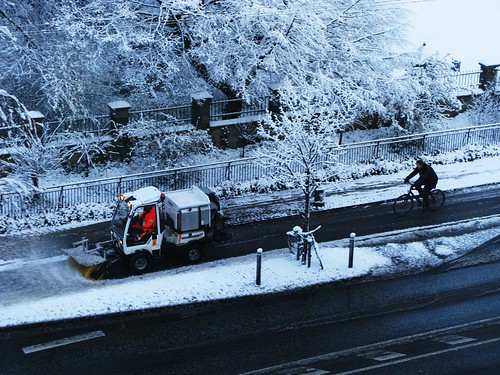
The standard of road maintenance for snow and ice clearing that we see exceeds that of anything else, even (regrettably) sidewalks. As for trails, many see infrequent or even no snow clearing. Ice patches form, and are not as easily melted and dispersed as they are by automobile tires on the city streets.

Also, road maintenance tends to be for car lanes only. Bike lanes get short shrift, often becoming dumping ground for snow piles that, once melted, deposit their suspended debris in a thick mat of tire-destroying crap that remains uncleared until April. That formerly complete street is now a narrow car-only strip of pavement, and drivers once acclimatized to watching for bikes seem to have forgotten all about them.

Image Source: Treehugger

Snow and ice are major obstacles to cycling only because we are allowing them to be. Eventually we will learn from our colder but more cycling-savvy cousins, and we will establish a core cycling network with year-round maintenance. But until then few will be able to ride regularly through the winter because they have nowhere to ride.


Visibility

Winter brings darkness and inclement weather.

When daylight savings is in effect, most people can cycle commute while the sun is up. As the days shorten and the the clock "falls back" in November, the ride home is suddenly a dark one.

And no matter what we do, we can't change Waterloo's latitude. Even in a climate-changed world, our winter days will always be short.

And yet, despite equating ourselves with Nordic countries, our city is at the same latitude as the balmy south coast of France. Long winter nights are a problem that all of the big cycling nations of Europe contend with, and to a greater degree than we have to.

Image source: Copenhagenize
The problem with cycling in the dark is sharing space with car drivers who have a harder time seeing us. This problem is only an issue when we have to share space with those cars. But with our snow-locked trails closed to us and our cycling lanes covered in plow drifts and glass, we have to contend with spending much more of our time negotiating for space with cars in the dark, possibly as a flurry starts to make conditions even more treacherous.

The solution here is the same as before. Establish a cycling network that is maintained year-round, give people the ability to ride their bikes in safe conditions separate from traffic, and visibility becomes less of a problem.

Image course: Copenhagenize

The hundred year storm

The aspects that lead people to criticize the practicality of cycling and the worth of investing in cycling infrastructure come back again and again to the quality of that infrastructure. Build it and maintain it properly, and these criticisms will lose their force.

Massive blizzards will still roll through each winter, and they will still prevent people from cycling. But then, we also urge people to stay off the roads in cars, too-- and see grim reminders of what happens when people inevitably don't.

But in a multi-modal city, people have choice. For those days that are too snowy, or too cold for even the hardiest cyclists, there is always transit, or carshare, or walking, or simply driving. Cycling is just a part of the puzzle. If it were a year-round transportation option, it could help many people reduce or eliminate their car ownership burden. This way lies real reduction in traffic congestion, as well as big savings for families who now maintain one, two or more cars because they must plan for the coldest season-- but end up using them year-round.

Goals

There's nothing special about our city that makes it impossible to be a bike-friendly place all twelve (or, perhaps, eleven and a half) months of the year.

To get us there, Kitchener and Waterloo should be filling in our trail network with a goal of establishing not only a contiguous, separated network for cycling (something that we still lack), but also committing to maintaining it through the winter.

As for me, this year I'll be carrying on through November as long as I can. This year I've got my sights on an arbitrary, but achievable, numeric goal: 2000km. For me, round numbers are good motivators. A little extra incentive to put on an extra layer, and keep pulling the bike out of the garage. The morning rides are becoming increasingly beautiful as the leaves turn, and that's an extra reward.

After that, I'll look at fighting another winter cycling obstacle: inertia. Yes, it's dark, yes, it's cold... but it's often neither snowy or icy. I haven't done a good job of taking advantage of these days when they come up because the bike is "put away". But if the trails and the expressway overpass are passable, this year I will try to get a few winter rides in as conditions allow.

Perhaps you can too.

Image source: whatsgoinon

Thursday, September 27, 2012

Feed Fiddling

Heads up feed-based readers: I've tried turning on full feeds. This came as a request from a blackberry user whose antiquated mobile device struggled with advanced concepts such as "embedding", and "blogs" and "pixels".

The feed is available as before at http://waterloons.blogspot.com/feeds/posts/default and also through feedburner (this drives the "subscribe by email" feature) at http://feeds.feedburner.com/Waterloons .

I confess I'm not a feed expert. All I hope is that I haven't slammed a few subscribers' inboxes with 70 or so republished articles. My apologies if this goes pear-shaped.

Oh, what the hell. If they were worth reading once, they're worth reading again. Right?


Tuesday, September 25, 2012

[LOABKW]: Getting from NE Waterloo to SW Kitchener by trail!

I work near Northfield and Bridge.

My dentist, for reasons best left unexplained, is at the Sunrise Centre at Ottawa and Fischer-Hallmann.

This is quite a trek: almost 16km! And today I did it by bike. The resulting ride shows off how well you can get around by trail, if you:
  • Know where you're going
  • Are willing to bridge the gaps in the cycling network.
Green, yellow and red dots highlight the good, meh, and bad parts of the ride. Blue dots are informational.

I hope this record helps you find better ways to get around on two wheels. And to learn how good our cycling network could be, with some key strategic improvements!

View the map.

Update: I had some good feedback on Facebook from a friend of mine, Chris D, who knows the southwest side of Kitchener better than I do. His advice is helpful:

"Some ideas in my neck of the woods (SW Kitchener):

During construction there is a bike/pedestrian crossing of the express way at Fisher-Hallman divided from normal traffic by a ba
rrier. Of course, with the speed of traffic through the bottleneck there you probably could ride with traffic (as I have).

After you get across the expressway you immediately gain a bike lane that can be used to get to the trails that border the culvert all the way to Victoria Park. As an added advantage, you can follow the trails under Westmount so crossing there isn't too bad... and if you don't like the bike lane on Fisher-Hallman, you can turn at McGarry Drive and pick up a trail along the creek that takes you to the culvert trails.


Another interesting path is to follow the paths on the hydro corridor, which will take you from Kingswood (a block from Homer-Watson) to Fisher-Hallman at Activa. Based on your path I'd cross Ottawa at Westmount and you'll find access to this trail on Westmount 50m past the intersection. It can be a challenge to follow between Westmount and Fisher-Hallman because it splits a few times, but if you end up on Dinison St it's easy enough to pick up the small trail to the lights at Fisher-Hallman and Activa further down anyway.

Once you're on Activa, take Grey Fox to Orchard Cresent and you can pick up a trail that drops you across Ottawa from the Home Depot at the Sunrise Centre.

The advantage here is that despite needing to cross Ottawa twice you don't need to travel along it at all..."
My notes on this: Fischer-Hallmann (I believe) will have bike lanes across the expressway-- and a removal of a dangerous basket weave-- when construction is complete. But FH is (to me) a route of necessity only, not a preferred choice. Much better for roads of this size and speed to have a separated trail or cyclepath, as parts of FH already does and will soon.

He also provided an alternative route segment. But it involves an un-improved section of Westmount, which doesn't seem better to me than a bike-laned section of Ottawa.

I see this as a key area for strategic infill. A little work along Westmount could greatly improve connectivity for the whole area!

Thursday, September 20, 2012

Routes and Secrets of east Waterloo

Fall looms

It's that part of September that is still officially summer, but is fall in spirit. It's positively autumnal these last few days. And it feels good! Even if it's a tad wet. I admit that I wussed out of cycling through Tuesday morning's deluge and took transit instead.

I've not blogged much about #loabKW lately, because there hasn't really been anything very interesting to say. I bike during the week. It's normal. The Lexington expressway crossing still sucks, but that's normal too. Groceries get bought, places get visited, life is surprisingly unremarkable.

But I do like the ducks. And the bunnies. I see a lot of each on my rides. Flickers, too, for some reason-- you can recognize them by their white butts as they fly away.

That's one thing I haven't really talked about: the rides, and the routes that I'm on every day. I do try and explore as much of KW as I can on bike, but most of the time I'm going to and from work. Much of these rides are on quiet streets or trails (though some trails have only recently been reopened) and when you're on two wheels, you can take in the scenery a lot more.

Route secrets


If you need to move to and from north-east Waterloo, you move from embarrassment of cycling riches to awful choke points and back again. There is great cycling in the neighbourhoods around Bridge Street, north of University:

<<<< sorry guys, Google doesn't embed maps with the cycling layer turned on, because Bob returned late from lunch last Friday and didn't spend 5 minutes implementing that feature... please click the links to follow along. As for Google, they and I need to have a few words. >>>>

Snippets of trail, lots of cut-through paths (although not on Allenby Court), and cycling lanes on roads like Bridge and Davenport. Even the ward councilor, Diane Freeman, is an avid cyclist.
 
Unfortunately, you can't get there from here. Literally: if you don't have the intestinal fortitude to mix with speeding traffic-- or are willing to flaunt the rules and sensibility by biking a sidewalk perilously close to a low guardrail and a 30 foot drop to the expressway below-- this neighbourhood is entirely cut off from the rest of Waterloo. But we've been here before and we know the solution is: road-diet Lexington. Just waiting on staff and council to see the light.

Still: if you can stomach Lexington, the city is your oyster. Well, maybe not quite-- UW is a major high-traffic gap away (the Columbia/King mess), but you can get to Uptown and to Kitchener if you know where you're going. Dearborn Boulevard is your gateway off Lexington and away from the 80km/h traffic, and connects with the great trail system that is the Forwell Creek and Hillside Park. From here you can ride trails up to Manulife headquarters, over to Canadian Tire, or all the way down to University Avenue near a small street called Carter Avenue.

It's hard to get across University right now, but that will change in a year or two: reconstruction will add a refuge island here. And Carter leads you to Moses Springer Park and into the heart of the bike-navigable Lincoln neighbourhood.

Infill! Infill!


Last night I saw something that piqued my interest: a City of Waterloo planning map that shows a proposed trail extension from Lincoln Park across Weber to connect with a trail leading to Uptown, here at Mackay Crescent. Getting across Weber here is key. I hope discussions between city and region bear fruit.

If you can get across Weber right here (here's a hint: you can't. It's stupid.) then you have almost clear sailing all the way to Uptown Waterloo, the Laurel Trail, the Iron Horse, you name it. Otherwise, there are some options if you filter along Lincoln Ave and through the Sobeys plaza (pick up your groceries while you're there!) and then on down Devitt or Moore. Moore provides access to Duke, which is the best way to downtown Kitchener on a bike if you can't get to the Iron Horse... or it will be, until the Spur Trail is constructed.

(Do you sense a theme? A theme of being close to a great cycling network but for a few critical gaps? Talk to your councilors. Explain to them the wonder of infill. Tell them you're not willing to wait until the gaps get reconstructed.)

Of course, this also passes the Mount Hope cemetery, which is my stomping grounds (or... maybe a little less in the cemetery as near it.) From here you're on your own.

Alternatives


But if you want to make the same trip in a different way, you could try riding past the Canadian Tire, braving a short stretch of Weber and Columbia, and head down Regina. Not too bad, especially if you work the lights right. You still have to cross at Lexington though.

Or you could take a different plot and head down Bridge to Lancaster (possibly avoiding the roundabout by taking this dogleg). This is not pleasant cycling, as it's decades-old infrastructure with no cycling accommodation-- but the widths are generally good, and if you don't mind a brutal hill or two, you could do okay. Lancaster happens to lead right to Queen, which is a great gateway to Kitchener too. But it's a traffic lunatic asylum, so be warned.

Look, what I'm trying to say is that there's some great cycling in the City of Waterloo, especially on the east end. But to enjoy it, you have to deal with the fact that the City of Waterloo is in fact two cycling networks, disconnected by an expressway. Maybe this will be fixed soon, but in the meantime you should ask yourself if you really need to wait for that.

I can't. I have to be out there.

There's ducks, after all. And bunnies. And flickers.

See you on the trails.

Thursday, September 6, 2012

A by-election of significance

A brief commentary for today, by-election day in Kitchener-Waterloo.

Today's a big day in KW. Provincial by-election here and in one other riding, where voters have the ability to push the minority Liberals into de facto majority territory-- or deny them that majority. The result has been a huge amount of attention paid to our area, as this column indicates.


We're having a by-election just 11 months after the last general provincial election, because of the resignation of two MPPs: Elizabeth Witmer here in KW, and Greg Sorbara in Vaughan.

I see the results here as having a huge influence on the next election. If the Libs can keep Vaughan and secure the KW seat, it's all quiet on the election front for the next few years as they'll control the house. If the NDP or the PCPO prevail, it could point the way towards how the province will swing in an inevitable no-confidence election some time in the next year or two. And while nobody expects the Greens to win, it will be interesting to see what kind of support will they garner, and how will that affect party platforms next time around.

And to top it all off, the KW result is no foregone conclusion. Nobody is sure how any of the big three will place.

Exciting!